
Icarus Robotics Completes First Microgravity Tests for ISS Robot
After conducting a series of parabolic flights in Canada, Icarus Robotics has validated the core systems of its JOY robot, bringing the startup one step closer to its mission on the International Space Station.
 Radwan AbdulhadiEditor and technology writer
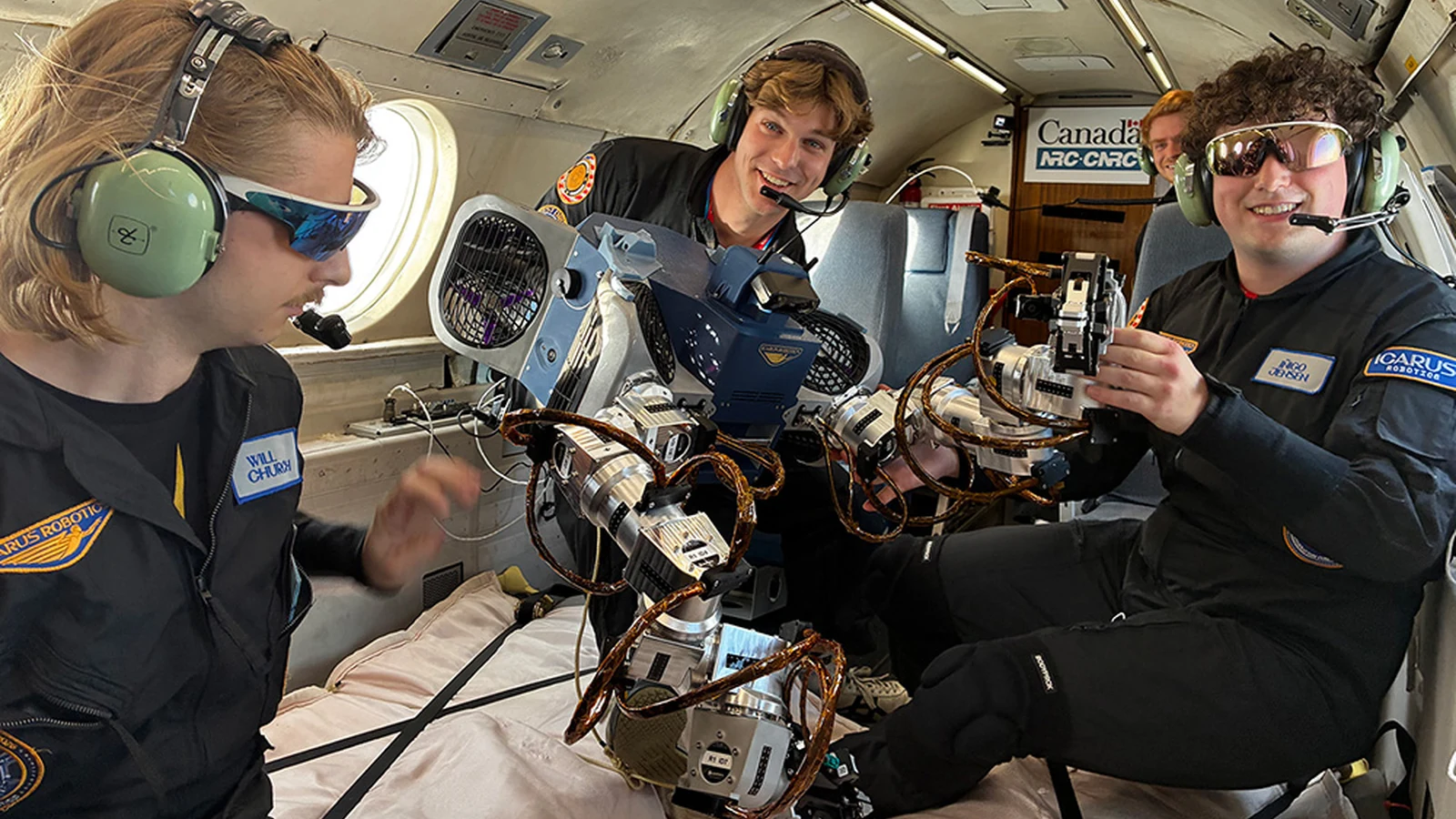
Validating JOY in Weightlessness
Brooklyn-based startup Icarus Robotics recently reached a critical development milestone for its free-flying robot, JOY. Between September 9 and 11, the company conducted four parabolic flights, executing a total of 66 parabolas. This campaign provided the team with approximately two cumulative minutes of weightlessness, allowing them to test the robot's performance outside of terrestrial conditions.
Parabolic flight remains the primary method for simulating real microgravity environments without traveling to orbit. By flying in steep arcs, the aircraft creates approximately 20 seconds of weightlessness during each parabola. For Icarus Robotics, this was the final major testing phase before finalizing the flight hardware scheduled for handover to NASA in January 2027.
Core System Capabilities
The testing campaign focused on three primary components: manipulation, state estimation, and flight control. Jamie Palmer, co-founder and CTO of Icarus, noted that the team was particularly pleased with the performance of the robot's internally developed arms. These arms feature seven degrees of freedom (DoF) and are equipped with adaptive pinch grippers.
Because real-time teleoperation was not possible during the parabolic tests, the team utilized pre-recorded trajectories and set points to evaluate the system. By benchmarking the performance of these movements in a controlled office environment against their behavior in microgravity, engineers were able to verify that the robot could accurately return to its designated positions when disturbed.
Overcoming Operational Challenges
The transition into a weightless environment presented unique operational challenges, particularly regarding the flight control system. Palmer acknowledged that the settling period—the brief window as the aircraft enters the weightless portion of the arc—introduced gravity variances that are not expected during standard operations on the International Space Station (ISS).
To manage these conditions, the team maintained a conservative approach, utilizing human operators to manually catch and release the robot during each flight. As the team gathers more data, they hope to utilize more aggressive testing parameters to push the system to its operational limits in future campaigns.
Navigating Global Testing Bottlenecks
While the mission destination for JOY is the U.S.-managed ISS, Icarus Robotics was forced to conduct its testing campaign in Canada. This decision stemmed from the current suspension of the only U.S.-based parabolic flight operator, which has created a significant hurdle for American space hardware developers.
CEO Ethan Barajas highlighted the broader implications of this testing shortage, noting that many companies are currently forced to look to providers in Japan, France, or Japan. This shift in demand has led to increased competition for flight time and longer project timelines for startups looking to validate their space-bound technologies.
The Road to the ISS
Icarus Robotics created the JOY system to assist astronauts with the routine cargo and logistics tasks that currently occupy significant portions of their time. By automating these processes, the company aims to free up the crew to focus on high-value research and complex mission objectives. The robot is scheduled to launch to the ISS in 2027 under the mission name Joyride-1, following a management agreement with Voyager Technologies.
With the recent successful testing, the company is shifting its focus to software upgrades and fine-tuning. Palmer indicated that while the software will see performance enhancements, the recent tests confirmed that no major overhauls of the hardware architecture are required. The team is now preparing for the final hardware delivery to NASA in early 2027.
Sources
- The Robot ReportIcarus Robotics flies ISS-bound robot in microgravity for the first time