Specializing SLM Vocabularies Cuts Inference Cost by 77%
Researchers preview the VocabX method for small language model vocabulary specialization, addressing both text fragmentation and excessive model output layer size.
 Radwan AbdulhadiEditor and technology writer
The Production Challenge of General Vocabularies
Models specialized for a particular domain or task via fine-tuning of open-source architectures like Qwen and Gemma typically inherit a general-purpose vocabulary built for multiple domains and diverse applications. This approach is standard across the industry, but it introduces hidden performance costs when deployed in production systems.
In a production automated essay grader running on Qwen3-4B, the default vocabulary splits the text written by the model into an excessive number of tokens. To address this limitation without altering the base model itself, developers previewed upcoming findings from the VocabX paper on the <a href="https://huggingface.co/blog/Dharma-AI/vocabx-vocabulary-specialization">Hugging Face Blog</a>, demonstrating significant efficiency gains in real-world applications.
Understanding Tokenizer Waste in Specialized Domains
The tokenizer is traditionally treated as a fixed property of a base model, inherited and left untouched before training begins. However, for a model operating within a single domain, the default tokenizer serves as a major cost lever.
For instance, an automated grader built on Qwen3-4B receives a student essay, a prompt, and supporting texts to return a structured JSON assessment containing a grade and comments. Although the model is compact at 4 billion parameters and fine-tuned for the task, its tokenizer remained the original Qwen3-4B version designed for numerous languages and writing styles. This setup creates two primary sources of operational inefficiency.
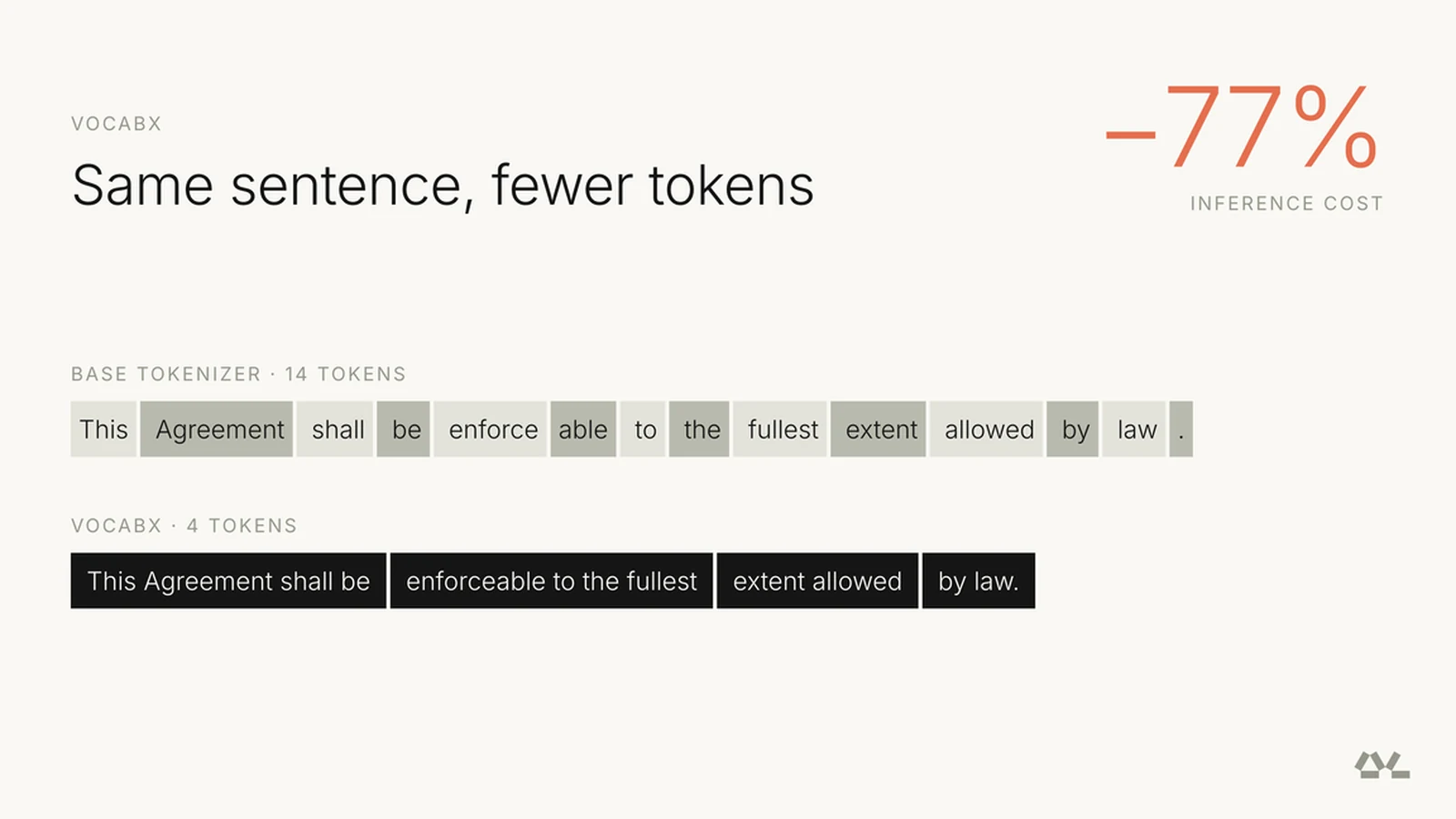
The first inefficiency is text fragmentation, where the tokenizer splits the most frequently repeated domain phrases into multiple pieces. The second is excess vocabulary size, as the model carries tens of thousands of entries that the specific domain never utilizes while still computing scores for all of them during text generation.
Why Generation Costs Outweigh Input Processing
Counting raw tokens is often the first instinct when trying to optimize costs, but the token count alone does not dictate the final bill. Language model inference consists of two distinct operational phases with different computational bottlenecks.
During the prefill phase, the model processes the entire input in a single network pass, making compute the primary limit. Conversely, during the decode phase, the model generates responses one token at a time. Each generated token requires a full pass where weight reads are limited by memory bandwidth, causing the GPU to spend considerable time waiting for data.
In the measured essay grader application, generating a single token costs 7.4 times more than reading an input token, though this ratio varies depending on hardware, batch size, and context length. Consequently, optimization methods that compress input and output equally miss the majority of potential savings.
The Impact of Output Layer Matrix Size
A third contributing factor to inference expenses is the vocabulary layer itself. The final language model head translates internal model states into scores for every potential token, maintaining one parameter row for every entry in the vocabulary.
In a model comparable to Qwen3-4B, this output matrix accounts for nearly 10% of all parameters. While larger models absorb this share easily, it places a noticeable burden on smaller architectures.
Furthermore, while the input layer looks up only the specific token being read, the language model head reads and multiplies the entire matrix for every generated token. Because decoding is already memory-bound, every unused entry creates unnecessary data movement.
Comparing VocabX with Existing Adaptation Techniques
Adapting model vocabularies is an established concept supported by reference methods in literature. These include fast vocabulary transfer, multi-word tokenization, and <a href="https://www.liquid.ai/blog/tokenizer-expansion">in-place tokenizer expansion</a> which continues byte-pair encoding training from an original vocabulary.
While existing methods successfully reduce fragmentation, they generally select tokens based on frequency rather than generation cost and typically operate on a single layer without combining sub-word adjustments and phrase merging under a unified criterion.
By rebuilding the vocabulary around token cost rather than frequency, the VocabX approach successfully reduced the output layer size from approximately 152,000 rows down to about 65,000 rows in the tested production grader, cutting overall measured inference cost by 77%.
Sources
- Hugging Face BlogHow Specializing the Vocabulary of SLMs Can Cut Inference Cost by 77% in Real Applications
Continue chronologically


Related stories
FairStress Benchmark Measures LLM Demographic Fairness
Discover FairStress, a new benchmark designed to evaluate demographic fairness and hidden asymmetries in large language model decision-making.
Liquid AI Unveils LFM3 Multimodal Model Family
Liquid AI introduces LFM3, a new generation of multimodal foundation models spanning text, vision, audio, omni, and decision capabilities on a 2B backbone.
Liquid AI Unveils LFM2.5-24B-A2B Reasoning Model
Liquid AI introduces LFM2.5-24B-A2B, a 24B reasoning model with 2B active parameters built for fast, private, and efficient on-device AI agents.
Liquid AI Releases Multimodal Open d1 Decision Models
Liquid AI has launched its open d1 decision model family, introducing the d1-3B and d1-omni-600M models for multimodal edge applications.