Liquid AI Unveils LFM2.5-24B-A2B Reasoning Model
Liquid AI has announced LFM2.5-24B-A2B, an open-weight 24-billion-parameter reasoning model featuring just two billion active parameters, designed to run fast and private AI agents directly on local hardware.
 Radwan AbdulhadiEditor and technology writer
Architecture and Design
Liquid AI has detailed the architecture behind its latest release on the Hugging Face Blog, outlining a reasoning-only model designed specifically for on-device agentic workflows.
Building directly upon its predecessor, the new model maintains a structure of 40 layers alongside 64 experts per mixture-of-experts block utilizing top-4 routing. It also retains a hybrid configuration combining gated short convolutions and group-query attention. The context window has been expanded substantially from 32K up to 131K tokens. Furthermore, an in-place tokenizer expansion doubles the vocabulary capacity from 65K to 128K tokens, facilitating improved handling of non-Latin tokenization workloads.
Training Methodology and Post-Training Stages
The pre-training scale for the model increased from approximately 17 trillion tokens up to roughly 33 trillion tokens. Subsequent mid-training introduced two additional components: two trillion tokens focused on a 32K context weighted toward reasoning, mathematics, programming, instruction following, and multilingual data, alongside 300 billion tokens targeted at a 131K context emphasizing long-context information. Trajectories involving multi-turn interactions and tool calls appear across both training phases.
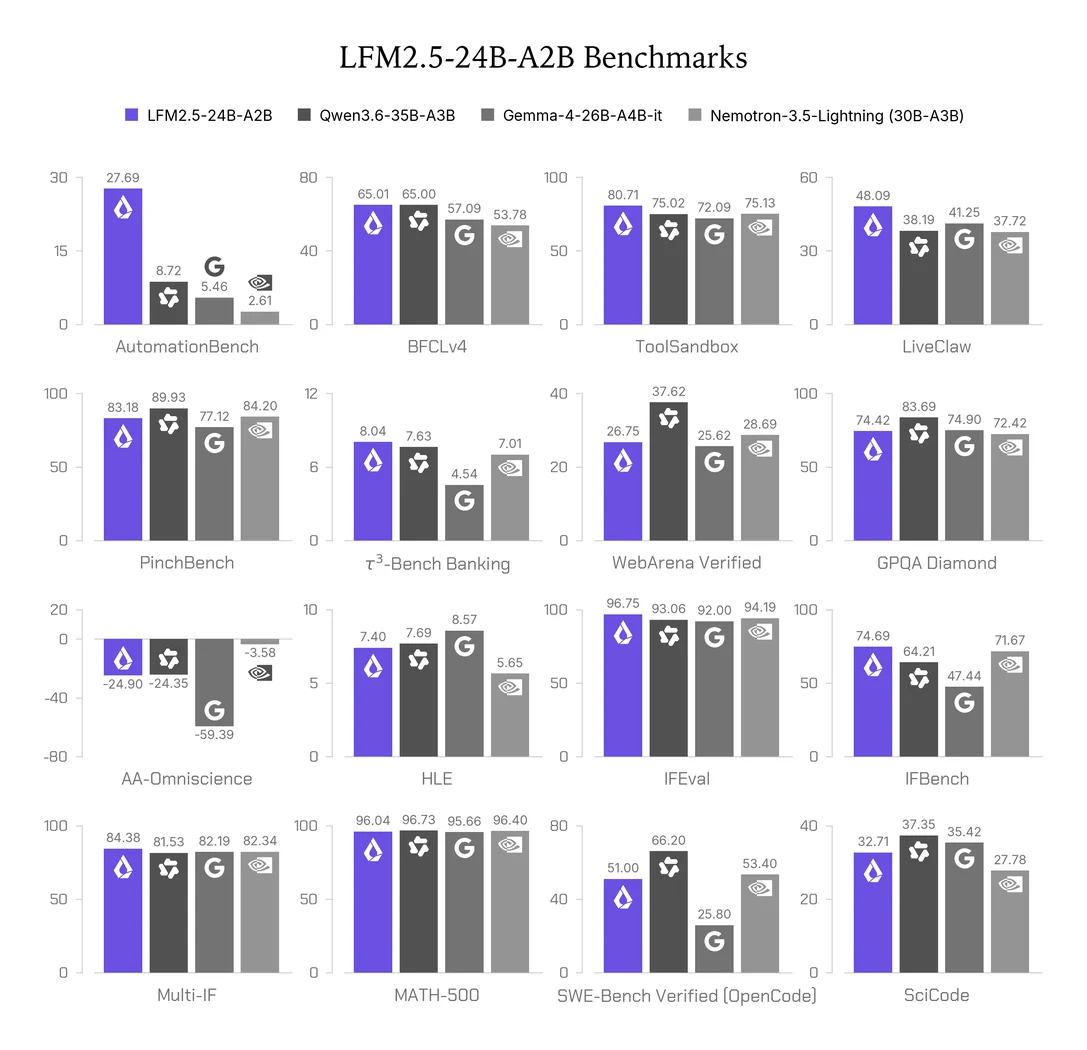
To transform the base architecture into a functional agent, the post-training pipeline proceeds through five distinct stages. These include multi-domain on-policy distillation for non-agentic tasks, a second distillation stage targeted at agentic operations, and agentic reinforcement learning executed within standard agent harnesses such as OpenClaw and Hermes Agent.
Benchmark Performance and Capabilities
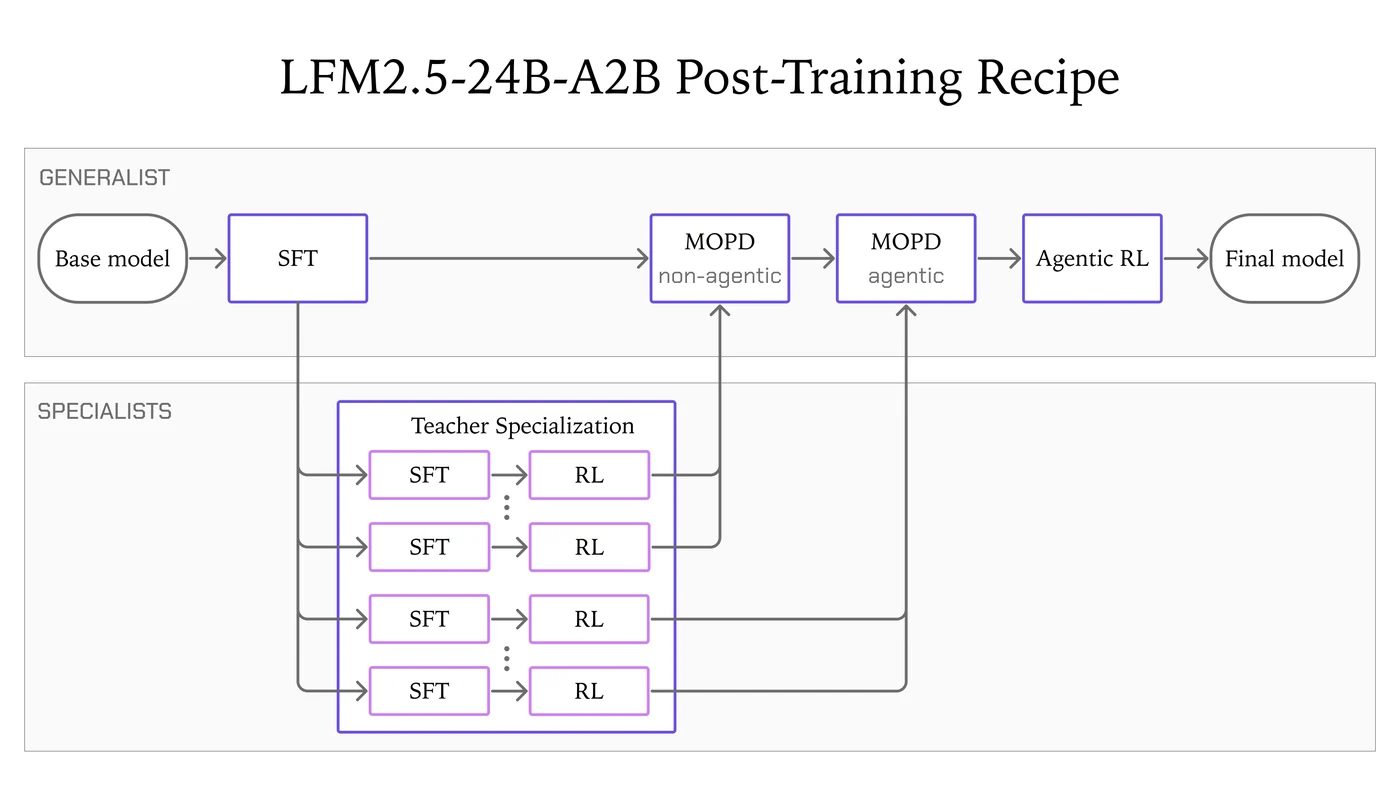
Evaluations performed across 16 benchmarks place the model in a competitive position against larger counterparts like Qwen3.6-35B-A3B, despite possessing roughly 50% fewer total and active parameters. Detailed evaluation discussions and further community insights can be followed via LiquidAI on the platform.
The model leads or matches competing systems across five out of eight tool-use and agentic benchmarks, including AutomationBench, BFCLv4, ToolSandbox, LiveClaw, and τ³-Bench Banking. It achieves top scores across all three evaluated instruction-following benchmarks. However, larger models retain advantages on knowledge-intensive evaluations such as GPQA Diamond, HLE, and AA-Omniscience, as well as coding tasks like SWE-Bench Verified and SciCode, suggesting developers should pair the system with retrieval or web search tools for knowledge-heavy applications.
Inference Efficiency and Local Deployment
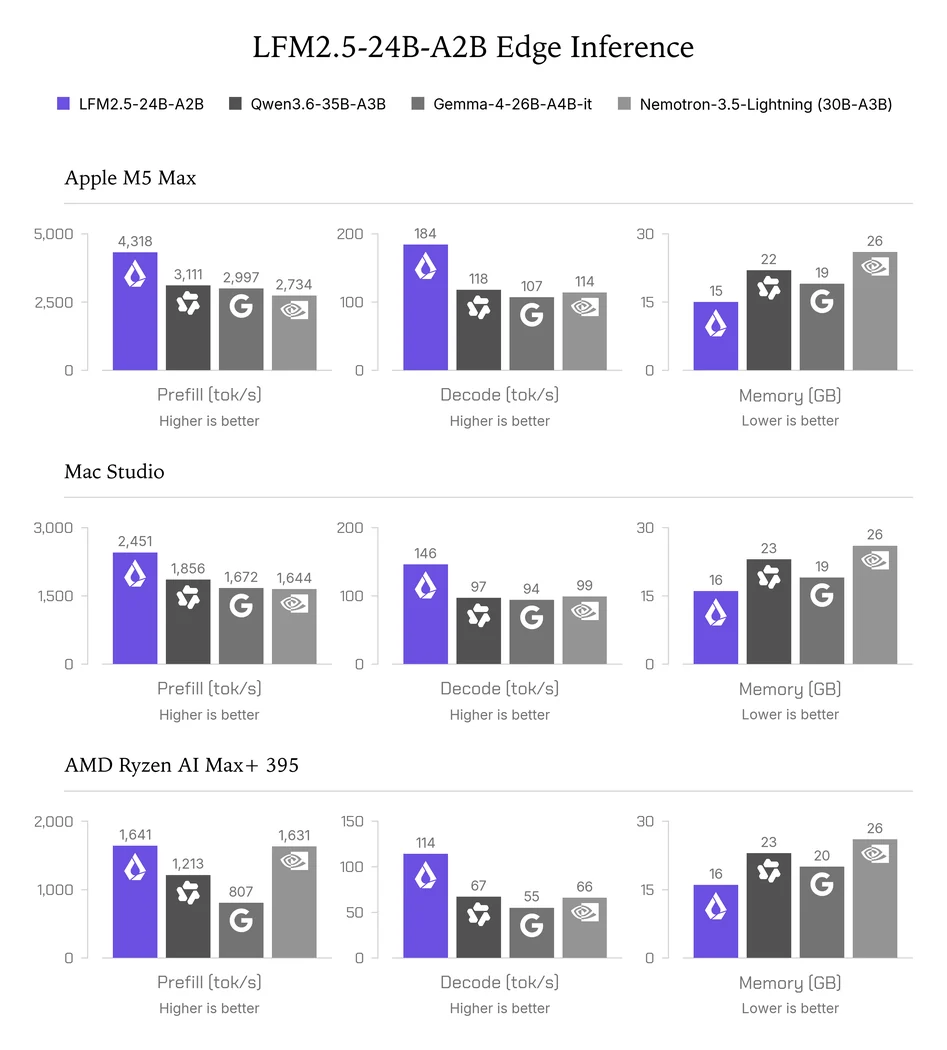
Operating with only two active parameters per token keeps individual reasoning token costs minimal, facilitating continuous agent execution on local hardware. During edge inference assessments, the system achieved decoding speeds of 184 tokens per second on an Apple M5 Max and 114 tokens per second on a Ryzen AI Max+ 395 processor.
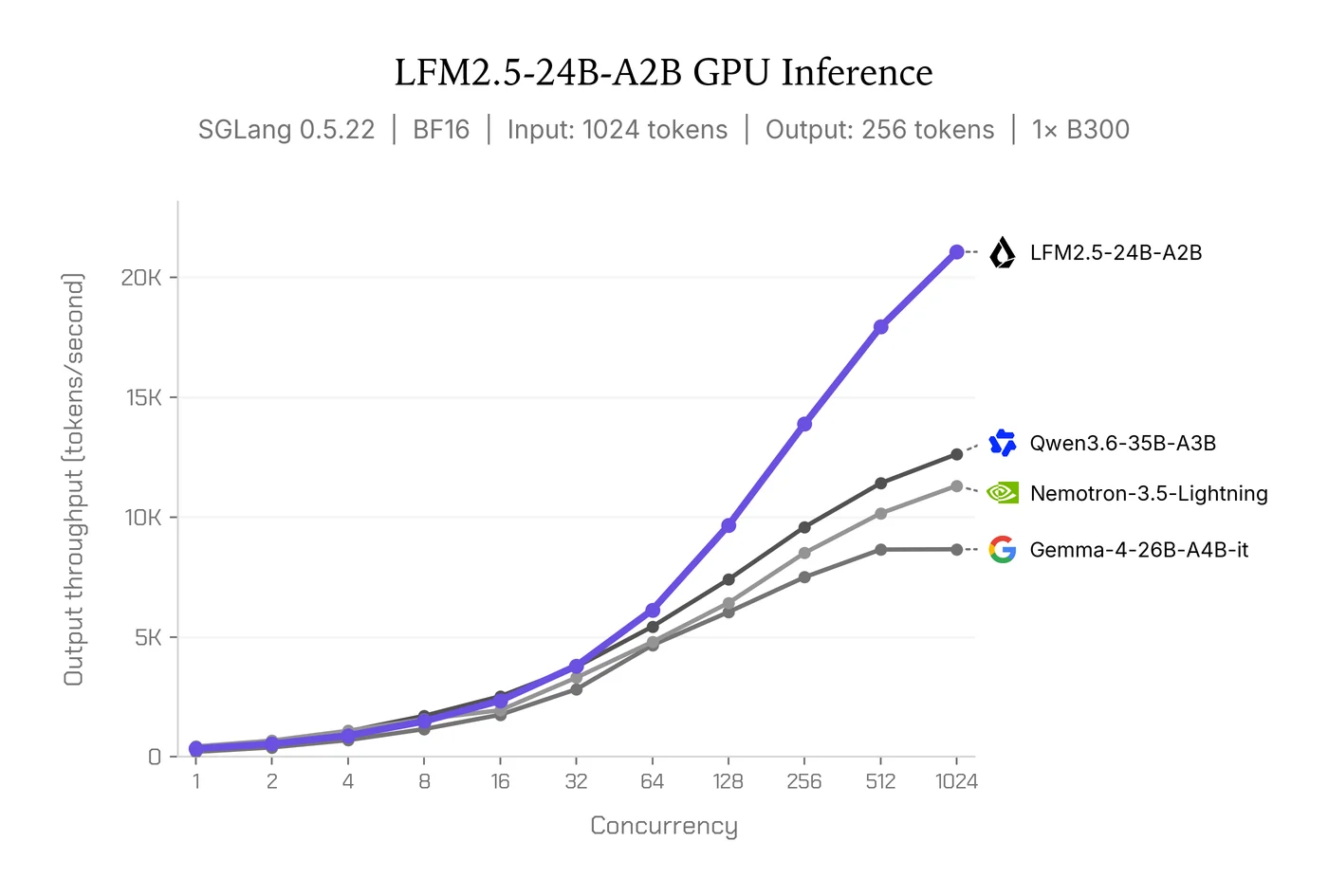
At higher concurrency levels on a single NVIDIA B300 GPU, the model delivers over 21,000 output tokens per second. Day-one ecosystem support includes compatibility with llama.cpp, MLX, vLLM, SGLang, and ONNX. Both the standard model and its base counterpart are open-weight and accessible directly via Hugging Face for deployment, fine-tuning, and integration into local agent frameworks.
Sources
- Hugging Face BlogRun fast, private agents on-device with LFM2.5-24B-A2B
Continue chronologically


Related entity coverage
Related stories
Liquid AI Releases Multimodal Open d1 Decision Models
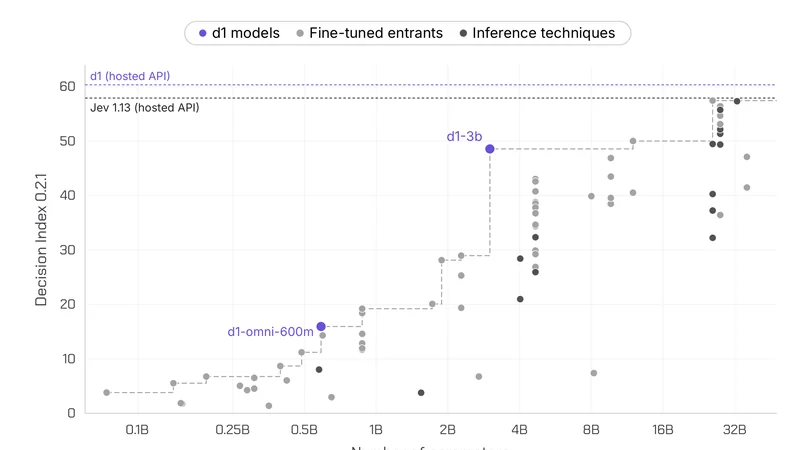
Liquid AI has launched its open d1 decision model family, introducing the d1-3B and d1-omni-600M models for multimodal edge applications.
Why OpenAI Skipped Nvidia’s Open Agent Safety Platform
Explore why OpenAI is privately working with Nvidia on agent security while remaining absent from Nvidia's new industry-wide safety consortium.

US and China Discuss AI National Security Alert Mechanism
US and Chinese officials are exploring a framework to notify each other of AI incidents that could pose national security risks amid growing safety concerns.

AnyLanguageModel 1.0 Launches with Apple Platform Updates
AnyLanguageModel 1.0 arrives after a year of development, bringing local and hosted model integration, Swift updates, and new features.