Liquid AI Unveils LFM3 Multimodal Model Family
Liquid AI has announced the launch of LFM3, a new generation of Liquid Foundation Models designed to bring text, vision, audio, omni, and decision models onto a single shared backbone within the 2B parameter range.
 Radwan AbdulhadiEditor and technology writer
Introduction to LFM3
Liquid AI has officially launched its LFM3 series, engineered to serve as a versatile foundation for specialized intelligence applications. Detailed on the Hugging Face Blog, the new generation unifies text, vision, audio, omni, and decision models onto a shared backbone. This design allows developers to select a model tailored to a specific modality, fine-tune it using local data on a single GPU, and deploy it efficiently where applications run.
Compared to the previous LFM2 family, the LFM3 architecture brings four major improvements. These include higher capability per parameter, a unified backbone for six 2B-class models, edge optimization with small memory footprints, and single-GPU fine-tuning capabilities. Further details about the architecture and development can be found directly via LiquidAI.
Tri-Hybrid Architecture and Long-Context Performance
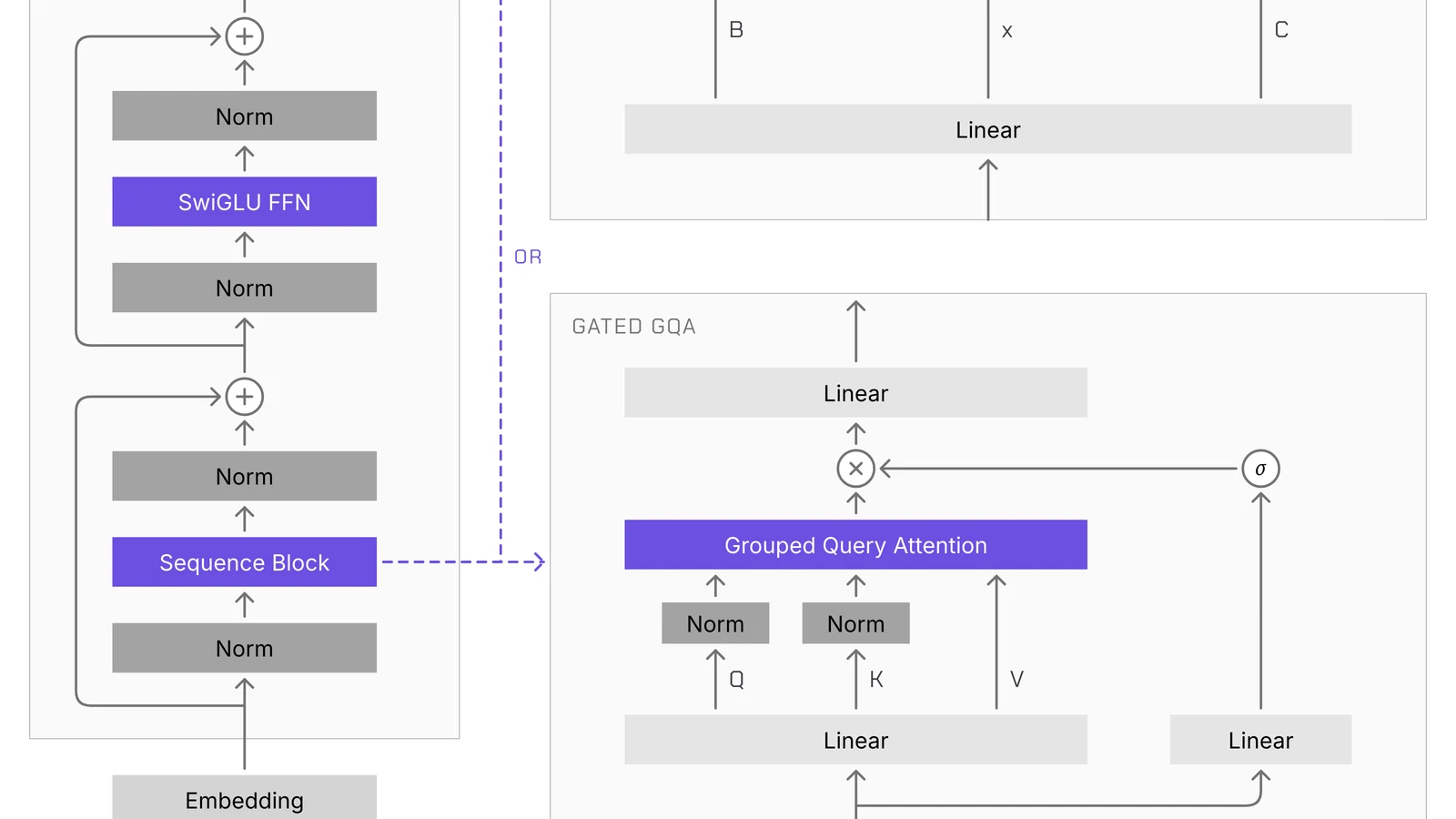
The foundation of the lineup, LFM3-1.7B-Base, incorporates a 24-layer tri-hybrid mix consisting of 13 gated short convolutions, 5 sliding-window attention layers with a 256-token window, and 6 global attention layers. Liquid AI utilized hardware-in-the-loop architecture searches covering 14 device and backend combinations—ranging from mobile phones and Raspberry Pi 5 units to laptops, cloud CPUs, GPUs, and Qualcomm Hexagon NPUs—to optimize the model for agentic use cases.
In addition to its layer mix, the base model features head-wise gated attention with sigmoid scaling to suppress activation outliers and partial RoPE application in global attention layers. Pre-trained on 22 trillion tokens, the model concludes with a mid-training stage using curated data and agentic traces, which successfully extends its context window to 256K tokens.
Specialized Models: Text, Vision, and Audio
The LFM3-1.7B model is built for local agents, tool calling, structured outputs, and domain-specific fine-tuning. It outperforms its predecessor with 35% fewer parameters and has been post-trained for execution within agentic frameworks. Meanwhile, the LFM3-VL-2B vision model introduces native video input support, step-by-step reasoning, and object localization capabilities suited for robotics and on-device visual understanding.
For auditory applications, the LFM3-Audio-2B model handles voice chat, speech recognition, synthesis, and translation across 18 languages on edge hardware. Powered by a new in-house audio encoder and the LiquidCodec speech tokenizer, the audio model achieves low time-to-first-token latencies and supports real-time streaming capabilities.
Unified Omni Capabilities
Rounding out the release is LFM3-Omni-2B, Liquid AI's first omni model designed to see, listen, and talk back within a single on-device architecture. Replacing separate automatic speech recognition, vision-language, large language, and text-to-speech models, it can process simultaneous audio and video inputs while performing tasks such as visual question answering and tool invocation.
Sources
- Hugging Face BlogBuild specialized multimodal models with LFM3
Continue chronologically

Related stories
Liquid AI Releases Multimodal Open d1 Decision Models
Liquid AI has launched its open d1 decision model family, introducing the d1-3B and d1-omni-600M models for multimodal edge applications.
Liquid AI Unveils LFM2.5-24B-A2B Reasoning Model
Liquid AI introduces LFM2.5-24B-A2B, a 24B reasoning model with 2B active parameters built for fast, private, and efficient on-device AI agents.
AnyLanguageModel 1.0 Launches with Apple Platform Updates
AnyLanguageModel 1.0 arrives after a year of development, bringing local and hosted model integration, Swift updates, and new features.

Specializing SLM Vocabularies Cuts Inference Cost by 77%
A new vocabulary specialization method called VocabX cuts small language model inference costs by 77% in production environments without base model changes.