Octave Builds Secure AI Foundation on Amazon Bedrock
Octave has built a secure, multi-tenant AI foundation on Amazon Bedrock for its Reliance quality management platform. The architecture is designed to help a Complaint Triage Assistant search billions of regulated documents without crossing customer boundaries.
 Radwan AbdulhadiEditor and technology writer
A platform-wide AI foundation
Octave has chosen to build a horizontal AI foundation before adding a larger set of specialized features to Reliance, its cloud-native quality management system for regulated industries. The company describes the approach in an AWS Machine Learning Blog post, which says the foundation is intended to support complaint summarization and triage, audit readiness monitoring, incident narrative generation and predictive quality risk scoring.
The decision followed workshops with AWS that identified multiple high-impact use cases across dozens of applications, each with different document types and workflows. Rather than rebuilding infrastructure for every feature, the Reliance team started with complaint summarization and triage as the first vertical slice through the shared platform. Octave says the foundation has since cut deployment time per use case by 50%.
The architecture is designed for a platform in which every customer is a separate tenant and data cannot cross tenant boundaries. Octave operates in 180 countries and says it serves more than 60% of the Global Fortune 500. Reliance supports more than 650 enterprise customers with over 40 applications, including complaint management, CAPA tracking, audit management and supplier quality.
Isolation is the central requirement
Reliance stores complaint records, audit findings, corrective actions and standard operating procedures that may contain sensitive information about regulated products and processes. Octave says its platform serves more than 14,000 customers across medical devices, pharmaceuticals and food manufacturing, making inadvertent disclosure between customers a significant regulatory risk.
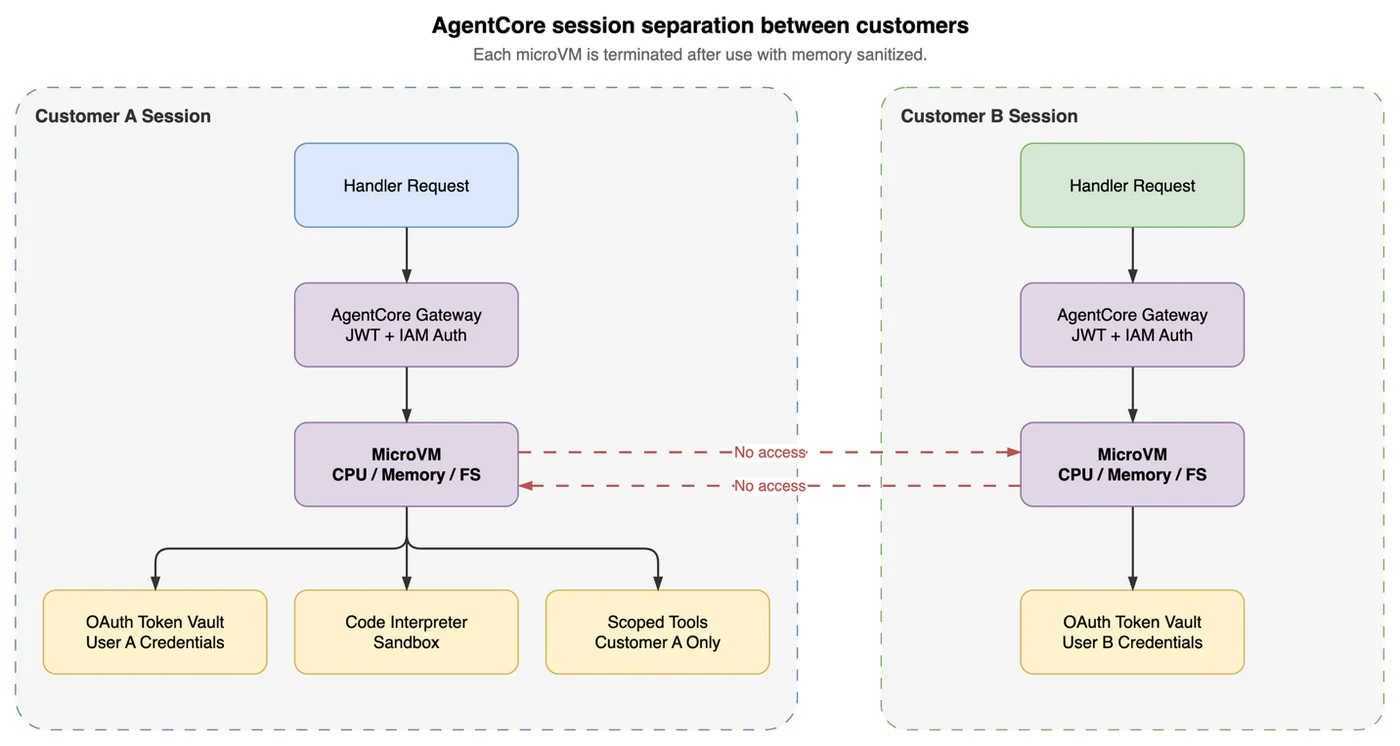
That requirement shaped the foundation before the team selected a model. The vector store, retrieval logic and generation context must all be scoped to one tenant, so an AI query cannot retrieve material belonging to another customer. The design also avoids a shared agent pool with static credentials: permissions for tools, data stores and model endpoints are scoped to the requesting user, available during execution and constrained by that user’s existing access rights.
Octave also treats ingested content as untrusted. Complaints, email attachments, scanned PDFs and images may contain hidden instructions or other content that could manipulate an agent. The company identifies prompt injection, sensitive information disclosure, improper output handling and excessive agency as relevant risks from the OWASP Top 10 for LLM Applications 2025.
Three layers on Amazon Bedrock
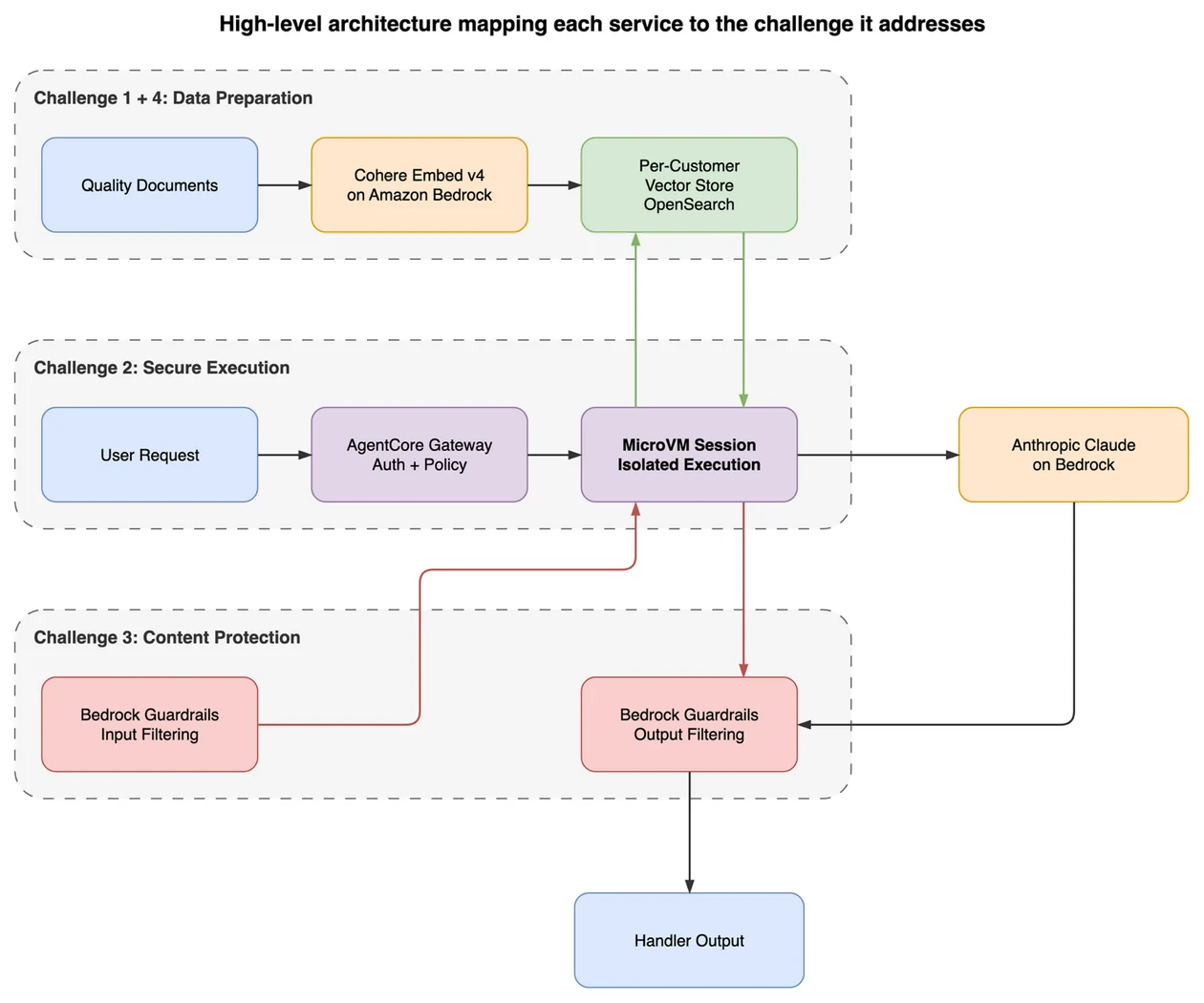
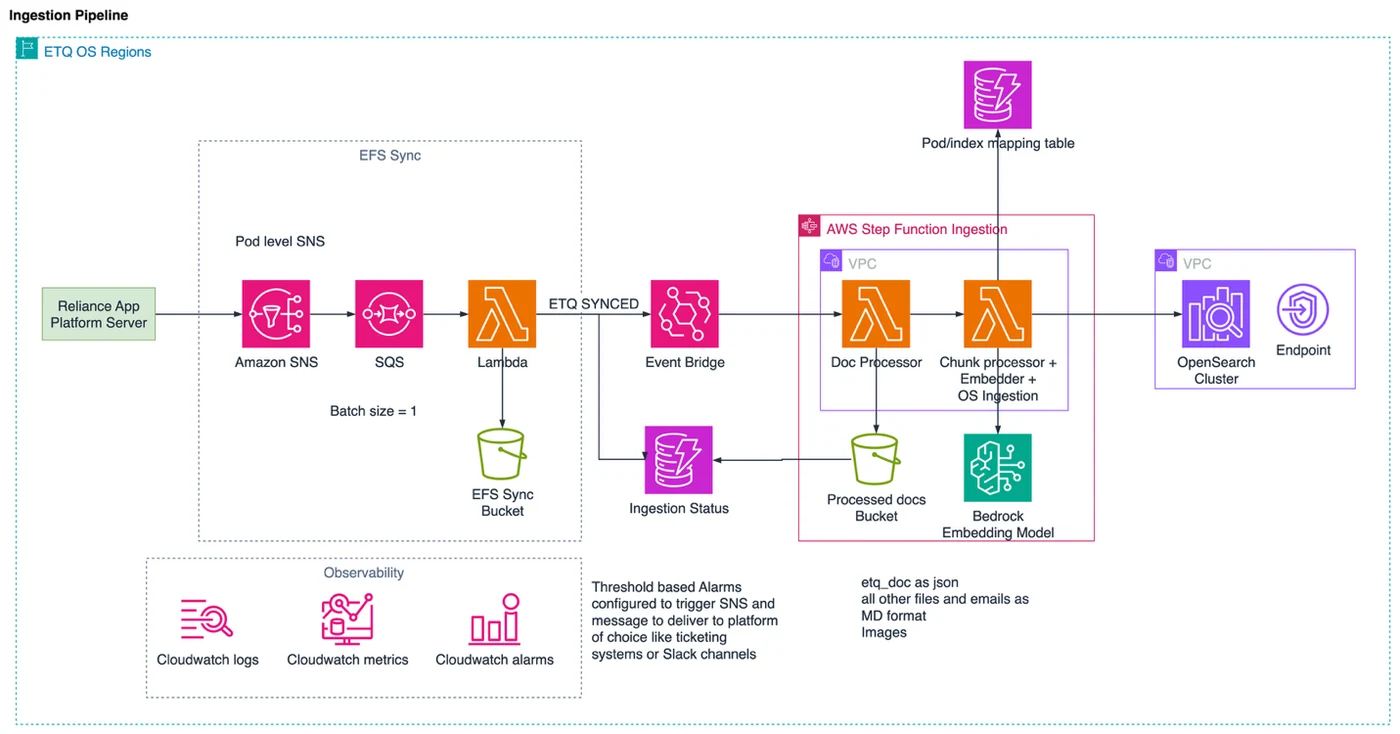
Octave’s foundation is organized into three layers: data preparation, secure execution and content protection. In the preparation layer, quality documents are embedded with Cohere Embed v4 on Amazon Bedrock and written to a per-tenant vector store on Amazon OpenSearch Service. Retrieval is therefore separated by customer before documents become context for an AI response.
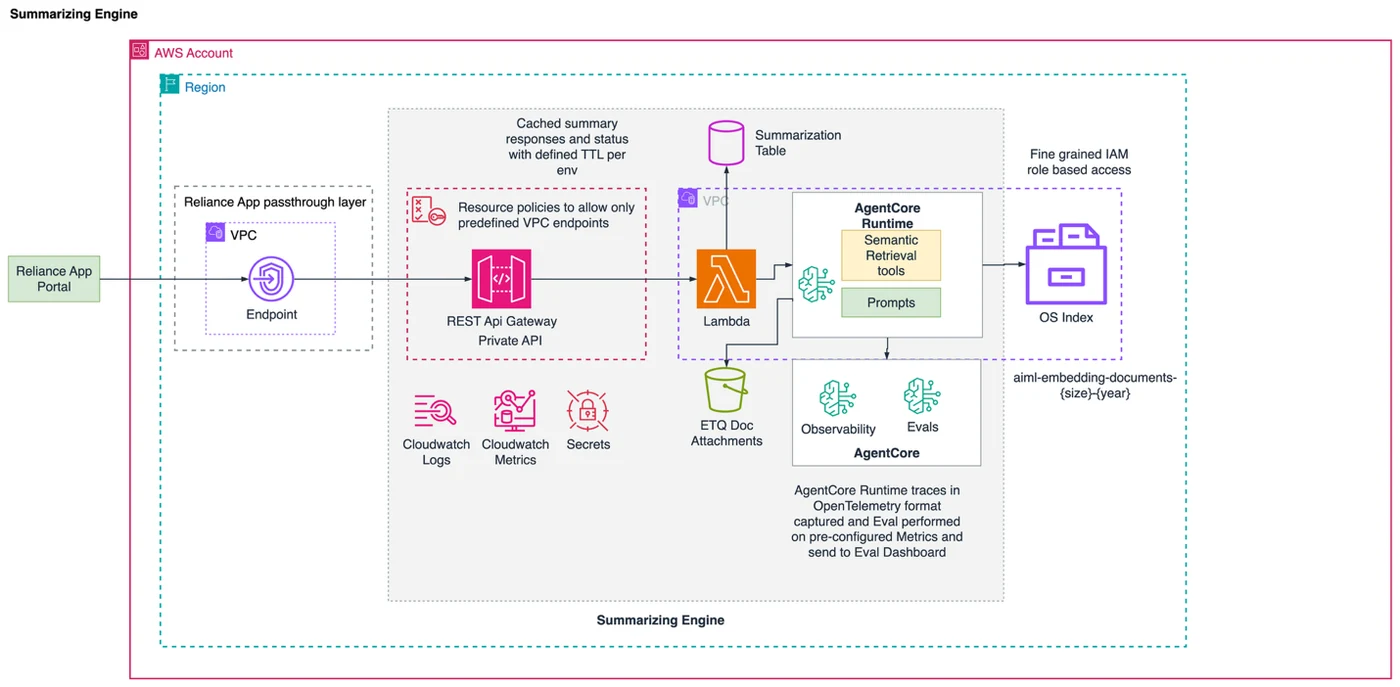
For execution, a user request passes through AgentCore Gateway, which applies authentication and policy before sending the request to an isolated microVM session. That session can call an Anthropic Claude model on Amazon Bedrock. Octave says the separation allows retrieval, execution and screening to be enforced and evidenced as distinct stages.
The third layer applies Amazon Bedrock Guardrails twice: once to filter incoming content and again to screen output before it reaches the handler. Octave presents the arrangement as a way to place content controls around the agent rather than relying on a single screening step.
Embedding billions of mixed-format records
The foundation depends on making Reliance’s document history searchable across languages and formats. Octave says the platform hosts more than 2 billion documents, while individual tenants may store millions of Word files, PDFs, scanned forms, spreadsheets, images and email. The team committed to onboarding even the largest tenant within a single working day without sacrificing retrieval quality.
The team evaluated embedding models against its own corpus instead of relying on public leaderboards. It tested questions specific to quality records, including whether an image of a cracked housing could be associated with the paragraph describing the defect and whether a German complaint could be connected to an English CAPA.
Octave selected Cohere Embed v4 because it supports text and images in one vector space and provides multilingual capability. The company says that means a photo, scanned form or annotated diagram can be handled alongside text without separate modality pipelines, while multilingual records can be processed without translation preprocessing.
Complaint triage as the first proof point
The Complaint Triage Assistant is the first production use case described for the foundation. It is intended to search an organization’s historical complaints, CAPAs and audit findings for relevant precedents, allowing investigators to draw on institutional memory that would otherwise remain distributed across billions of records.
The use case reflects the practical reason Octave built the foundation before expanding its AI roadmap: quality teams already generate regulated data across many applications, but the value of that information depends on retrieving the right evidence without exposing another tenant’s records. The AWS account’s regional residency and IAM controls, combined with Bedrock’s multi-model access and Guardrails, form the platform controls Octave says address those requirements.
Sources
- AWS Machine Learning BlogHow Octave built a secure multi-tenant AI foundation on Amazon Bedrock
Continue chronologically
Related entity coverage
Related stories
NarrateAI Brings LLM Quality Assurance to Amazon Bedrock
NarrateAI implements five advanced quality assurance techniques on Amazon Bedrock to achieve 99% numerical accuracy with real-time streaming.
Building Ambient Agents with Amazon Bedrock AgentCore
Learn how to build framework-agnostic ambient agents on Amazon Bedrock AgentCore that respond to event-driven signals and human-in-the-loop workflows.
Build Multi-Agent Pipelines with Amazon Bedrock AgentCore
Learn how to build a multi-agent music production pipeline on Amazon Bedrock AgentCore Runtime Instances using shared sessions and GPU infrastructure.
AWS Details Enterprise Agentic AI Platform Blueprint
Discover how enterprises can build a governed, multi-account Agentic AI Platform using Amazon Bedrock and AgentCore reference architecture.