
Build Multi-Agent Pipelines with Amazon Bedrock AgentCore
A new architectural pattern for multi-agent systems enables persistent workflows, GPU utilization, and shared filesystems across multiple collaborating agents on AWS.
 Radwan AbdulhadiEditor and technology writer
Introduction to Amazon Bedrock AgentCore Runtime Instances
As organizations transition from single-purpose agents to complex multi-agent systems, infrastructure requirements are evolving rapidly. While a lone agent handling straightforward customer queries can operate efficiently in a serverless environment with short-lived sessions, creative and long-running workflows demand persistent environments. To address these needs, AWS introduced Amazon Bedrock AgentCore Runtime Instances, which provide managed EC2 infrastructure equipped with GPUs, persistent volumes, and support for multi-day sessions.
According to the AWS Machine Learning Blog, developers can now deploy sophisticated multi-agent workflows where agents colocate on a single GPU instance, share a common filesystem, and seamlessly hand off work to each other. Comprehensive technical guidance is detailed on the AWS Machine Learning Blog for teams looking to implement these persistent systems.
Architecture of the Three-Agent Music Production Pipeline
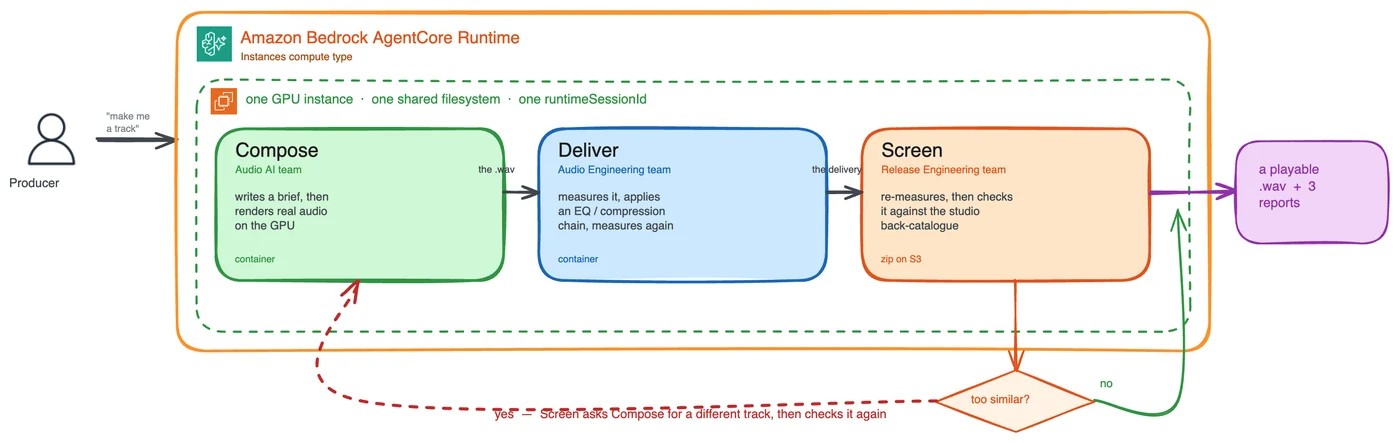
The reference architecture outlines a three-agent music production pipeline consisting of a composition agent, a delivery agent, and a compliance agent. The composition agent turns producer requests into musical briefs using Anthropic Claude Sonnet 4.6 and renders audio utilizing ACE-Step, an open-source foundation model running directly on the instance's NVIDIA L4 GPU.
Once the initial track is rendered as a .wav file onto a shared volume, the delivery agent opens the file, measures it, and derives an appropriate signal processing chain for EQ, compression, and limiting. Finally, the compliance agent independently re-measures the finished track, verifies delivery targets, and screens the audio against the studio back catalog for harmonic similarity.
Key Capabilities of Runtime Instances
Amazon Bedrock AgentCore offers two primary compute options for hosting agents: MicroVMs designed for serverless workloads with fast cold starts, and Runtime Instances tailored for persistent, long-running processes. Runtime Instances introduce several crucial capabilities for advanced AI deployments, including multi-day session persistence, dedicated GPU access, and the ability to run multiple agents within a single session.
By invoking multiple agent runtimes with the exact same runtimeSessionId on a shared capacity provider, the platform places them onto the same underlying EC2 instance with identical volumes mounted. This colocation allows agents to share a local filesystem, exchange intermediate files instantly, and maintain context across overnight pauses without losing state.
Deployment and Framework Flexibility
The platform supports a wide range of custom frameworks, allowing developers to build applications using tools such as Strands Agents, CrewAI, LangGraph, or LlamaIndex. Furthermore, the architecture accommodates mixed artifact types, enabling container images stored in Amazon Elastic Container Registry and code packages stored in Amazon Simple Storage Service to coexist on the same capacity provider.
Independent deployment workflows mean that individual development teams can ship updates to their specific agent artifacts without requiring coordination with other engineering groups. For those looking to inspect or deploy the reference architecture directly, complete working code and implementation instructions are accessible via the AgentCore samples GitHub repository.
Prerequisites and Getting Started
Setting up the multi-agent music production pipeline requires an active AWS account with permissions to create IAM roles, S3 buckets, ECR repositories, and AgentCore capacity providers. Developers must also have the AWS Command Line Interface (AWS CLI) installed, along with an OCI-compatible container tool such as Finch and appropriate foundation model access enabled in the Amazon Bedrock console.
After fulfilling all environment prerequisites and verifying library versions like boto3, users can follow the step-by-step procedures outlined in the AgentCore samples repository to provision infrastructure, deploy runtimes, and execute collaborative multi-day workflows.
Sources
- AWS Machine Learning BlogBuild a multi-agent music production pipeline on Amazon Bedrock AgentCore Runtime Instances