AWS Details Enterprise Agentic AI Platform Blueprint
A new open-source reference blueprint from AWS provides organizations with a structured framework for deploying governed, multi-account agentic AI platforms using Amazon Bedrock and Amazon Bedrock AgentCore.
 Radwan AbdulhadiEditor and technology writer
Addressing Enterprise Bottlenecks in Agentic AI
Moving an AI agent from initial development into a production environment often presents operational challenges that extend far beyond model selection and basic tool usage. Organizations looking to scale agentic use cases frequently struggle with establishing secure environments, defining clear ownership boundaries for models and tools, and implementing consistent AgentOps protocols. For platform teams supporting multiple domains, designing a scalable platform product has become a critical requirement.
To address these challenges, organizations can leverage technologies such as Amazon Bedrock to support scalable AI implementations. Workstream teams require structured pathways featuring approved models and tools, isolated runtimes, automated evaluations, and clear cost attribution.
The Federated Operating Model
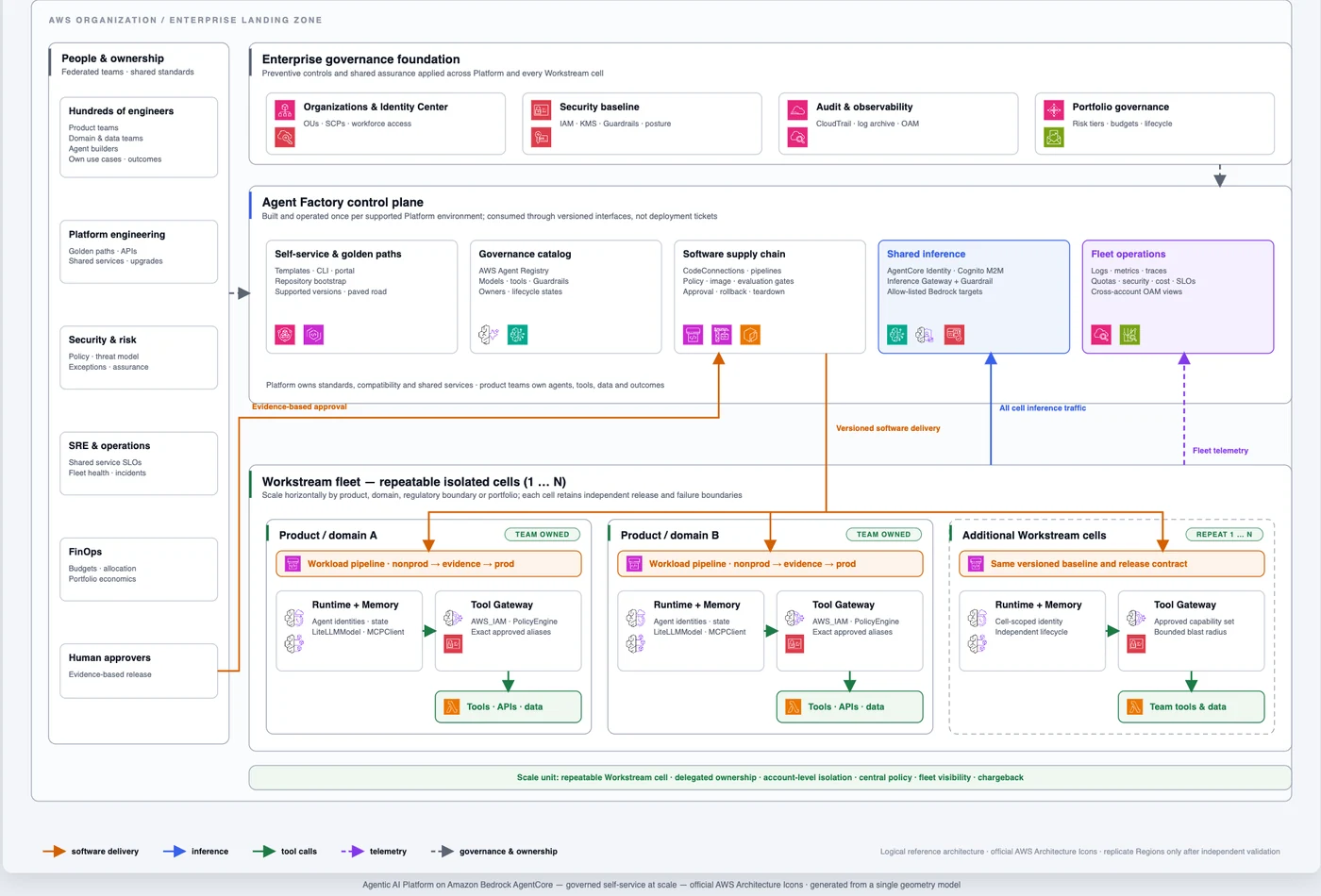
When structuring agentic AI initiatives, enterprises typically evaluate centralized, decentralized, and federated operating models. While centralized structures can introduce bottlenecks and decentralized setups risk control drift, a federated approach establishes a balance. In a federated model, a central platform team provides shared, governed services while domain-specific teams maintain ownership of their respective applications, data, and tools.
Organizations seeking structured guidance on these structural frameworks can consult the AWS Prescriptive Guidance page on Governance Models for detailed operational recommendations.
Core Architecture and Amazon Bedrock AgentCore
The reference architecture relies on modular services designed to support agents at scale. Specifically, Amazon Bedrock AgentCore supplies foundational components for runtime management, gateway routing, identity verification, memory handling, policy enforcement, registries, and evaluations.
Building upon these modular foundations, the Enterprise Agentic AI Platform Blueprint translates enterprise requirements into deployable infrastructure-as-code configurations. These configurations govern account boundaries, software delivery workflows, observability pipelines, cost tracking mechanisms, and retirement lifecycles.
Governed Inference and Tool Access Gateways
To maintain security and operational compliance, the platform architecture incorporates distinct gateways for model inference and tool execution. Untrusted inference requests must travel through an approved inference gateway equipped with controls such as Amazon Bedrock Guardrails. These guardrails apply organizational policies, restrict usage across unauthorized regions, and enforce strict per-workstream token quotas and budgets.
Similarly, tool access is regulated through an authenticated Model Context Protocol gateway. This ensures that agents discover and execute exclusively approved tools adhering to least-privilege execution roles and policy decisions.
Fleet Operations, Cost Governance, and Delivery
Visibility across multi-account deployments is another focal point of the platform blueprint. Operations engineers utilize centralized logs, metrics, and traces, while workstream owners monitor direct costs associated with individual agents. For financial tracking, the architecture integrates with AWS Cost Explorer and the AWS Cost and Usage Report to support accurate chargeback processes across different business units.
Developers can review the complete configuration details, deployment guidelines, and architectural breakdown by consulting the repository documentation and the README file provided in the open-source sample repository.
Sources
- AWS Machine Learning BlogBuilding an Agentic AI Platform on Amazon Bedrock AgentCore
Continue chronologically
Related entity coverage
Related stories
NarrateAI Brings LLM Quality Assurance to Amazon Bedrock
NarrateAI implements five advanced quality assurance techniques on Amazon Bedrock to achieve 99% numerical accuracy with real-time streaming.
AWS Details Multi-Agent Cloud Migrations on Bedrock AgentCore
AWS Professional Services details a multi-agent framework on Amazon Bedrock AgentCore to automate enterprise cloud migrations and reduce IaC time.
AWS Introduces Agentic Conversational Video Intelligence
Amazon Web Services details a new agentic conversational video intelligence solution using Amazon Bedrock, Rekognition, and Transcribe.
MoEngage Integrates 400 APIs With AgentCore Gateway
Discover how MoEngage scaled agentic workflows by converting 400 private REST APIs into secure tools using Amazon Bedrock AgentCore Gateway.