Ethernet Cables Can Do Much More Than Just Connect to a Router
While commonly viewed as mundane tech accessories, category cables can handle specialized tasks like transmitting video, multiple audio channels, and electrical power.
 Radwan AbdulhadiEditor and technology writer
Beyond Basic Home Internet
Ethernet cables are often considered some of the least exciting tech accessories in a standard setup. However, according to an [Engadget](https://www.engadget.com/2273746/ethernet-cables-can-do-more-than-just-improve-home-internet/) report, these familiar category cables can do much more than simply connect devices to a router. They can also carry video, audio, and power.
Although they possess these capabilities, it does not necessarily mean they represent the best option for every scenario. Understanding their secondary uses requires looking at how adapters and specific standards transform their functionality.
Extending Video Signals Over Long Distances
HDMI usually connects two devices that sit relatively close together, but certain setups require video signals to travel much farther. This is one area where category cables can [find a second use](https://bzbgear.com/blog/av-over-ip-explained-what-it-is-how-it-works-and-why-its-the-future-of-pro-av/) in modern environments.
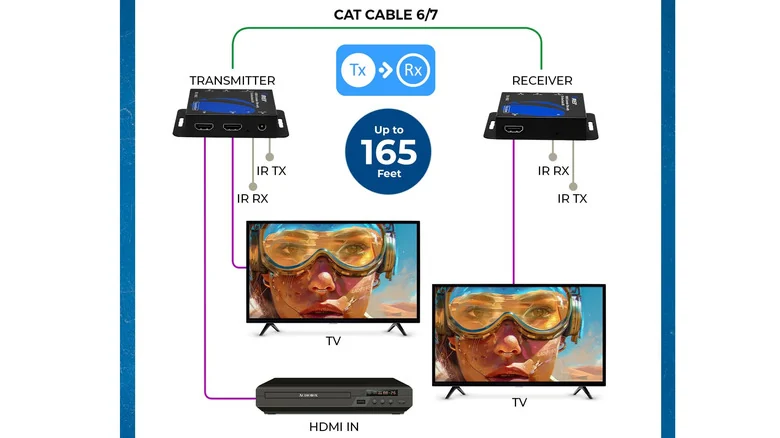
Category cables cannot perform this feat on their own. Accomplishing this setup requires purchasing HDMI extenders to pair with Cat5e, Cat6, or similar cables. These adapters place a transmitter at one end and a receiver at the other, using the cable as the physical connection between them to send video much farther than a standard HDMI cable typically allows.
Despite using a familiar category cable, this process is not actually Ethernet networking. AV over IP, by contrast, relies on a local network to transmit audio and video. In this case, the category cable simply carries the signal between two extenders, proving useful when an unused cable is already inside walls or when reaching a distant device like a projector is necessary.
Even so, this approach may not be the optimal solution for every case. Active optical HDMI can also handle long distances, and certain cables support formats like 4K at 120Hz that many extenders fail to support. Category cables are best viewed as a potentially useful option for niche setups rather than an immediate go-to solution.
Handling Multiple Channels of Analog Audio
Beyond video transmission, these same category cables can also [carry multiple channels of analog audio](https://www.soundproofyourstudio.com/blog/audio-over-ethernet-the-smart-way-to-wire-your-home-studio). Equipped with the right adapters, a single cable can manage several audio channels simultaneously.
For instance, a recording studio might use this method to connect microphones in one room to recording gear in another room without running numerous individual cables through a wall. While standard XLR cables remain easier and quite inexpensive for most setups, pre-existing wiring makes category cabling a clever way to replace several cable runs with just one. Additionally, some setups require shielded cables, particularly when microphones receive power directly through the connection.

Power Delivery Through Power over Ethernet
When it comes to power delivery, Power over Ethernet (PoE) offers a second life for category cables that goes beyond a simple gear hack. PoE enables a single Ethernet cable to transport both data and power concurrently.
This functionality proves especially convenient for security cameras, Wi-Fi access points, and other hardware situated far away from standard electrical outlets. A porch security camera, for instance, can utilize a single Ethernet cable for both its network connection and its power supply. Similarly, a ceiling-mounted Wi-Fi access point can run on the same principle, provided the cable leads back to an accessory capable of supplying PoE, such as a compatible switch or injector.
Unlike some of the more niche applications, PoE operates as a genuinely useful standard rather than an oddball option. However, users must still verify that their equipment supports PoE and delivers sufficient power for the connected device.
Sources
- EngadgetEthernet cables can do more than just improve home internet
Continue chronologically


Related stories
Why DVI Cables Still Connect to Modern TVs with an Adapter
Discover how DVI cables work with modern TVs using a simple adapter, and explore the limitations and history of this legacy video standard.
Understanding Audio Amplifiers and Sound System Quality
Explore what audio amplifiers do, how they impact your sound system quality, and whether you actually need a separate unit for your home theater.

Google Pay vs. Google Wallet: Understanding the Differences
Explore the history and differences between Google Pay and Google Wallet, and learn how these digital payment tools function together on devices.

How to Know It Is Time to Replace Your Apple Pencil Tip
Learn the key warning signs indicating when it is time to replace your Apple Pencil tip, from increased friction to exposed metal components.