
Destro AI Emerges From Stealth With $8 Million Seed Round
Destro AI has officially exited stealth with an $8 million seed round, adopting a software-first strategy that synchronizes human labor and autonomous machines in supply chain environments.
 Radwan AbdulhadiEditor and technology writer
Stealth Exit and Funding
Destro, a startup focused on artificial intelligence in the supply chain sector, has officially emerged from stealth mode backed by an $8 million seed round. The funding round was led by Base10 Partners and Bonfire Ventures, with additional investment coming from CoFound Partners.
While many emerging companies in the automation space concentrate on designing robotic form factors or developing metal hands for industrial tasks, Destro has taken a different approach. The company built an AI intelligence layer designed to help robots operate effectively in logistics environments by orchestrating both autonomous machines and human workers simultaneously.
A Software-First Strategy
Founder Manthan Pawar, a veteran of the industry who earned a master's degree in robotics at NYU Tandon and spent approximately eight years in the U.S. supply chain sector, highlights that the startup's operational philosophy centers on software rather than hardware manufacturing. "A lot of robotics companies started from robotics engineers [asking,] 'What cool things I can do?' One of the biggest reasons we are winning against robotics companies is because we are not a robotics company," Pawar stated.
According to Pawar, the startup understands customer problems deeply and is on a clear path to achieving cash-flow positivity by the end of the year. The company believes that avoiding hardware development allows it to integrate smoothly into existing operational workflows without the constraints of building a proprietary robot body.
Collaboration With Yusen Logistics
The direction of the startup was shaped in part by Richard Brunelle, the director of automation for the American logistics group at Yusen Logistics, a major South Korean shipping enterprise. Brunelle oversees automation across approximately 30 facilities in the United States, managing fixed automation like conveyors and sorters alongside pilot technologies such as trailer-unloading robots and autonomous floor scrubbers.
When Brunelle first met Pawar, Destro was focused on picking and pack operations. However, Brunelle identified cross-docking—unloading goods from one truck and sorting them into mixed loads for delivery trucks—as his primary operational bottleneck. He asked if Destro could adapt its solution to support that specific environment.
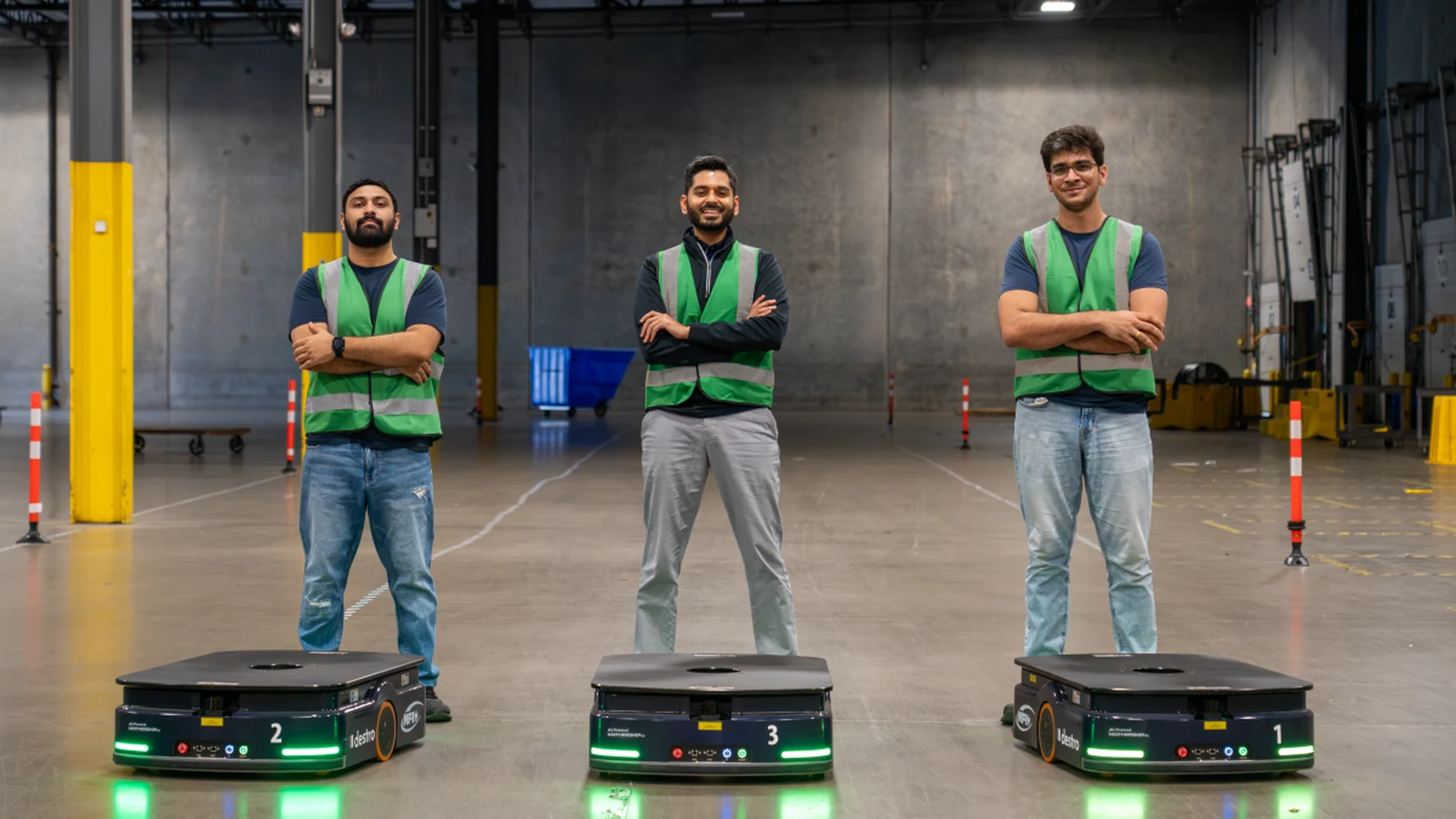
After reviewing the request, the startup agreed to modify its tool to address the cross-dock space. Destro subsequently launched a pilot program at a Yusen facility located in the Pacific Northwest, deploying three cart-moving robots built by Miva Robotics and controlled by Destro's Vision operating system, which is powered by open-weight vision-language-action models.
Orchestrating Humans and Machines
In the deployed workflow, human workers unload goods from incoming trucks into different carts, while autonomous robots locate full loads and transport them to their destinations. Both the human personnel and the robotic carts are coordinated by Destro's Mothership operating system.
"We make that operation less labor intensive, and we get away from the paper. Everything is now systematic," Brunelle explained, noting that other prominent robot startups previously evaluated by Yusen could not successfully integrate into their specific operational workflow.
Following the initial Pacific Northwest pilot, Destro is expanding its deployment to a full fleet of 26 robots and initiating a secondary pilot involving 17 robots at a Yusen facility in Southern California. Pawar intends to replicate this cross-dock loading workflow across thousands of additional warehouses handling similar labor requirements.
Future Outlook and Industry Position
While Destro focuses on software orchestration, the company acknowledges potential challenges involving workflows requiring advanced dexterity and physical manipulation, areas where generic robot bodies and open-source models remain limited. Nevertheless, Pawar remains confident that his firm occupies the most valuable layer of the technology stack.
"Robots are a platform. Every layer model is a platform. But we build a harness around it. That harness is just so complex and value-added that without that harness, these workflows are completely impossible, right?" Pawar noted.
Destro is scheduled to showcase its software platform at TechCrunch Disrupt. Attendees can see the company in person at the event alongside other early-stage ventures participating in the Startup Battlefield.
Sources
- TechCrunchDestro AI’s secret sauce is getting robots and humans on the same page