
Automating Amazon Textract Adapter Lifecycle Management
A structured approach to managing Amazon Textract adapters across environments helps organizations transition from proof-of-concept document processing workflows to secure, scalable production deployments.
 Radwan AbdulhadiEditor and technology writer
Introduction to Amazon Textract Custom Adapters
Organizations frequently automate document processing workflows such as mortgage application intake, invoice parsing, insurance claim handling, and identity verification to eliminate manual data entry. Amazon Textract is a fully managed machine learning service that automatically extracts text, handwriting, layout elements, and structured data from scanned documents. To learn more about the service fundamentals, review the official documentation on Amazon Textract.
While baseline extraction handles many standard formats, organizations often encounter unique layouts or domain-specific terminologies that require fine-tuning. For these specialized use cases, developers utilize the Amazon Textract Custom Queries documentation to extend pre-trained deep learning models into modular components tailored for specific form versions.
Core Operational Challenges in Production
Transitioning document extraction workloads from initial proof-of-concept stages to full-scale production environments introduces several operational obstacles. The first major hurdle involves adapter promotion, which dictates how trained adapters move securely across different AWS accounts. Without proper automation, transferring these components relies on manual request workflows.
Furthermore, enterprise systems typically process multiple form versions simultaneously. Because the underlying processing APIs accept a single adapter per page per feature type, engineering teams must deploy upstream routing mechanisms. These upstream routines correctly direct incoming documents to the matching adapter before extraction takes place.
Document Processing Pipeline Architecture
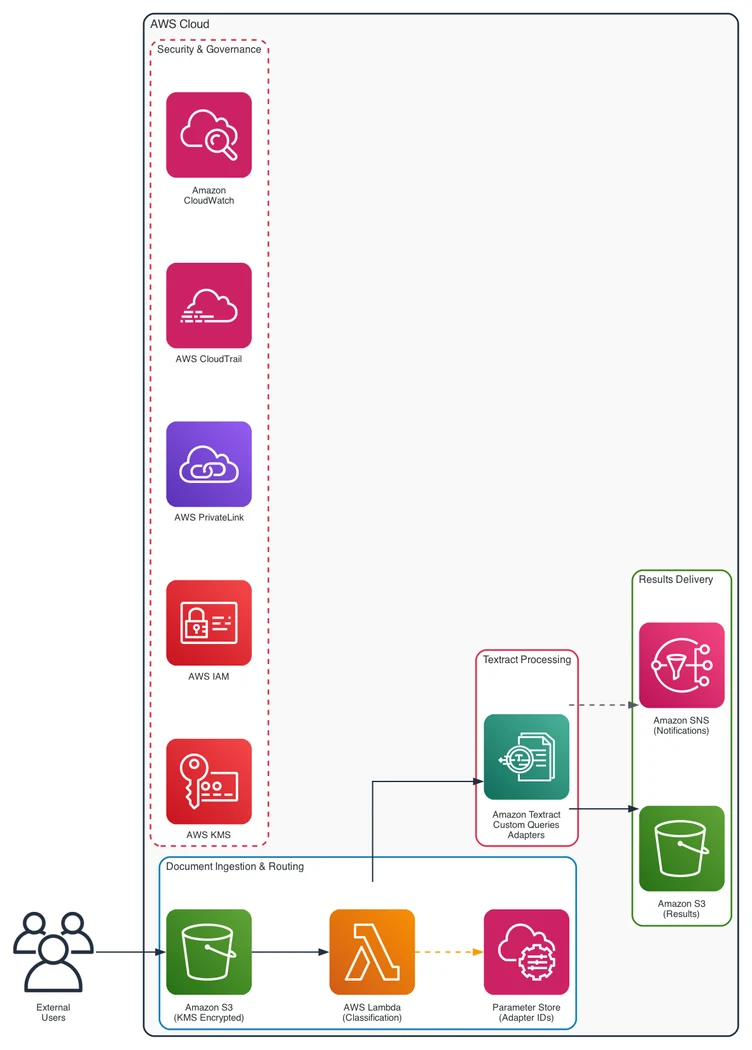
To solve multi-version challenges, developers can implement a multi-stage document processing pipeline that cleanly separates document classification, adapter selection, and data extraction. Ingested documents arrive in encrypted storage buckets, where lightweight text detection routines scan for specific titles, field labels, or version identifiers.
Once the document version is identified, the processing pipeline retrieves the appropriate adapter identifier dynamically. By leveraging operational parameter storage rather than hardcoding references into application code, engineering teams can update production adapter references instantly. This externalization strategy ensures zero downtime and removes the need for full application redeployments when updating model weights.
Infrastructure as Code and Automation
Operationalizing these pipelines effectively requires repeatable infrastructure templates and deployment scripts. Organizations can provision required resources using infrastructure as code frameworks. Available resources include an official CloudFormation template alongside a modular Terraform configuration to accelerate deployment across multi-account environments.
In addition to infrastructure definitions, teams can utilize automated scripts such as the create-adapter.sh utility file to streamline initialization workflows. These automation scripts align with standard command-line interfaces to simplify the setup of custom adapters across development and staging environments.
Multi-Environment Lifecycle Stages
A robust adapter lifecycle typically spans four logical environments to guarantee stability before production release. These stages begin with a training environment dedicated to adapter creation and annotation, followed by a validation environment focused on regression testing against diverse document sets.
The subsequent pre-production phase enables integration testing with downstream enterprise systems and performance benchmarking. Finally, the production environment handles live document processing workloads under strict operational controls. Depending on organizational maturity, teams can map these distinct stages to separate AWS accounts or isolate them using resource tags within a single account.
Security and Compliance Controls
Regulated industries handling sensitive documents must enforce rigorous security measures throughout their machine learning pipelines. Production deployments require network isolation via virtual private cloud endpoints, encryption at rest using customer-managed keys, and comprehensive audit logging.
Applying principle-of-least-privilege permissions through identity and access management policies ensures that downstream systems only access required document types. Furthermore, tracking service limits and operational quotas helps maintain reliable throughput. Developers can consult the official documentation on Amazon Textract quotas to understand service boundaries and scale applications safely.
Sources
- AWS Machine Learning BlogAutomating Amazon Textract adapter lifecycle management across accounts