Build Self-Improving Document Processing With Amazon Bedrock AgentCore
A new architectural guide outlines how organizations can deploy multi-agent document processing workflows that learn from new document formats without manual template configuration.
 Radwan AbdulhadiEditor and technology writer
The Challenge of Rule-Based Document Processing
According to IDC research, document-related challenges cost organizations $19,732 for each information worker annually while reducing productivity by 21.3 percent. Enterprises that receive invoices, purchase orders, insurance claims, and loan applications from hundreds of distinct suppliers routinely encounter layouts that vary widely by issuer and change without prior notice.
Furthermore, staff members can spend up to 30 percent of their time on manual document-related tasks, while traditional manual data entry error rates range from 1–4 percent. Conventional intelligent document processing systems attempt to alleviate this administrative burden, but they demand extensive upfront configuration for every unique format and typically break when document layouts vary across vendors.
Introducing Agentic Intelligent Document Processing
To counter template rigidity and the scaling burden of rule-based pipelines, developers can leverage Amazon Bedrock AgentCore to build self-improving workflows. Amazon Bedrock AgentCore serves as a comprehensive platform designed to build, connect, and optimize AI agents at scale using any preferred framework or model. By adopting an agentic approach, systems analyze incoming documents, generate precise extraction instructions, validate results, and automatically learn from corrections.
Over time, the system constructs a robust knowledge base of various document formats, allowing subsequent files of the same type to proceed straight to data extraction without requiring manual intervention or retraining.
Multi-Agent Orchestration and Workflows
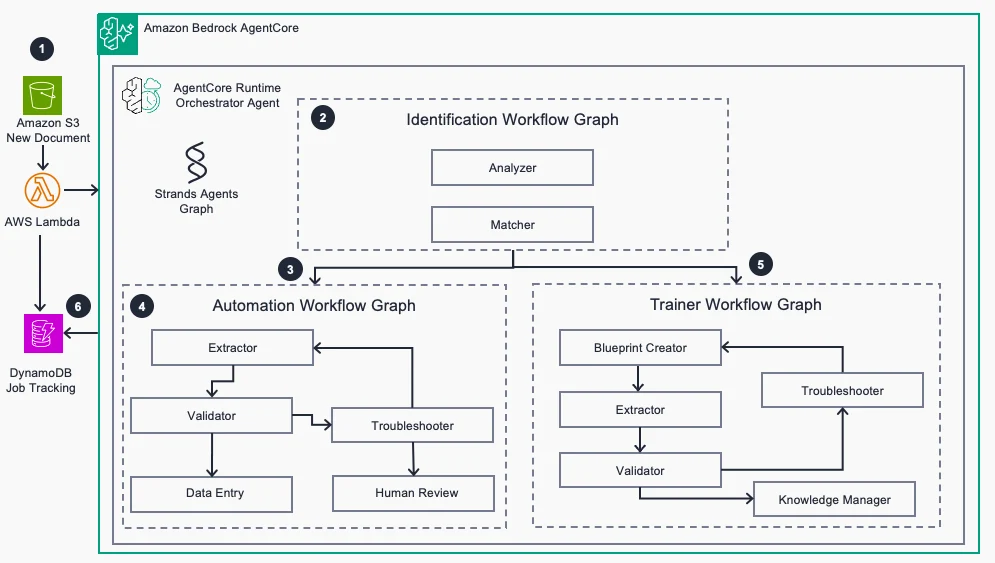
The reference architecture relies on eight specialized agents collaborating across two distinct graph-based workflows. These workflows are built using Strands Agents, an open-source software development kit designed specifically for creating artificial intelligence agents.
In the initial identification workflow, the Analyzer agent extracts text using Amazon Textract and identifies the document type along with its sender. Following this, the Matcher agent searches for similar prior documents using vector similarity.
When a document matches a known format, an automation workflow directs the Extractor agent to utilize existing instructions. If a completely new document format arrives, a separate training workflow triggers the Instructions agent to generate prompts, the Extractor agent to parse structured data, and the Validator agent to check the results against schemas and business rules.
Infrastructure and AWS Services Integration
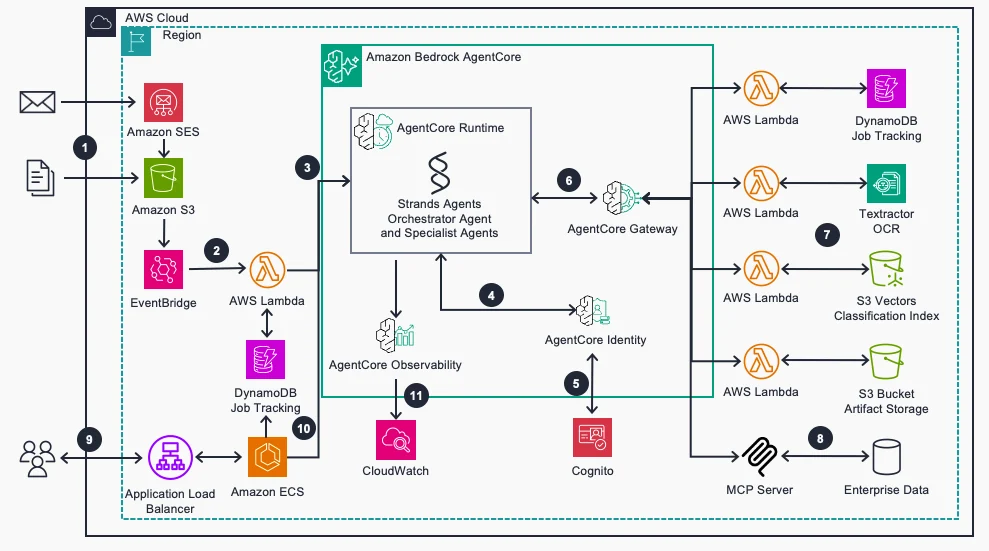
The underlying technical infrastructure integrates multiple cloud services to ensure secure, scalable execution. Business documents arrive either through Amazon Simple Email Service or via direct uploads into Amazon Simple Storage Service.
An Amazon EventBridge event then triggers an AWS Lambda function that establishes a tracking job and invokes the runtime capabilities of the platform.
Data storage and validation leverage modern cloud-native databases. Vector embeddings are stored using vector capabilities, while business validation rules operate against robust database services.
Deployment and Verification Steps
Deploying the complete solution infrastructure and web user interface to an AWS account typically takes between 15 and 20 minutes. Prerequisites include access to Amazon Bedrock with specified models enabled, Docker, and the AWS Cloud Development Kit v2.
Administrators can clone the repository from the AWS Machine Learning Blog guidance, set up a virtual environment, and execute the deployment script with their designated administrator email address.
Once the CloudFormation stacks finish creating successfully, administrators receive an email containing a CloudFront URL and temporary login credentials to access the orchestrator dashboard.
Sources
- AWS Machine Learning BlogBuild self-improving document processing using Amazon Bedrock AgentCore
Continue chronologically

Related entity coverage
Related stories
Migrating Multi-Model AI Agents to Amazon Bedrock AgentCore
AWS introduces a streamlined path to migrate multi-model AI agents from self-managed ECS to Amazon Bedrock AgentCore, reducing operational complexity.
AWS Details AI-Powered Contract Intelligence Platform Architecture
Learn how an AWS reference architecture uses AI agents, dual-model verification, and Amazon Quick analytics to solve portfolio-wide vendor contract challenges.
Bayer Builds Agentic Decision Engine on Amazon Bedrock AgentCore
Bayer Crop Science has developed the Agentic Decision Engine using Amazon Bedrock AgentCore and AWS Unified Operations to streamline plant breeding analytics.
Building Trust in AI Agents With Amazon Bedrock AgentCore
Discover a nine-stage production evaluation framework built on Amazon Bedrock AgentCore to catch silent AI agent regressions.