
AWS Details AI-Powered Contract Intelligence Platform Architecture
A recently shared AWS architecture tackles the limitations of standard RAG chat tools by combining AI agents, structured database storage, and embedded analytics for vendor contract portfolios.
 Radwan AbdulhadiEditor and technology writer
The Scaling Challenge of Vendor Contracts
Managing hundreds or thousands of vendor contracts presents a significant operational hurdle for organizations. Documents containing critical details such as expiration dates, signing statuses, and total values are frequently locked away inside lengthy PDF files. Teams often rely on manual data extraction or standard Retrieval-Augmented Generation (RAG) chat tools to query this information. While RAG works well for isolated, single-document queries, it falls short when users ask portfolio-wide questions that require aggregating data across an entire document repository.
According to the AWS Machine Learning Blog, semantic search mechanisms used in standard RAG split text into chunks and only retrieve the top results relevant to a specific query. Consequently, asking aggregate questions like total portfolio exposure or upcoming renewals fails because the system never processes the entire dataset simultaneously. To address this limitation, a different architectural approach is required to convert unstructured PDF documents into structured, queryable data.
Structured Extraction Versus Retrieval
The core of the architecture shifts the focus from better retrieval to structured extraction. By pulling key contract fields into a database, organizations can leverage traditional analytics tools to perform mathematical operations, counts, and comparisons across the portfolio. Meanwhile, original documents remain accessible in a knowledge base for targeted, single-document inquiries.
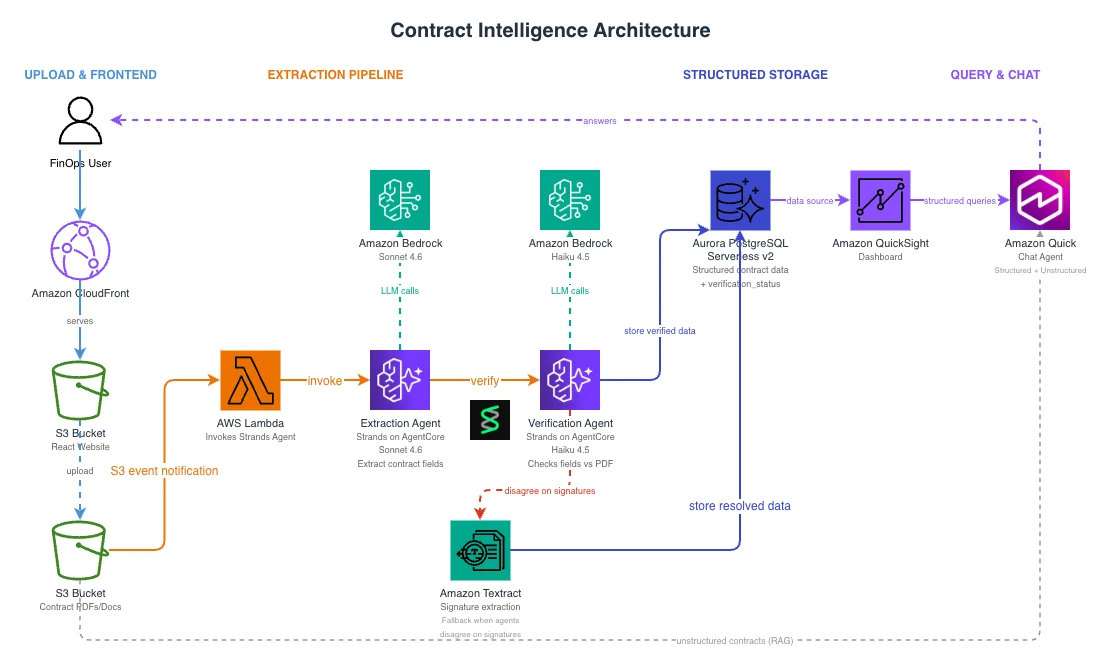
This setup allows a React-based web application on AWS to ingest contract PDFs via an Amazon Simple Storage Service (Amazon S3) bucket. Once a document is uploaded, an automated processing pipeline triggers immediately, providing real-time status updates over WebSocket and preparing the extracted fields for user interaction.
Dual-Model Verification and Agent Infrastructure
To ensure data accuracy, the platform uses two independent foundation models for extraction and verification. The extraction agent reads the full PDF to gather key fields, while a separate verification agent independently checks the results. If the two models disagree on signature detection, Amazon Textract provides a deterministic tiebreaker using computer vision capabilities.
These autonomous agents are constructed using the open-source Strands Agent SDK and run on serverless infrastructure managed by Amazon Bedrock AgentCore. Developers can reference the official Amazon Bedrock AgentCore documentation for details on setting up serverless hosting, automatic scaling, and session isolation. Security and data governance are enforced using Cedar-based rules, which can be reviewed in the Policy in Amazon Bedrock AgentCore guidelines.
Analytics and Embedded Dashboards
Once verified by the automated pipeline, structured contract data is securely stored in Amazon Aurora PostgreSQL. This database serves as the foundation for answering aggregate queries and complex portfolio questions. Users can explore metrics and review contract details directly through embedded dashboards and natural language chat agents.
Organizations looking to implement similar visualization layers can consult resources such as the Amazon Quick Sight Embedding SDK to integrate analytics directly into their web applications. Additionally, developers can review regional model availability via Supported models by AWS Region and check pricing details on the Amazon Quick Pricing page before deploying production workloads.
Sources
- AWS Machine Learning BlogBuilding an AI-powered contract intelligence platform with Amazon Quick and Amazon Bedrock AgentCore