
EXL Cuts Medical Claims Review Time Using AI on AWS
A new AI-powered intelligent document processing solution from EXL is transforming the insurance sector by automating the analysis of voluminous medical records.
 Radwan AbdulhadiEditor and technology writer
The Challenge of Medical Claims Adjudication
For insurance adjusters and underwriters, the process of reviewing medical records is both labor-intensive and highly complex. Medical records are frequently hundreds of pages long and arrive in a wide array of formats, ranging from emergency room visits and diagnostic tests to psychiatric evaluations and operative reports. According to recent data from the [AWS Machine Learning Blog](https://aws.amazon.com/blogs/machine-learning/reducing-medical-claims-review-time-with-ai-on-aws-the-exl-medical-idp-solution/), adjusters typically spend more than 100 minutes per case manually reviewing these unstructured documents. This process is prone to human error and inconsistency, which can lead to delayed settlements and suboptimal customer experiences.
An Intelligent Document Processing Pipeline
To modernize this workflow, [EXL](https://www.exlservice.com/) has deployed a robust AI-powered Medical intelligent document processing (IDP) solution hosted on AWS. The system utilizes a dual-application approach designed to handle both document ingestion and deep medical reasoning. The first component, Xtrakto.AI, manages the ingestion and classification of documents. Utilizing computer vision and agentic AI workflows, it extracts structured data without the need for pre-configured templates, effectively bridging the gap between raw, unstructured medical text and actionable data.
Domain-Specific Intelligence with Large Language Models
The second layer of the solution relies on the EXL Insurance LLM, which has been fine-tuned on nine years of historical insurance and medical claims data. By incorporating clinical terminology, ICD and CPT coding, and complex diagnosis-treatment relationships, the model is capable of performing deep reasoning and providing traceability that general-purpose models often lack. EXL utilizes [Amazon SageMaker AI](https://aws.amazon.com/sagemaker/ai/) to host this domain-specific model, providing the necessary environment for multi-GPU fine-tuning and scalable real-time inference.
Architectural Integration on AWS
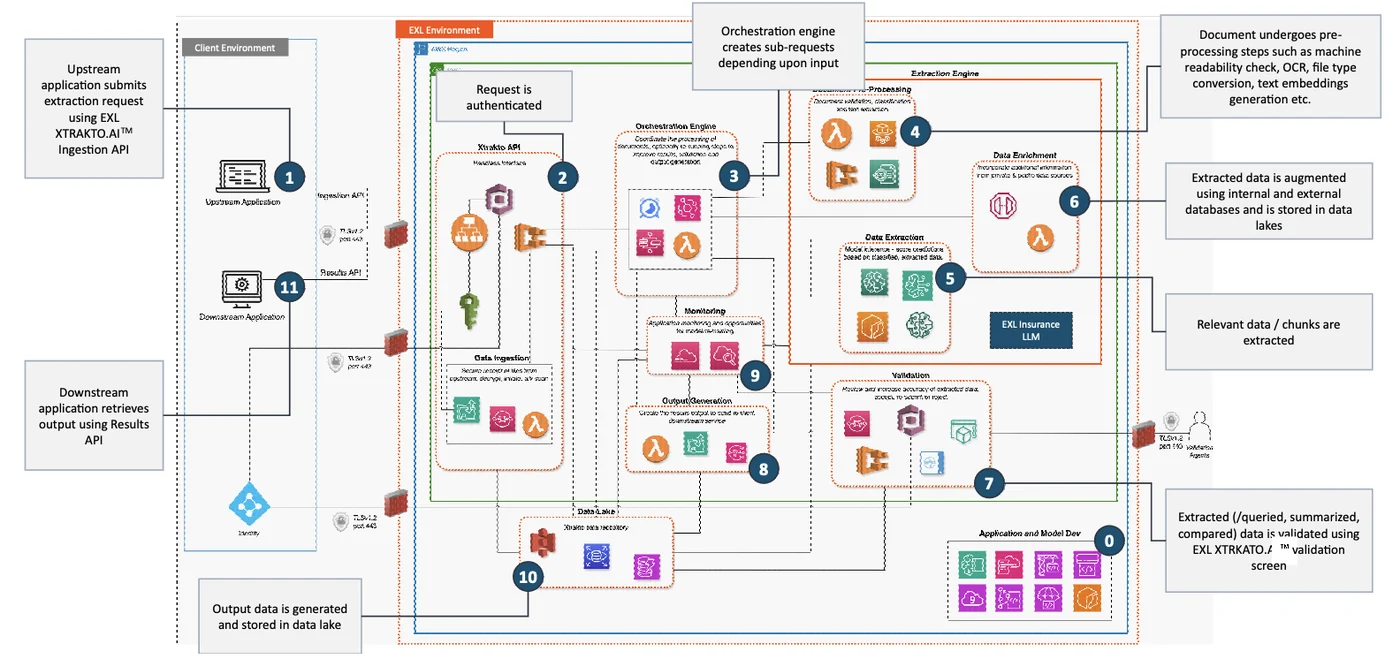
The solution is built on a comprehensive AWS architecture designed to manage security and throughput at an enterprise scale. Following ingestion through [Amazon API Gateway](https://aws.amazon.com/api-gateway/), requests are authenticated via [Amazon Cognito](https://aws.amazon.com/cognito/). The orchestration of these complex workflows is managed by [AWS Step Functions](https://aws.amazon.com/step-functions/), which routes tasks through various services, including [Amazon Textract](https://aws.amazon.com/textract/) for OCR and document preprocessing, and [AWS Lambda](https://aws.amazon.com/lambda/) for executing specific processing functions.
Leveraging Hybrid Model Capabilities
A key strategic advantage of the EXL platform is its ability to integrate [Amazon Bedrock](https://aws.amazon.com/bedrock/) alongside its proprietary Insurance LLM. While the custom model handles insurance-specific reasoning and validation, Amazon Bedrock provides on-demand access to broader foundation models for general language tasks. This allows the system to remain highly efficient without the overhead of managing infrastructure for every model type. The entire architecture, supported by [Amazon DynamoDB](https://aws.amazon.com/dynamodb/) for enrichment and data storage, allows EXL to provide measurable outcomes for insurance providers, ensuring that sensitive protected health information is handled within secure, monitored environments.
Sources
- AWS Machine Learning BlogReducing medical claims review time with AI on AWS: The EXL Medical IDP solution