
Windows Task Manager Creator Releases Modern TMOG Tool
Three decades after developing the iconic Windows utility, Dave Plummer has returned with a new project called TMOG. The tool, which runs on macOS, Windows, and Linux, leverages AI to streamline system diagnostics.
 Radwan AbdulhadiEditor and technology writer
A New Chapter for a Legacy Developer
For many users, the command Ctrl+Shift+Esc is a muscle-memory response to system sluggishness. That keyboard shortcut triggers the Task Manager, a tool famously written by Dave Plummer over thirty years ago. Now, Plummer is revisiting his foundational work with the launch of TMOG, or Task Manager OG. As noted by [Engadget](https://www.engadget.com/2262039/vibe-coded-modern-task-manager-runs-on-mac-and-linux/), this new iteration arrives significantly later than the original software, which first shipped with Windows NT 4.0 in August 1996.
Unlike the original tool, which was built during the nascent stages of modern [Microsoft](https://www.engadget.com/category/microsoft/) operating systems, TMOG is designed to function across multiple platforms. It is currently in beta, with support for macOS, Windows, and Linux, allowing users to monitor their systems regardless of their environment.
The Rise of 'Vibe Coding'
The development process for TMOG represents a modern shift in software engineering. Plummer described his approach by [Taking on X last month](https://x.com/davepl1968/status/2091562472323056070), where he detailed how he utilized [Claude Code](https://www.engadget.com/ai/anthropic-brings-claude-code-to-ios-and-the-web-180023611.html) to build the application. This method, often referred to as [vibe code](https://www.engadget.com/2247892/what-is-vibe-coding-explained/), involves using AI assistance to write code, which Plummer credits for the app's rapid development cycle.
Rather than relying on generic prompts, Plummer created a 107-page specification sheet to guide the AI. He explained that simply telling an AI to 'write a task manager' would yield poor results. By providing structured documentation, the development team managed to create a functional app in under six weeks—a task that historically would have required a much larger investment of time and resources.
Native Performance and Feature Depth
While the project was accelerated by AI, the resulting software is not a simplistic web-wrapper. Under the hood, TMOG uses native code for each operating system: Swift and AppKit for macOS, Direct2D for Windows, and Qt 6 for Linux. These platform-specific implementations all interact with a shared C++ core, ensuring consistency across all three versions of the software.
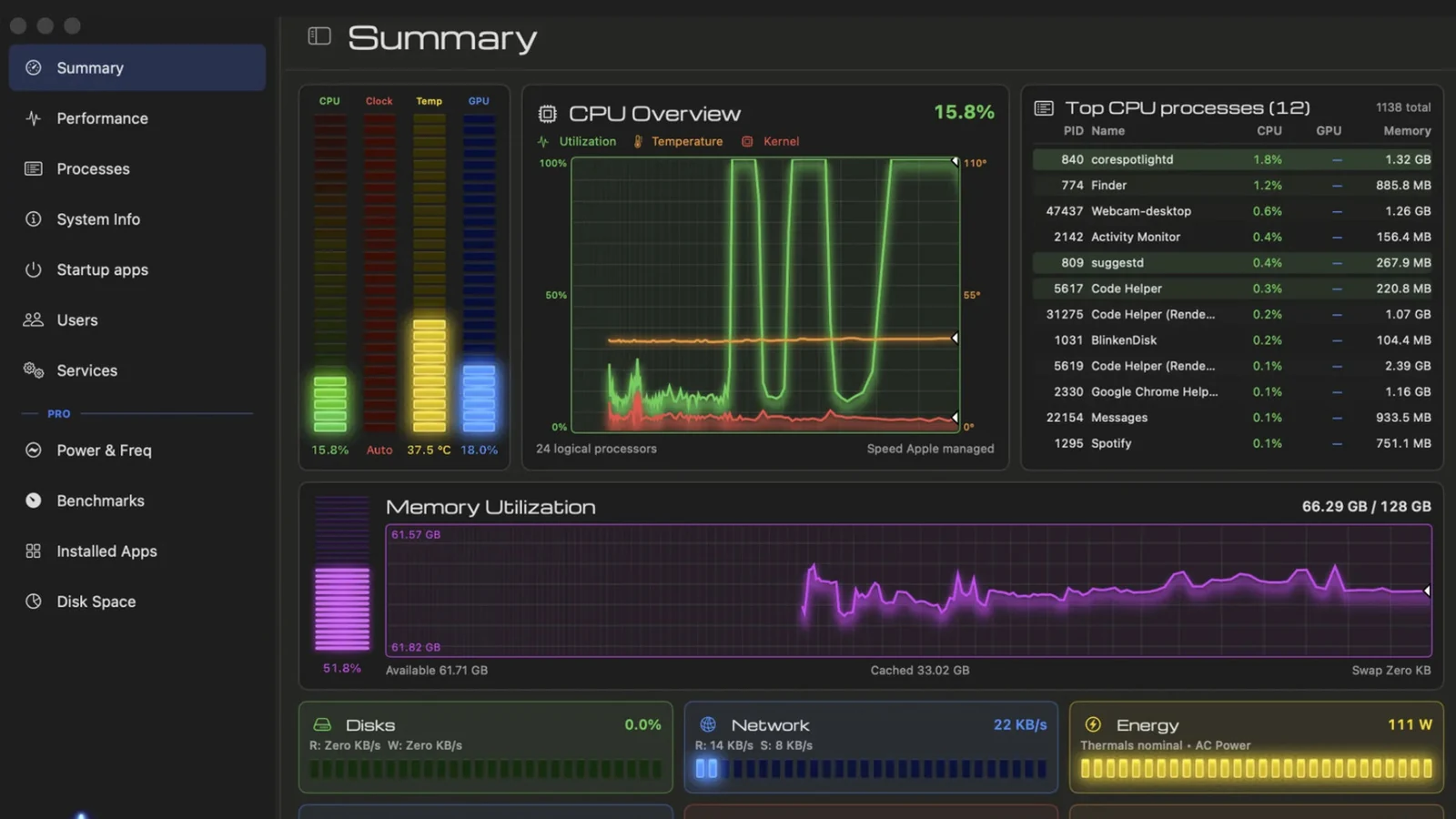
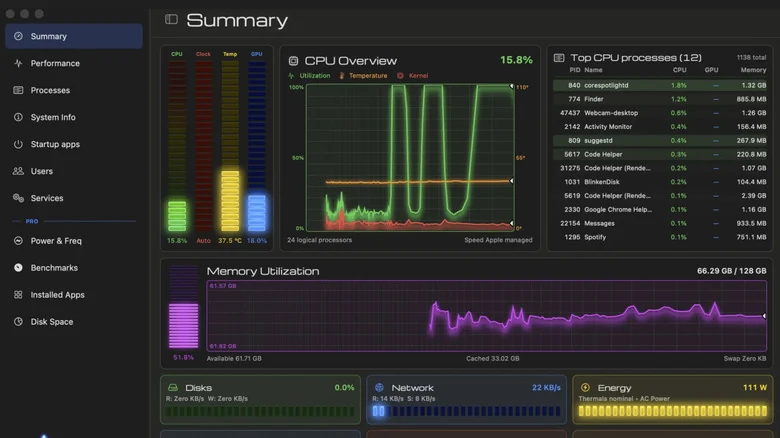
TMOG provides a comprehensive suite of 12 distinct views in a single window. These include a summary dashboard, startup app management, power and frequency monitoring, and disk space benchmarks. Notably, the status meters refresh at 60Hz, providing a much smoother visual representation of system health than the one-second refresh rate of traditional task managers. Furthermore, users can identify the contribution of efficiency cores through color-coded indicators.
Addressing Diagnostic Limitations
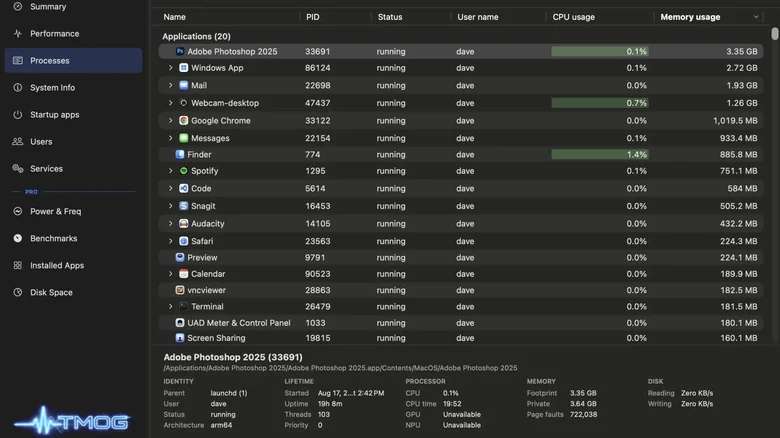
Plummer’s primary motivation for the project is to simplify diagnostics for everyday users. He argues that the standard built-in tools often obscure why a computer slows down, sometimes providing misleading information regarding CPU usage or failing to explain spikes from background processes. TMOG aims to resolve this by offering a more transparent history of machine activity, allowing users to trace performance issues directly to specific processes.
For those seeking even more granular detail, a 'Pro' tier is available for $39.95. This version includes a 'Flight Recorder' that allows users to record system activity and scrub back through historical data to identify the cause of slowdowns or system events after they occur. Because of restrictive sandboxing policies, this Pro version is sold directly through Plummer's [Dave Plummer, TMOG.org](https://tmog.org/) site rather than through official app stores.
Looking Ahead
The project is currently in a beta phase, with ongoing updates to refine functionality and address user-reported bugs. While the Pro tier offers advanced features for power users, the free version of TMOG provides robust system and process monitoring with no expiration date. Interested users can download the application directly from the developer's website without needing to create an account, marking a new chapter in the history of one of computing’s most essential tools.
Sources
- EngadgetThe creator of Windows Task Manager has 'vibe coded' a new version that runs on macOS and Linux