
Researchers Develop Whiskers for Tactile Drone Navigation
Researchers at the Delft University of Technology have developed a bio-inspired tactile navigation system that allows tiny drones to map and traverse environments using touch. This innovation overcomes common limitations of cameras and LiDAR in low-visibility conditions.
 Radwan AbdulhadiEditor and technology writer
Bio-Inspired Tactile Sensing
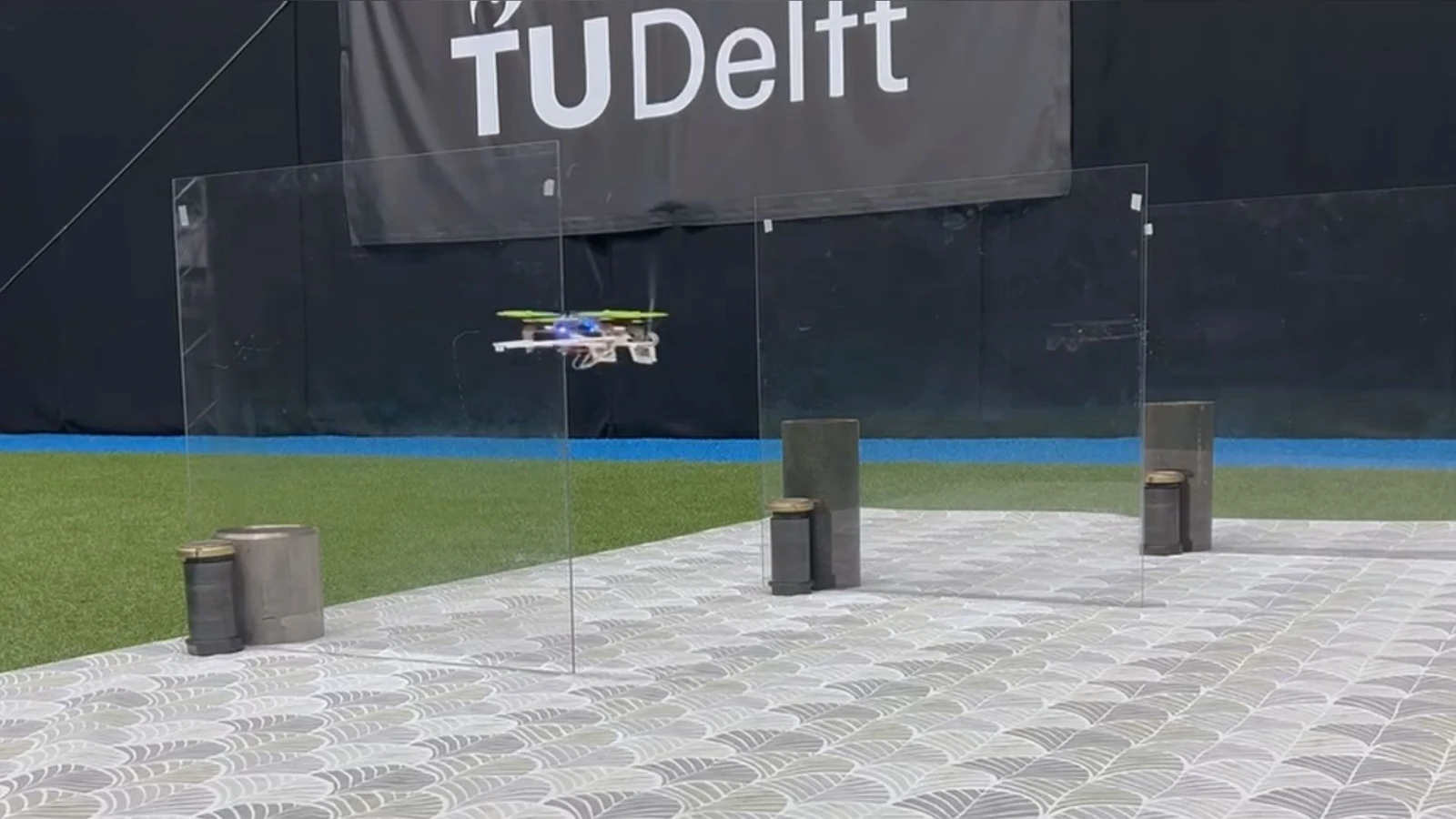
A team of researchers from the [Delft University of Technology](https://www.tudelft.nl/en/2026/lr/bio-inspired-whiskers-enable-tiny-drones-to-navigate-in-darkness-using-touch) has introduced a novel approach to autonomous flight. By integrating physical whiskers onto tiny aerial vehicles, the researchers have enabled a new method of tactile navigation that allows robots to "feel" their way through challenging environments. Unlike standard optical cameras or LiDAR systems, which often struggle in poor lighting, smoke, or dense dust, this tactile approach remains reliable where visual sensors fail.
The project addresses a significant hurdle in robotics: the difficulty of equipping sub-100 gram drones with sophisticated navigation hardware. Because these smaller platforms have strict limitations regarding power, weight, and computational capacity, traditional sensor suites are often impractical. The researchers turned to nature for a solution, specifically emulating the vibrissae found on rodents, which use whiskers to navigate tight, dark spaces with high precision.
Technical Implementation and Hardware
The tactile hardware consists of two whiskers positioned at the front of the drone, angled upwards. Each whisker is connected to three miniature pressure sensors located at the base. When the whisker makes contact with an object, the resulting pressure changes are recorded, allowing the drone to estimate its relative position and depth. According to [Tom's Hardware](https://www.tomshardware.com/tech-industry/drones/researchers-build-a-drone-that-navigates-with-physical-whiskers-to-operate-in-dark-dusty-or-smoky-places-where-cameras-or-gps-can-fail-sub-100-gram-drones-run-34kb-software-to-enable-sub-millimeter-precision), this system allows the drone to map surrounding surfaces, avoid obstacles, and actively follow paths through unknown areas.
Dr. Salua Hamaza, an Associate Professor of Aerial Physical Interaction and Embodied Intelligence, explained that the primary goal was to introduce rich tactile sensing not for manipulation, but for exploration. The team focused on ensuring the system remained lightweight and low-power, confirming that tactile navigation is a viable alternative for autonomous drones that cannot carry heavy computing stacks.
Efficient Onboard Processing
One of the primary challenges identified by the team was atmospheric turbulence. Since airflow can cause unintended movement in the whiskers, the researchers developed a sophisticated real-time processing pipeline. This software is capable of distinguishing between background turbulence and legitimate surface contact, effectively filtering out noise to maintain sub-millimeter accuracy.
Remarkably, the software required to power this perception pipeline occupies only 34 kilobytes of memory. Researcher Chaoxiang Ye highlighted that the project demonstrates that advanced tactile perception does not necessitate high computational costs. By running the entire system onboard using such a small footprint, the drone can respond to environmental cues in real time without straining its power source.
Future Applications in Search and Rescue
While this system is not designed to replace high-speed [drones](https://www.tomshardware.com/tech-industry/drones/wireless-ota-charging-with-lasers-could-keep-drones-airborne-indefinitely-improved-receiver-converts-at-38-49-percent-efficiency-and-uses-nanocrystalline-material-for-thermals) that rely on traditional sensors for rapid transit, its value lies in specialized low-visibility applications. The development team envisions these tactile-equipped robots being deployed in search-and-rescue operations. In scenarios where structures have collapsed, these drones could traverse rubble and interior spaces where cameras would be blinded by dust or darkness, providing critical visibility into areas too dangerous for humans or larger rescue dogs.
Sources
- Tom's HardwareResearchers build a drone that navigates with physical whiskers to operate in dark, dusty or smoky places where cameras or GPS can fail — sub-100 gram drones run 34KB software to enable sub-millimeter precision