IBM Research Introduces Palette to Train Small Open-Weight Models for Slide Deck Generation
IBM Research introduces Palette, a specialized training and inference pipeline designed to teach small open-weight models how to construct professional slide decks that adhere to custom design languages and corporate templates.
 Radwan AbdulhadiEditor and technology writer
The Limitations of Frontier Models in Presentation Generation
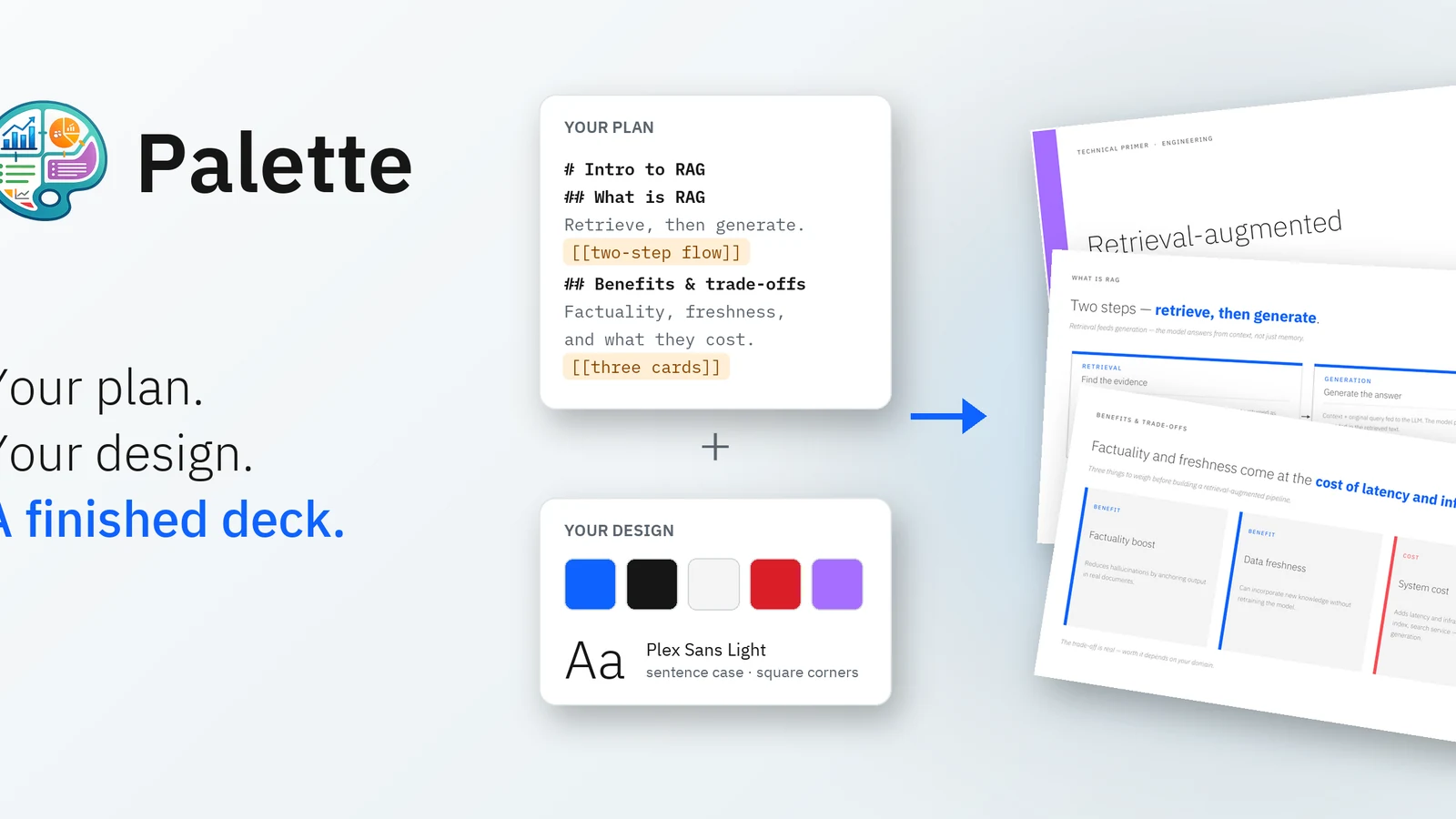
When users request slide decks from frontier artificial intelligence systems, the generated files frequently share a uniform aesthetic that reflects the default house style of the model rather than a specific brand identity. While these default outputs are often visually polished, they can drift away from custom corporate templates and fail to meet strict confidentiality requirements that prevent internal data from leaving local systems. To address these limitations, researchers often look toward self-hosted open-weight models that offer complete data ownership and operational control. However, smaller open models historically struggle with the complex arithmetic and spatial reasoning required to construct presentations, frequently producing overlapping shapes, unreadable titles, and text that runs off the edges of slides. According to the <a href="https://huggingface.co/blog/ibm-research/palette-deck-building">Hugging Face Blog</a>, IBM Research designed Palette to test whether a small open-weight model trained on synthetic data and supported by an automated validation harness can match the performance of larger systems.
Simulating Human Workflows Through Designer and Coder Roles
Creating presentations requires simultaneous management of editorial judgment, such as deciding what content to summarize or convert into charts, and geometric precision, such as positioning elements using specific coordinates and font sizes. Because single-pass generation often leads to layout failures, Palette divides the slide-building process into two distinct roles handled by a single LoRA adapter. In the first stage, the designer component reads the content plan and generates a structured JSON brief detailing the color palette, typography system, slide layouts, exact text content, and concise design rationales. In the second stage, the coder component processes individual slide specifications to write the underlying <a href="https://gitbrent.github.io/PptxGenJS/">pptxgenjs</a> JavaScript code required to draw each element. By separating editorial decisions from geometric execution, the framework allows the system to generate slide code in parallel, significantly accelerating the coding stage while ensuring consistent adherence to the <a href="https://www.ibm.com/design/language/resources/">IBM Design Language</a>.
Synthetic Data Generation and Counterfactual Reasoning
Because a comprehensive public corpus mapping raw source materials directly to design decisions and underlying slide code does not exist, IBM Research utilized a large open teacher model to synthesize approximately 1,000 training decks covering roughly 10,000 individual slides. These synthetic examples incorporate explicit counterfactual reasoning traces that explain why alternative layouts or formatting choices were rejected, helping the model internalize underlying design rules rather than just memorizing final visual outputs. Furthermore, every generated training deck was systematically rendered and evaluated by the same automated checking tool utilized during inference. When the checker identified layout errors such as text overflow or element collisions, the associated slides were repaired and the corresponding reasoning traces were updated to reflect the correction, turning every detected mistake into an improved training example for subsequent fine-tuning experiments.
Directives and Inference Harness Validation
To grant users finer control over specific aesthetic and structural choices without abandoning automated generation, Palette introduces a directive system that accepts short natural language instructions embedded directly within the content plan using double brackets. These directives allow operators to request alternative visualizations, such as transforming a standard data table into a structured timeline or modifying cover color schemes. Once the model processes the plan and produces the slide code, the output passes through an inference harness rather than returning directly to the user. The harness inspects every slide for potential visual defects, applies rule-based fixes to correct malformed elements or color codes, and ensures that the final presentation meets technical standards before it is finalized and delivered.
Evaluation and Performance on Benchmark Datasets
Following training and optimization, IBM Research evaluated the fine-tuned model using <a href="https://huggingface.co/datasets/PresentBench/PresentBench">PresentBench</a>, a benchmark designed to measure presentation generation capabilities. According to the published evaluation metrics, the Palette-trained model ranked first in two out of the three measured domains. The development demonstrates that smaller, self-hosted models can achieve competitive performance in specialized document creation tasks when paired with structured multi-stage reasoning frameworks, synthetic training methodologies, and automated post-processing validation harnesses.
Sources
- Hugging Face BlogPalette: teaching a small model to build decks in your design language
Continue chronologically


Related stories
IBM Granite Time-Series Models Gain Ensemble Forecasting
IBM Research introduces ensemble forecasting for Granite time-series models, combining four complementary architectures with no retraining required.

ALTK-Evolve Tops τ²-Bench Customer Service Tasks
Discover how IBM Research's ALTK-Evolve uses learned memory and GPT-4.1 to top the τ²-bench customer service leaderboard without frontier models.
NVIDIA and AI4Bharat Launch Indic Pretraining Corpus
NVIDIA and IIT Madras lab AI4Bharat introduce Nemotron-pretraining-Indic-v1, featuring 2.8 trillion tokens and an open data generation pipeline.
Swiss AI Initiative Releases Apertus 1.5 with Multimodal Capabilities
The Swiss AI Initiative has officially launched Apertus 1.5, introducing native image and audio understanding, a thinking mode, and a 262k context window.