Swiss AI Initiative Releases Apertus 1.5 with Multimodal Capabilities
The Swiss AI Initiative has expanded its open-weight language models with the release of Apertus 1.5, bringing native multimodal understanding, an optional reasoning mode, and significantly increased context length.
 Radwan AbdulhadiEditor and technology writer
Introduction and Release Overview
The Swiss AI Initiative has announced the official launch of Apertus 1.5, a major update that significantly expands the capabilities of the original 8B and 70B Apertus 1.0 models. The updated 8B and 70B model weights were released to Hugging Face on July 24, 2026, under an Apache 2.0 license, making advanced open-weight technology accessible to developers and researchers worldwide. Further technical documentation and insights can be explored through the official Technical Report.
This latest release builds upon the foundational architecture of the first generation by incorporating continuous pretraining. Specifically, the initiative added 4 trillion tokens of text and multimodal training data to the 8B model and 2 trillion tokens to the 70B model, bringing their total token counts to 19 trillion and 17 trillion, respectively. True to the ethos of every Apertus release, the models maintain a commitment to openness, featuring open weights, open data, open values, and fully transparent training details.
Native Multimodal Understanding and Architecture
Apertus 1.5 introduces native multimodal understanding, allowing the models to accept images and audio alongside traditional text input. This capability seamlessly integrates documents, diagrams, and photographs directly into conversations. While the models can also process spoken language, developers note that this specific feature remains experimental. Unlike systems that rely on separate vision encoders, the v1.5 models introduce multimodality using an early-fusion approach.
Under this early-fusion methodology, images and audio enter the Apertus architecture as discrete tokens within the exact same sequence as text tokens. Images are tokenized using the Emu3.5 tokenizer, where a standard 512×512 image translates into 1,024 tokens. Similarly, audio is processed via WavTokenizer at a rate of 40 tokens per second. Because the development team only extended the vocabulary rather than altering the core architecture, training runs at standard text-only speeds while successfully processing diverse input modalities.
Advanced Training Stages and Pretraining Data
The development of Apertus 1.5 involved four distinct pretraining stages starting from the baseline Apertus 1.0 architecture. The process began with an unpaired stage incorporating text, standalone images, and audio to help the model learn the new modalities. This was followed by a paired stage utilizing image-caption and audio-transcript pairs to align the non-text data with natural language. A subsequent cooldown stage introduced higher-quality data enriched with mathematics and programming code.
The final pretraining phase focused on expanding the context window step-by-step from 8,000 tokens all the way up to 262,144 tokens—representing a fourfold increase over the original Apertus 1.0 window. Throughout these phases, more than half of the training tokens remained strictly text-only, effectively preserving the core language proficiencies established in the previous generation. The updated text corpus was refreshed using high-quality sources such as FineWeb2-HQ+, FinePDFs, and Nemotron-CC.
Reasoning, Tool Use, and Post-Training
Post-training for Apertus 1.5 was executed across five sequential stages designed to optimize chat quality, safety, and reasoning. These included supervised fine-tuning (SFT), long-context SFT, reinforcement learning (RL), direct preference optimization (DPO), and charter alignment via self-distillation (SDPO). Furthermore, the models feature an optional thinking mode that can be activated to allow the system to reason extensively about inputs before delivering an answer, yielding notable performance improvements on complex problem-solving benchmarks.
In addition to enhanced reasoning, Apertus 1.5 delivers improved instruction-following and advanced tool integration. The models are specially trained to interact more effectively with external tools and APIs, supported by execution-verified trajectories in the training data. The team also incorporated Reinforcement Learning with Verifiable Rewards (RLVR) across approximately 350,000 prompts spanning mathematics, code generation, and multilingual tasks, while releasing relevant preference pools and training pairs to the public.
Comprehensive Benchmarking and Evaluation
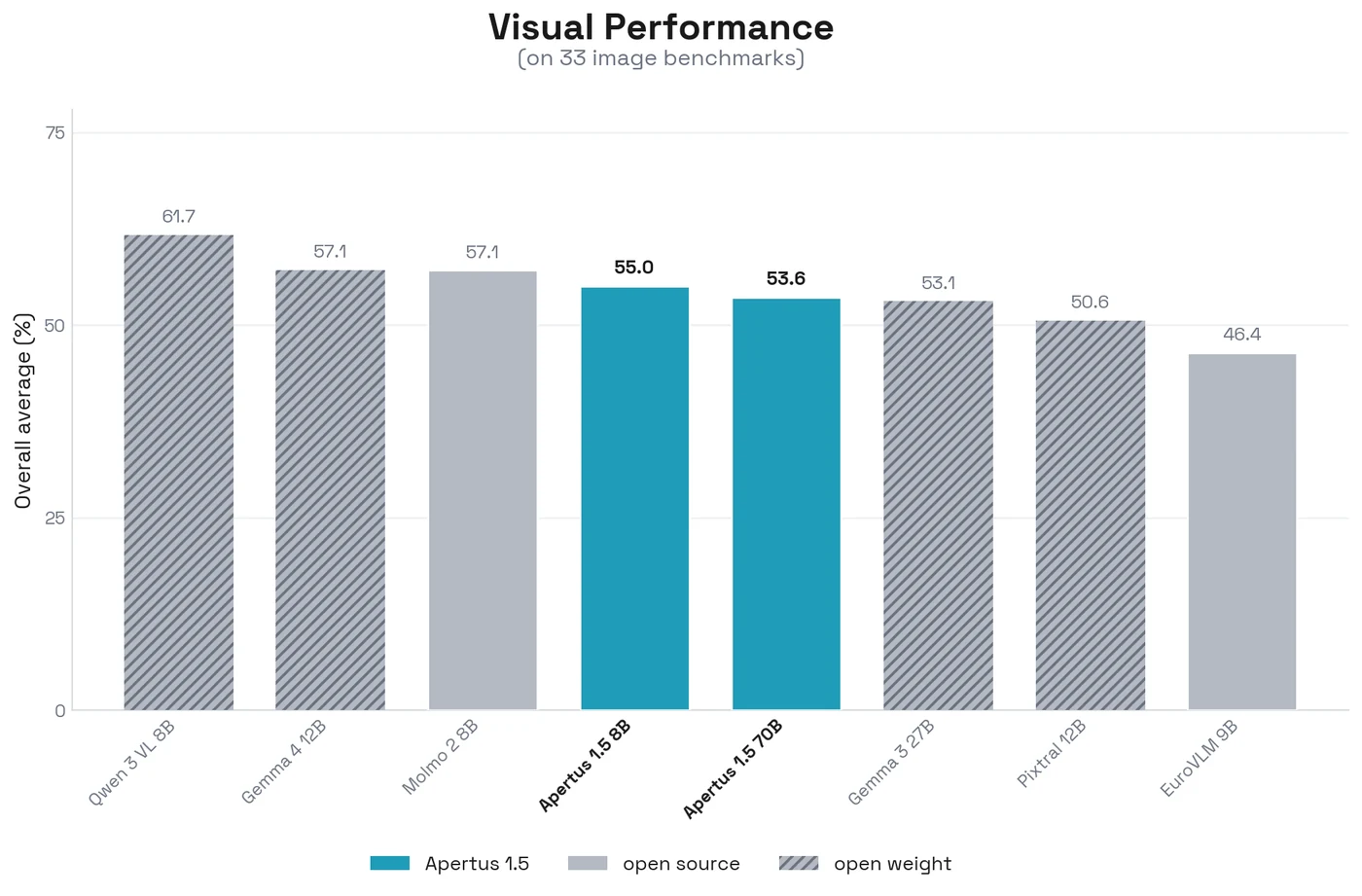
To rigorously assess the new capabilities of Apertus 1.5, the initiative significantly expanded its evaluation scope beyond the text-based benchmarks used for Apertus 1.0. The updated assessment framework incorporates multimodal evaluations for images and audio using the MLLM-eval-suite pipeline, which merges the lmms-eval and VLMEvalKit frameworks. Additional benchmarks focus on translation, multilingual proficiency, safety, and tool utilization.
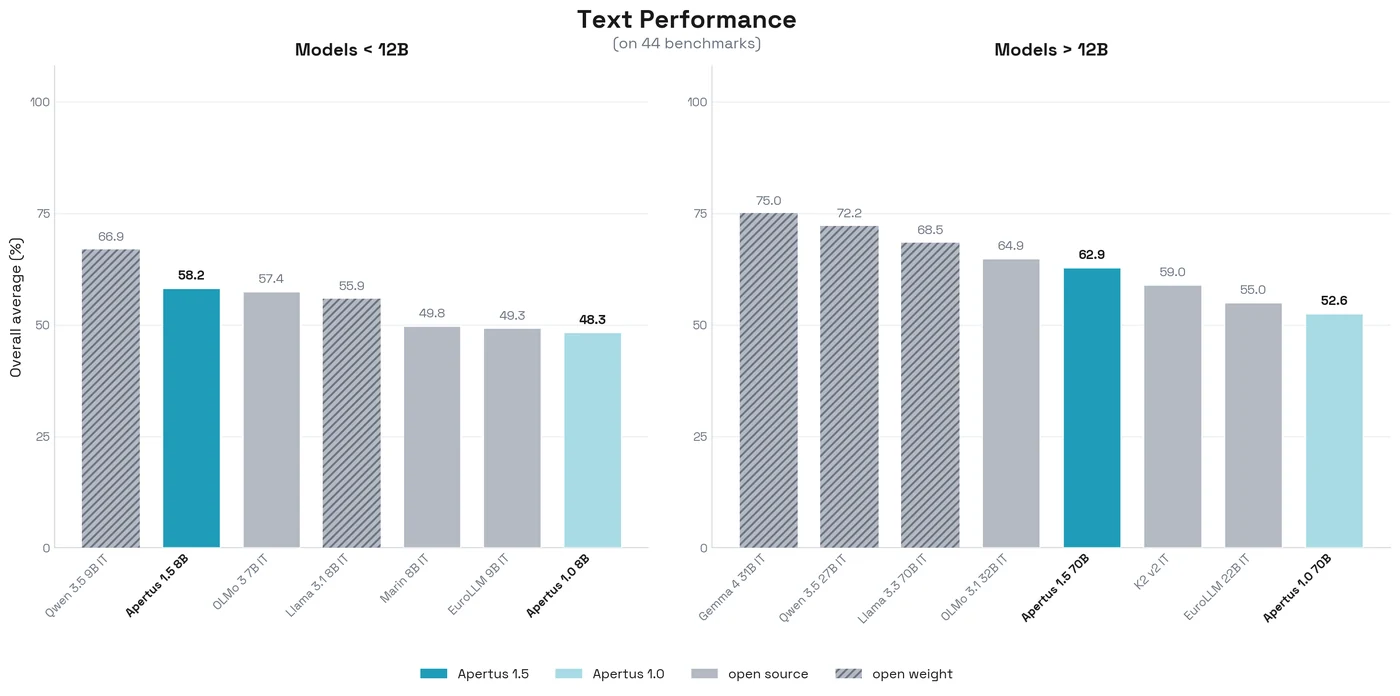
Performance evaluations indicate that Apertus 1.5 8B outperforms similarly sized open-weight models on instruction-following and multilingual tasks, while delivering competitive spatial understanding and document comprehension. Furthermore, the model demonstrates strong capabilities in specialized domains such as Swiss Legal tasks, matching leading open-weight alternatives, and exhibits machine translation performance on par with larger models on the Last Translation Benchmark.
Transparent Reporting and Governance
Apertus continues its commitment to transparency by collaborating with the EvalEval Coalition to publish fully reproducible benchmarking results. The project reports its findings using the Every Eval Ever (EEE) schema, a shared data format that records generation settings, runner details, access methods, and metric interpretations. This structured evaluation reporting provides clarity that is frequently absent from standard industry leaderboards.
By aligning evaluation cards with emerging AI governance requirements—including frameworks like the EU AI Act and the GPAI Code of Practice—the Apertus 1.5 release sets a benchmark for responsible AI development. Alongside the open weights, the initiative regularly publishes public summaries of training content and documentation to ensure complete clarity regarding model values and operational principles.
Sources
- Hugging Face BlogApertus 1.5 Release Notes
Continue chronologically


Related stories
CWE-bench v2 Launches With 100 Tasks to Test AI Cyber Capabilities
CWE-bench v2 has been released by Collinear AI, offering a public set of 100 tasks designed to evaluate frontier AI models on security workflows.
Liquid AI Unveils LFM3 Multimodal Model Family
Liquid AI introduces LFM3, a new generation of multimodal foundation models spanning text, vision, audio, omni, and decision capabilities on a 2B backbone.
Meta Releases Muse Spark Open Multimodal MoE Model
Meta has introduced Muse Spark Open, an open-weight frontier multimodal mixture-of-experts model featuring 816 billion parameters.
StateBench Released to Test Long-Document State Tracking
A new benchmark evaluates how well language models track changing entity states across long documents, revealing limitations in current architectures.