IBM Granite Time-Series Models Gain Ensemble Forecasting
IBM Research has introduced a new ensemble forecasting approach for Granite time-series models, combining four complementary architectures into a single interface to streamline predictions without the need for retraining.
 Radwan AbdulhadiEditor and technology writer

Streamlining Time-Series Model Selection
Choosing the right pre-trained time-series model can often involve significant guesswork depending on the target dataset, as a model optimized for smooth industrial signals may struggle with noisy retail demand. To address this challenge, IBM Research has released details on the Hugging Face Blog regarding a unified approach that removes the need to select a single architecture in advance. Further details are available from Hugging Face Blog in the original source material.
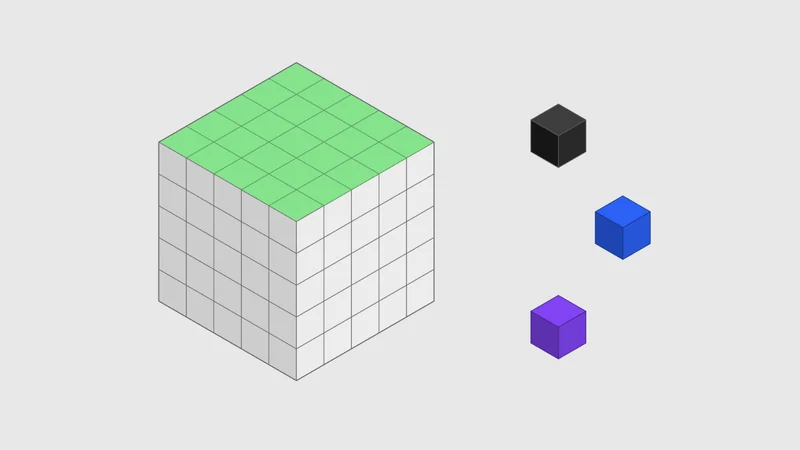
The newly detailed Granite Timeseries Ensemble combines four complementary Granite models through an extensible forecasting interface. Instead of requiring developers to manually evaluate which architecture best suits a specific seasonal horizon or data pattern, the recipe returns both median and quantile forecasts natively. Similar to multi-model approaches used in weather forecasting, the system merges multiple views of future outcomes into a single unified predictive distribution.
Architecture and Runtime Configuration
The default recipe stores the ensemble configuration rather than merged model weights, downloading the four member checkpoints dynamically at runtime. This configuration leverages models designed to capture trends, seasonality, and local variations through distinct structural designs. Developers can easily load and test the recommended recipes directly using Hugging Face infrastructure.
Once executed, the output includes both point forecasts and quantile predictions ranging by default from 0.1 to 0.9. Applications can utilize these probabilistic outputs to construct reliable forecast intervals, such as combining the 0.1 and 0.9 quantiles to achieve a nominal 80% coverage range for future values.
Probabilistic and Inter Quartile Range Recipes
The framework introduces two main recipes for aggregating individual member outputs into a cohesive forecast. The Probabilistic Ensemble serves as the recommended default, employing uniform probability pooling to give every member equal influence without any fitting step or hyperparameter tuning.
Alternatively, the Inter Quartile Range (IQR) Ensemble weights members based on their forecast spread, favoring narrower intervals with greater influence. While IQR weighting adapts weights dynamically per sample and horizon step, the framework incorporates features like temperature settings and weight caps to prevent overconfidence from overly narrow member distributions.
Evaluation Across GIFT-Eval Datasets
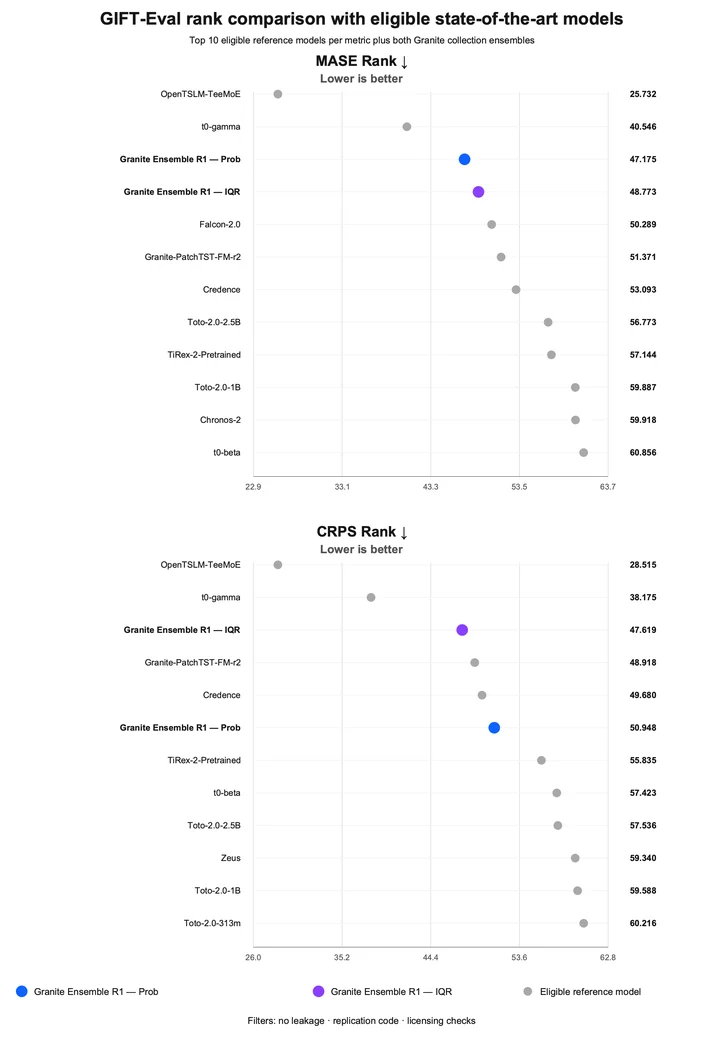
IBM Research evaluated both ensemble recipes across 97 GIFT-Eval dataset configurations without fine-tuning the models or utilizing test targets during aggregation. Results show that both ensemble recipes outperform all four individual constituent models on aggregate Mean Absolute Scaled Error (MASE) and average MASE Rank.
While individual models like PatchTST-FM-r2 retain advantages in specific metrics such as CRPS/MWQL scores, the ensemble approach delivers strong and consistent performance across diverse workloads. Rather than topping every leaderboard benchmark, the primary value of the Granite ensemble lies in its robustness, offering developers a dependable out-of-the-box starting point for complex time-series forecasting tasks.
Sources
- Hugging Face BlogEnsemble forecasting with IBM Granite time-series models
Continue chronologically


Related stories
IBM Research Introduces Palette to Train Small Open-Weight Models for Slide Deck Generation
IBM Research has unveiled Palette, a new approach for fine-tuning small open-weight models to generate custom slide decks following specific corporate design languages.
ALTK-Evolve Tops τ²-Bench Customer Service Tasks
Discover how IBM Research's ALTK-Evolve uses learned memory and GPT-4.1 to top the τ²-bench customer service leaderboard without frontier models.
IBM Announces Granite Speech 5.0 Collection
IBM unveils Granite Speech 5.0, introducing a new speech-language model, a faster multilingual Turbo CTC, and an updated 2B Plus model for enterprise audio.
IBM Granite Switch 4.1 Brings Chat and Speech to One Endpoint
Discover IBM's Granite Switch 4.1, combining chat, general and specialized decisions, and speech-to-text tasks from a single hosted endpoint.