Building Ultra-Low-Latency Voice AI on AWS
Cartesia and AWS are enabling developers to build real-time voice applications using purpose-built State Space Models.
 Radwan AbdulhadiEditor and technology writer
The Challenge of Real-Time Voice Latency
Conversational AI continues to transform how humans interact with technology across virtual assistants, real-time translation, and accessibility tools. Yet, delivering a natural voice experience remains a core challenge in AI infrastructure. Users expect human-like responsiveness, and excess latency can disrupt conversational flow and erode trust. To feel truly natural, AI-generated speech must match the temporal window of human turn-taking.
The demand for real-time voice AI spans contact centers, telehealth, gaming, virtual worlds, accessibility tools, and sales platforms. Traditional transformer-based text-to-speech models often struggle with streaming latency because they process entire sequences before producing output, creating a fundamental trade-off between higher quality and higher latency. To explore broader architectural insights, developers can consult resources provided on the Artificial Intelligence.
Advantages of State Space Models
To resolve the trade-off between latency and quality, State Space Models (SSMs) offer a fundamentally different approach compared to traditional transformers. While transformers utilize attention mechanisms with quadratic computational growth relative to sequence length, SSMs treat sequences as continuously evolving systems. They process data step by step while carrying a compact internal state forward, making them exceptionally well-suited for real-time streaming audio.
Key advantages of SSMs for audio processing include high-quality long-range dependencies, a constant memory footprint, and native streaming support. Unlike transformers that cache all previous tokens, SSMs maintain a fixed-size hidden state. Their recurrent structure processes input token-by-token to support true streaming without requiring architectural modifications.
Sonic and Ink Production Models
Cartesia leverages these SSM advantages within its production voice models. Founded by researchers who pioneered SSM advances, the real-time multimodal intelligence company has built solutions optimized for streaming inference at the edge of human perception. More details about their offerings can be found through Cartesia.
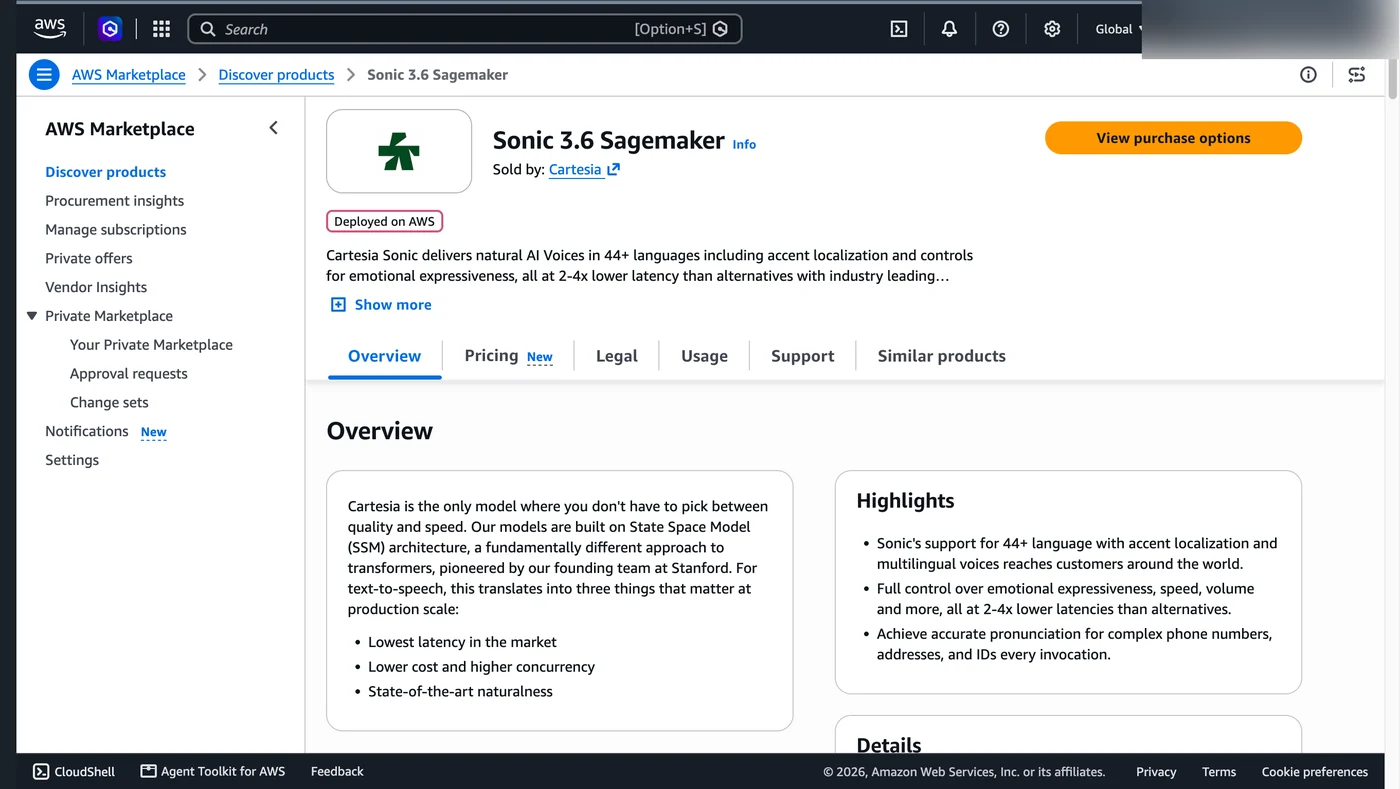
Sonic serves as Cartesia's flagship streaming text-to-speech model, delivering ultra-realistic speech synthesis with first audio bytes arriving in approximately 90 milliseconds. It supports over 44 languages and voice cloning from brief audio samples. Meanwhile, Ink handles streaming speech-to-text with native turn detection, context-aware end pointing, and robust noise handling.
Deployment Patterns on AWS
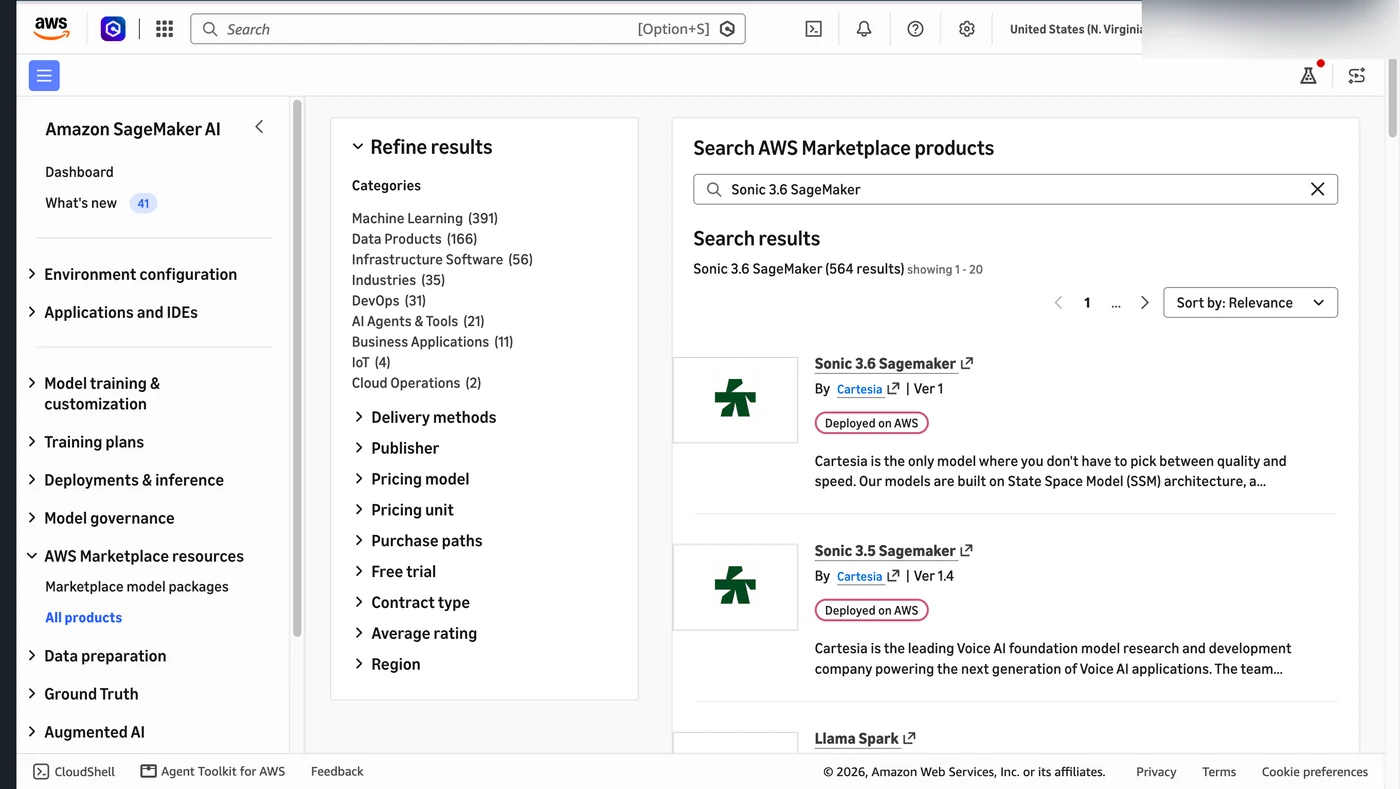
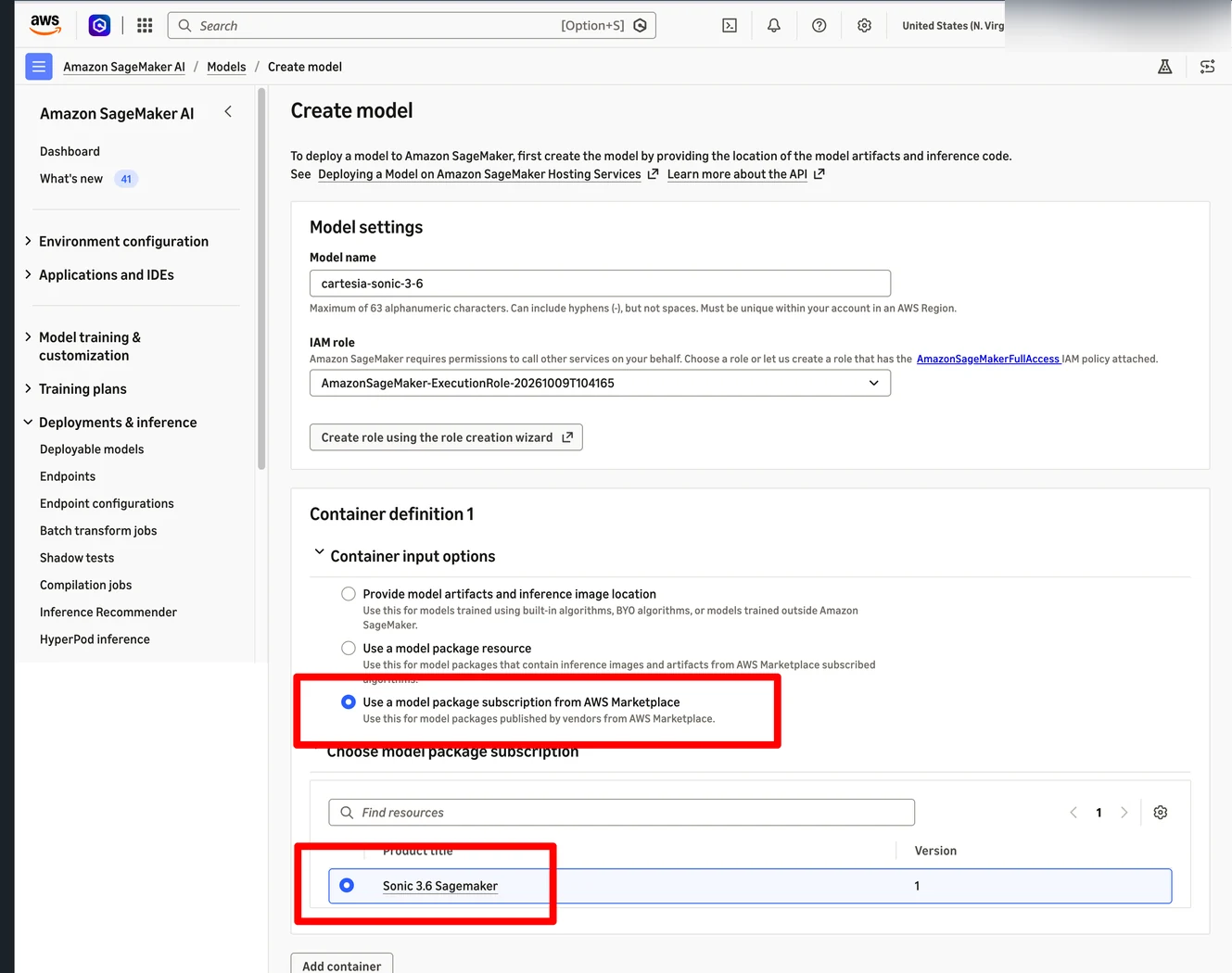
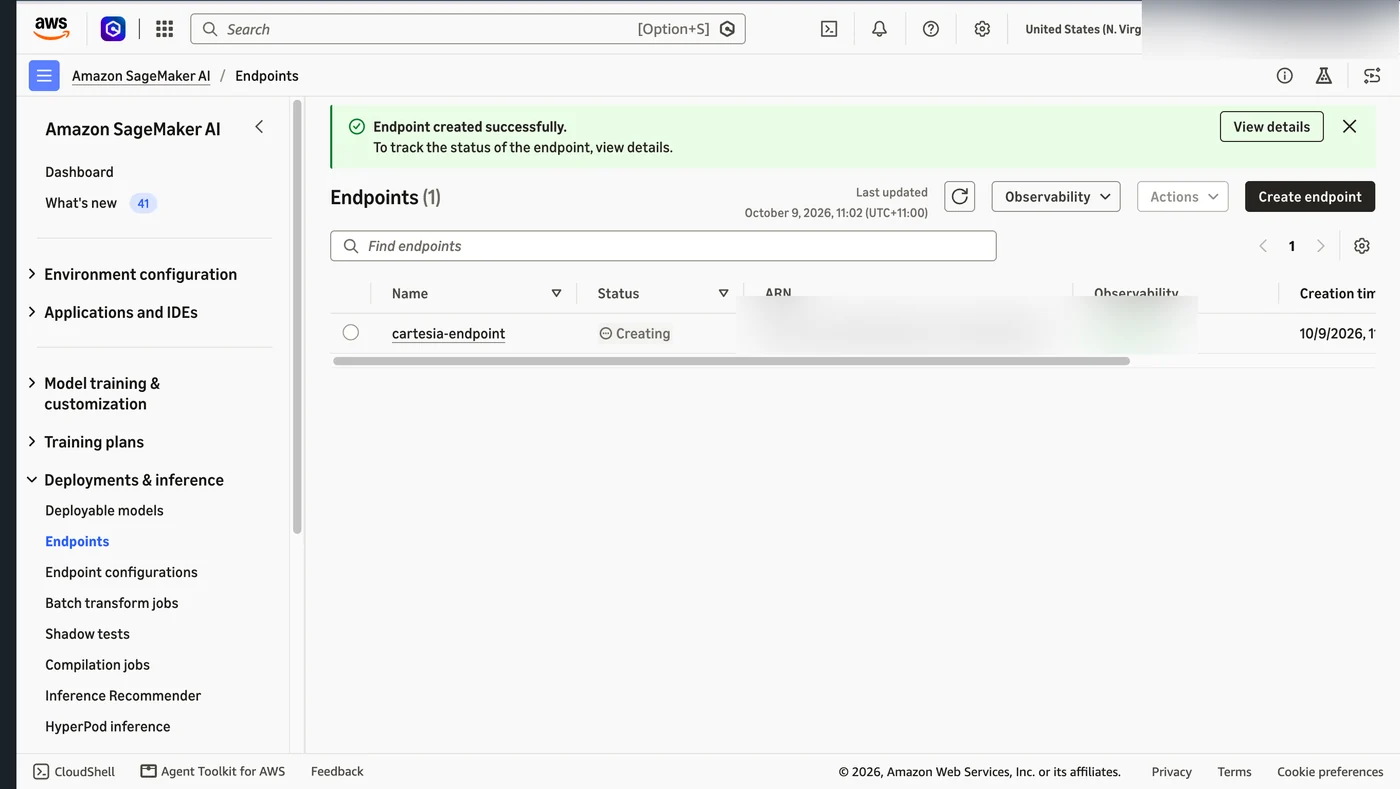
Organizations prioritizing data sovereignty, latency control, and compliance can deploy Cartesia models directly into their private cloud environments. Sonic is delivered as an Amazon SageMaker AI model package through AWS Marketplace, ensuring inference data remains secure within a virtual private cloud.
Teams can implement solutions by following the official Cartesia get-started guide or reviewing operational resources such as the Cartesia Voice AI Platform listing in AWS Marketplace. Additional implementation details and community contributions are accessible via the Cartesia GitHub repository.
Sources
- AWS Machine Learning BlogBuilding ultra-low-latency voice AI applications on AWS
Continue chronologically

Related entity coverage
Related stories
Amazon Payments Boosts Funnel Conversion with AWS AI
Amazon Payments applied multi-objective contextual bandits on Amazon SageMaker AI to personalize acquisition funnels and drive conversion lifts.
Hugging Face Skills Automate SageMaker Model Deployments
Hugging Face and AWS release open-source agent skills, letting coding agents automate production-ready model deployments on Amazon SageMaker AI.
Qlik Builds Grounded Enterprise AI With Amazon Bedrock
Learn how Qlik leverages Amazon Bedrock and a multi-agent architecture to deliver trusted enterprise AI at a global scale for its customers.
Tata Elxsi Builds IRIS Industrial Safety Platform on AWS
Tata Elxsi developed IRIS, a real-time industrial safety platform on AWS, using computer vision to detect workplace risks in seconds.