ALTK-Evolve Tops τ²-Bench Customer Service Tasks
A new approach by IBM Research utilizes learned memory to elevate a basic ReAct agent powered by GPT-4.1 to the top of the τ²-bench retail leaderboard without updating model weights or requiring human annotation.
 Radwan AbdulhadiEditor and technology writer
Reaching the Top Without a Frontier Model
A new research initiative details how learned memory can empower a basic ReAct agent using GPT-4.1 to reach the top of customer service benchmarks. According to the <Hugging Face Blog: https://huggingface.co/blog/ibm-research/altk-evolve-bc>, ALTK-Evolve analyzes training-task attempts to distill successes and failures into concise behavioral rules without updating model weights or utilizing human annotation.
Using this approach, an agent running on stock scaffolding with learned guidelines appended to its system prompt achieves 67.5% Pass^4 on the τ²-bench retail category. This score places it above every retail entry featured in the October 12, 2026 leaderboard snapshot.
Understanding the Playbook Mechanism
The ALTK-Evolve framework builds its operational playbook by closely examining previous agent trajectories on training tasks. The exact same model powers both the guideline extraction process and the active customer service agent, ensuring a streamlined workflow.
Once extracted, guidelines covering crucial tasks like authenticating customers, confirming transactions, or managing returns are added as a plain markdown list following the domain policy. These rules are then applied unchanged on held-out test sets.
Evaluating Benchmark Performance
The τ²-bench benchmark, developed by Sierra, rigorously measures how well an agent navigates real customer service constraints. Each evaluation pairs the agent with an LLM-simulated customer, specific domain tools, and strict written policies. A task is considered successfully solved only when the final database state matches the expected binary reward outcome.
Evaluations track both Mean Accuracy and the strict Pass^4 reliability metric across four independent trials per task. Results demonstrate significant improvements in capability and reliability across both retail and airline domains.
Guidance Configurations and Domain Differences
The research highlights that the optimal amount of guidance varies significantly depending on the target domain. While retail tasks benefit from the full lossless guideline set, airline tasks show greater reliability when using a smaller, high-confidence core of rules with higher support counts.
Mean accuracy climbs notably in both domains, rising by 4.4 points in retail and 7.5 points in airline. Meanwhile, the stricter Pass^4 metric jumps by 10 points in both testing categories.
Token Costs and Conversation Length
Analyzing the operational footprint reveals that improved performance does not result in longer, meandering conversations. In fact, guidelines slightly shorten the average assistant turns per conversation, helping lower end-to-end latency and time-to-completion for customers.
The primary trade-off is an increase in prompt input tokens due to the larger system prompt riding on every LLM call. However, production environments can largely reclaim this overhead using prompt caching, as the guideline block remains identical across calls.
Sources
- Hugging Face BlogALTK-Evolve: How learned memory tops the τ²-bench leaderboard on customer service tasks without a frontier model
Continue chronologically


Related stories
IBM Granite Time-Series Models Gain Ensemble Forecasting
IBM Research introduces ensemble forecasting for Granite time-series models, combining four complementary architectures with no retraining required.

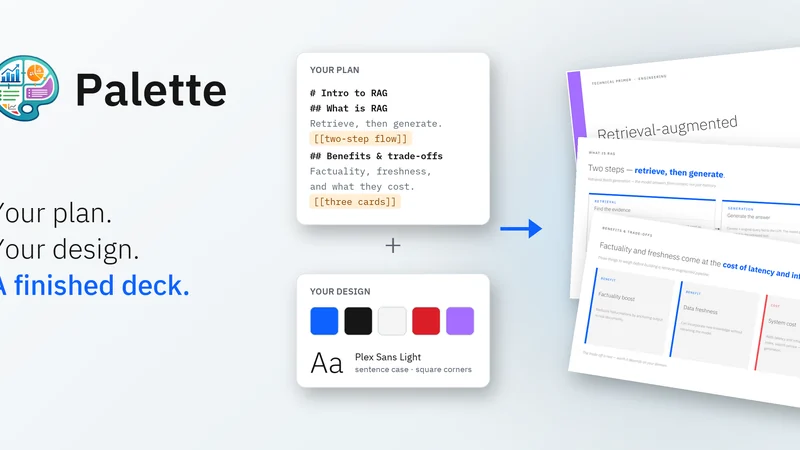
IBM Research Introduces Palette to Train Small Open-Weight Models for Slide Deck Generation
IBM Research has unveiled Palette, a new approach for fine-tuning small open-weight models to generate custom slide decks following specific corporate design languages.
CWE-bench v2 Launches With 100 Tasks to Test AI Cyber Capabilities
CWE-bench v2 has been released by Collinear AI, offering a public set of 100 tasks designed to evaluate frontier AI models on security workflows.
StateBench Released to Test Long-Document State Tracking
A new benchmark evaluates how well language models track changing entity states across long documents, revealing limitations in current architectures.