Intel names Crescent Island GPU D-Series accelerator
Intel has formally introduced the GPU D-Series name for its Crescent Island AI inference accelerator at OCP 2026. The air-cooled PCIe products are designed for high-capacity inference deployments rather than general-purpose graphics workloads.
 Radwan AbdulhadiEditor and technology writer
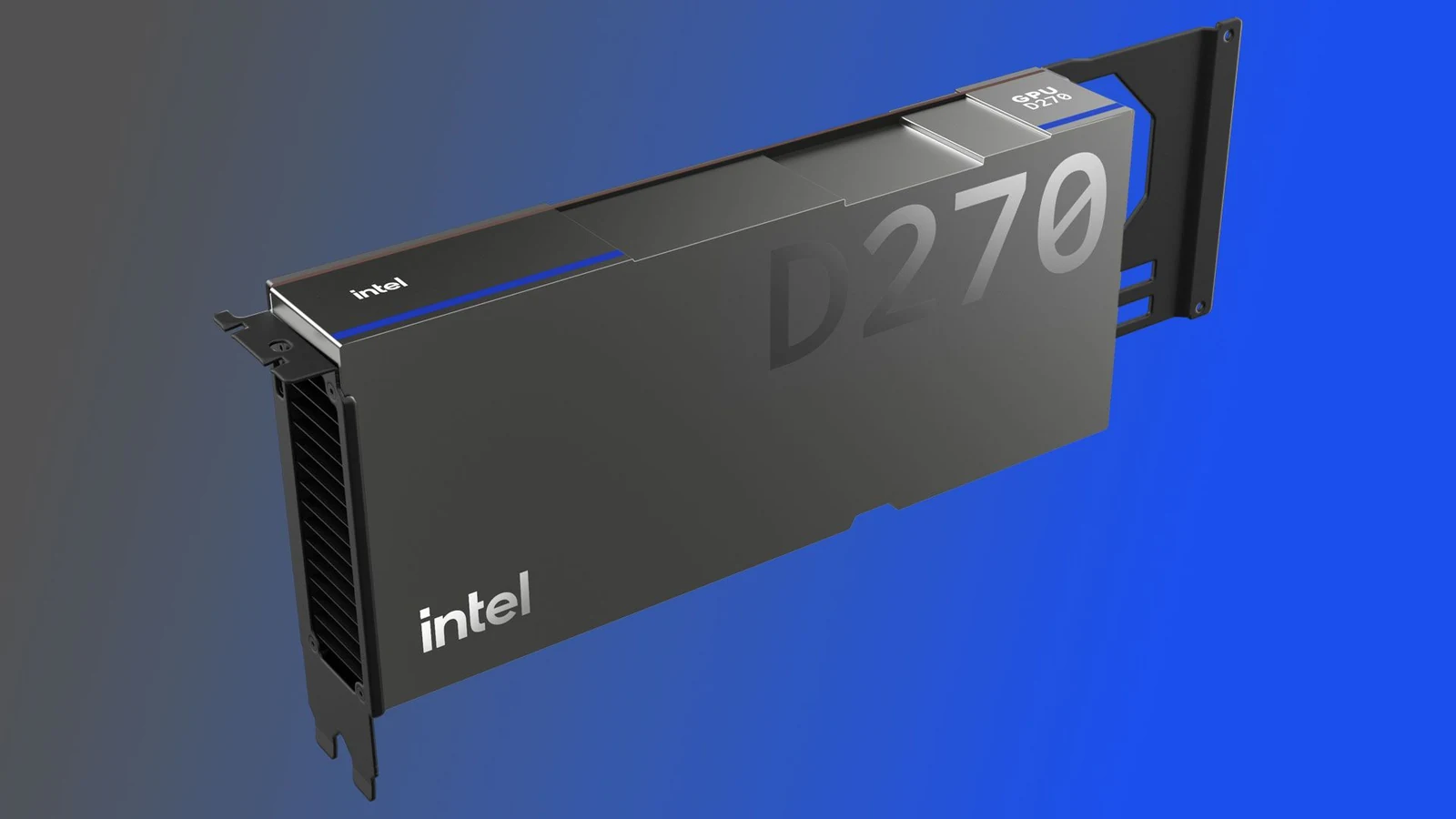
Crescent Island gets its product name
Intel has officially named its Crescent Island AI inference accelerator the GPU D-Series, giving the company’s previously disclosed data-center chip a formal product identity. The announcement, made at OCP 2026, also included performance and memory-bandwidth targets that had not previously been fully disclosed. According to Tom’s Hardware, Intel lists a theoretical peak of 1.3 PFLOPS of FP8 compute and 1.5TB/s of memory bandwidth for the accelerator.
The GPU D-Series is based on Intel’s Xe3P graphics architecture, although the chip is intended primarily for massively parallel computing and inference. Intel’s description places it closer to a specialized AI accelerator than a conventional graphics processor, with most or all graphics-specific functional units absent from the design.
Designed for air-cooled servers
Intel plans to offer GPU D-Series products in an air-cooled PCIe form factor with a 350W thermal design power. Each product can include up to 480GB of LPDDR5X memory, with the memory system providing the stated 1.5TB/s bandwidth. That combination points to a product aimed at expanding model capacity and inference throughput within more conventional data-center infrastructure.
The accelerator is intended for traditional air-cooled rack servers that can scale to eight GPUs, a configuration Intel compares with systems such as Nvidia’s HGX platforms. Intel says that, in such a setup, GPU D-Series products could support inference on models containing more than one trillion parameters. The company also identifies large language models, long-context inference and concurrent inference services as target workloads.
A different performance and infrastructure target
The GPU D-Series occupies a different performance and infrastructure category from Nvidia’s Vera Rubin NVL72 rack-scale system. Tom’s Hardware notes that each of the 72 Rubin GPUs in that system can deliver a theoretical 17.5 PFLOPS of FP8 throughput, while requiring liquid cooling and likely kilowatt-scale total graphics power. Intel’s 350W, air-cooled PCIe approach is instead focused on deployments that can use standard rack-server cooling and power arrangements.
Intel’s stated use cases include multi-tenant AI services, robotics and other latency-sensitive workloads. The company says the accelerator is designed to provide a foundation for long-context and concurrent inference, where multiple services or model requests may need to run at the same time. These claims describe the role Intel expects the product to play, rather than independently verified application performance.
Software will be central to scaling
Supporting distributed inference across multiple accelerators will require a software layer that can coordinate the GPUs as part of a larger system. Intel is highlighting a common Xe software foundation developed for AI workloads across its Xe Cores, including those found in integrated graphics and discrete GPU products. The company presented that shared foundation as part of its effort to bring Xe-based accelerators into data-center deployments.
Customer sampling is underway
Intel says it is working with a broad ecosystem that includes original equipment manufacturers, original design manufacturers, neocloud providers, independent software vendors, appliance providers and AI-native companies. The company also says customer sampling of GPU D-Series products is in progress. However, Intel did not provide details about a broad commercial launch, so availability timing remains undisclosed.
A new attempt at AI accelerator traction
The GPU D-Series represents another attempt by Intel to establish a stronger position in AI acceleration after the Data Center GPU Max family, known by its Ponte Vecchio code name, and subsequent follow-on projects failed to produce sustained momentum. Intel has also made several silicon acquisitions that did not consolidate into a clear AI strategy. The new product’s prospects will depend on whether its performance, memory capacity, software support and conventional cooling requirements appeal to data-center customers.
For now, Intel has disclosed the product name, headline compute and bandwidth figures, physical form factor, power target and intended deployment model. The company has not announced pricing or a broad launch date. Its ongoing customer sampling will provide the next indication of whether GPU D-Series can translate those specifications into wider adoption for inference workloads.
Sources
- Tom's HardwareIntel's Crescent Island AI accelerator officially powers new GPU D-Series products
Continue chronologically


Related entity coverage
Related stories
Software Bridges Open AI Models to Enterprise Systems
Intel executives outline an open software blueprint connecting CPUs, GPUs, and enterprise systems to transition AI models into production applications.

Intel Announces Day-0 Support for Meta Muse Spark Open
Intel announces day-0 support for Meta's 816 billion-parameter Muse Spark Open model across Intel Xeon processors and Intel GPU D-series platforms.

Intel and SAP Demonstrate Physical AI in Autonomous Warehouse
Intel and SAP have collaborated on a proof of concept demonstrating how Physical AI can bridge enterprise IT systems with autonomous warehouse robots.

Intel and Oracle Plan Expanded Collaboration on OCI
Intel and Oracle announce a multiyear collaboration to support enterprise and agentic AI on Oracle Cloud Infrastructure using future Xeon platforms.