Intel Announces Day-0 Support for Meta Muse Spark Open
Intel has enabled day-0 support for Meta’s newly released Muse Spark Open model across Intel Xeon processors and upcoming data center GPU platforms.
 Radwan AbdulhadiEditor and technology writer

Introduction to Meta's Muse Spark Open
Meta has officially released Muse Spark Open, an 816 billion-parameter any-to-text model that stands as a major milestone in multimodal AI and the most capable U.S. open-weights model to date. According to the [Intel Newsroom](https://www.intel.com/content/www/us/en/newsroom/news/artificial-intelligence/intel-offers-day-0-support-for-meta-muse-spark-open.html), deploying an architecture of this scale requires extreme memory efficiency and hardware-level low-precision acceleration. In response, Intel has enabled day-0 support across its hardware ecosystem.
Muse Spark Open is specifically trained for agentic coding workflows, delivering higher first-attempt accuracy, reliable tool calling, and deep codebase understanding. Its 1 million-token context window handles entire projects, legacy codebases, complex dependencies, and thousands of files without requiring tasks to be broken down.
Beyond code generation and debugging, the model supports multimodal understanding spanning audio, video, image, and document comprehension. Designed for agentic use cases, it can plan, act, observe, and self-correct over extended workflows while utilizing computer-use capabilities across diverse operating environments.
Infrastructure Demands and Intel GPU D-Series Support
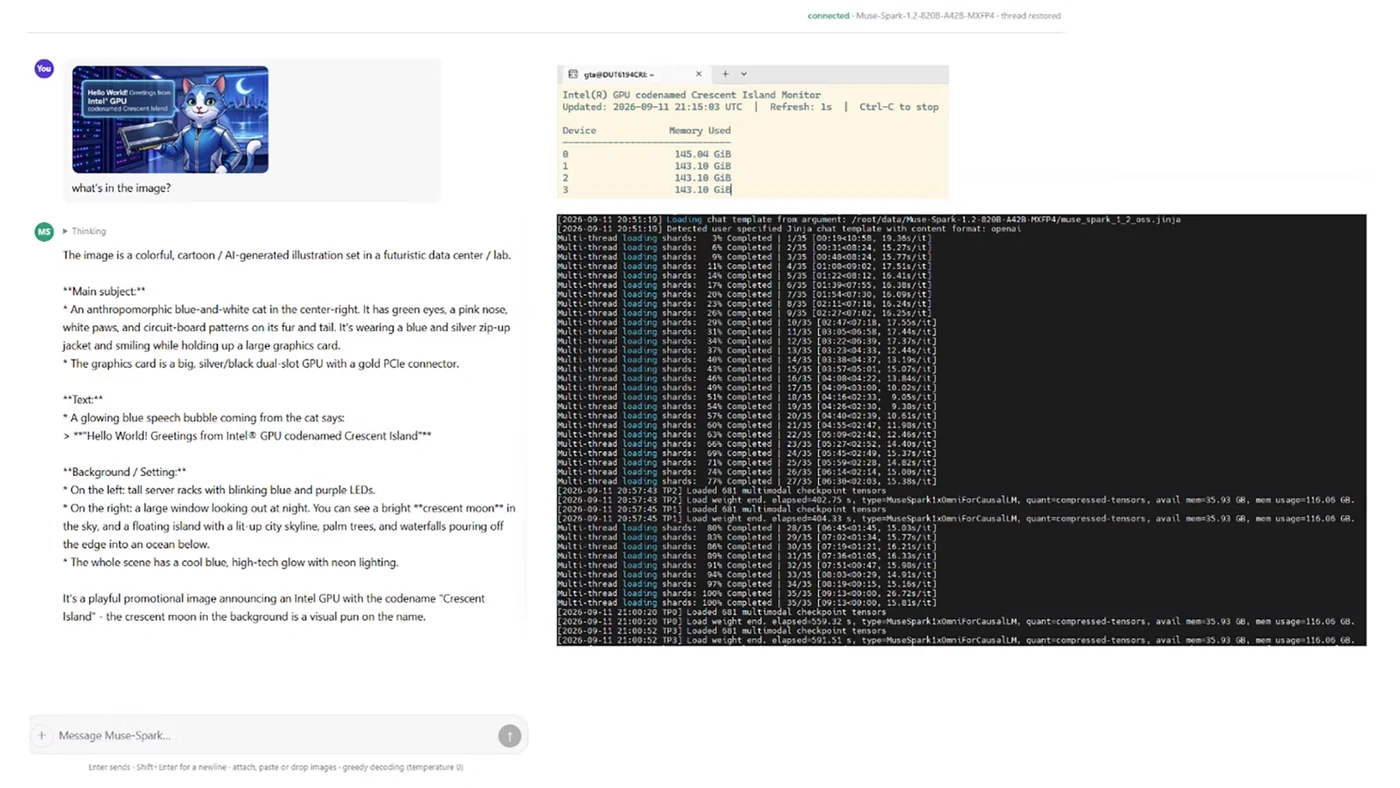
The massive scale of models like Muse Spark Open highlights the growing infrastructure demands of advanced workloads, requiring substantial memory capacity, efficient low-precision compute, and power-efficient architectures. The model has already been tested and is running on the upcoming Intel data center GPU, codenamed Intel GPU D-series, providing customers with an early path for evaluation.
The Intel GPU D-series is built on the Intel Xe3P architecture and features dedicated hardware acceleration across a broad range of data types, including MXFP4. Each GPU provides 160 GB of LPDDR5x memory capacity, with options scaling up to 480 GB, making it well-suited for large-model inference.
Operating within a 350W air-cooled PCIe form factor, a compact four-card configuration can host an 816 billion-parameter-class model inside conventional air-cooled data center racks. This design aims to simplify infrastructure complexity for organizations exploring frontier-scale deployments.
Intel Xeon Processors for Offline Inference
For organizations seeking alternative deployment paths, Intel Xeon processors offer support for high-capacity CPU inference. By utilizing INT4 weight-only quantized inference, Xeon processors reduce the required memory footprint while employing Intel Advanced Matrix Extensions to accelerate AI matrix operations.
The large system memory capacities available on Intel Xeon processors provide a practical approach for offline inference. This allows organizations to run workloads privately and replicate deployments smoothly across existing server infrastructure located within their own data centers.
Intel provides step-by-step instructions for running Muse Spark Open on Xeon processors using SGLang via its SGLang cookbook, alongside ongoing collaborative work with the vLLM community to establish dedicated recipes.
Software Optimization and Quantization Strategy
Intel’s Upstreaming First software strategy helps enterprise engineering teams deploy quantized variants using standard open-source tools. Full upstream support for compressed tensors like MXFP4 and GPTQ in mainline vLLM enables hardware-accelerated matrix execution, continuous batching, and PagedAttention.
Furthermore, native upstream integration for microscaling execution and Intel XPU-optimized kernels in SGLang drives high-throughput continuous batching and low-bit inference for complex agentic workflows. To maximize efficiency without sacrificing accuracy, Intel quantized MXFP4 and INT4 variants directly from the model's original BF16 weights.
This quantization process utilized vLLM’s native llm-compressor tool, powered by Intel’s AutoRound quantization algorithm. The algorithm optimizes rounding and clipping-range parameters layer by layer to preserve the model's fine-grained reasoning capabilities even at ultra-low bit widths.
Deployment Readiness for Enterprise AI
The combination of upstream support in vLLM and SGLang, alongside hardware-tailored MXFP4 and INT4 WOQ execution, equips enterprise teams with the performance needed for day-0 deployment. Developers can learn more about these developments by visiting the main [Artificial Intelligence (AI)](https://www.intel.com/content/www/us/en/newsroom/home.html#aiartificialintelligence) resource portal.
Whether opting for the high memory density of the Intel GPU D-series or the private offline inference capabilities of Intel Xeon processors, enterprise organizations now have structured hardware and software paths ready for Meta's frontier model.
Sources
- Intel NewsroomIntel Offers Day-0 Support for Meta's Muse Spark Open
Continue chronologically

Related entity coverage
Related stories
Meta Releases Muse Spark Open, an 800B-Parameter AI Model
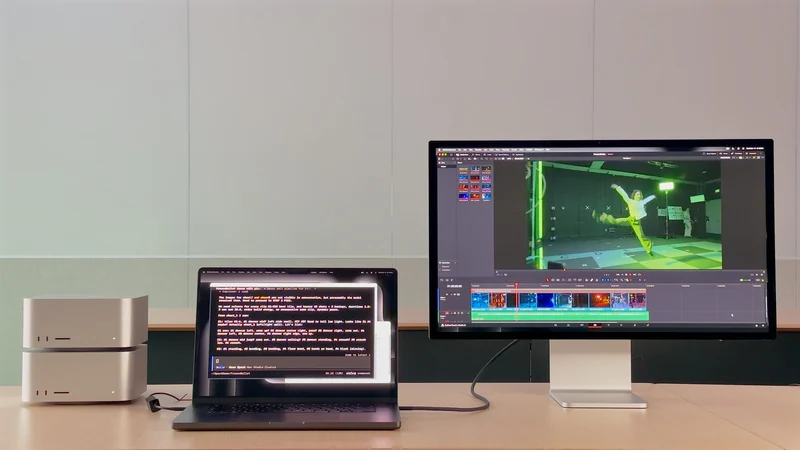
Meta has introduced Muse Spark Open, an 800-billion parameter open-weight AI model optimized for Apple's hardware, requiring 1TB of unified RAM.
Meta Launches Muse Spark Open AI Model for Macs
Meta has released Muse Spark Open, a massive open-weight AI model designed to run locally on Apple silicon using Mac Studio computers.

Meta’s Muse Spark Open Available in SageMaker JumpStart
Meta’s coding-optimized open-weight model, Muse Spark Open, is now accessible in Amazon SageMaker JumpStart for deployment on SageMaker AI.

Software Bridges Open AI Models to Enterprise Systems
Intel executives outline an open software blueprint connecting CPUs, GPUs, and enterprise systems to transition AI models into production applications.