Intel Advances Open Infrastructure for the Agentic AI Era
At the Open Compute Project Global Summit, Intel detailed new hardware solutions, including the Intel GPU D-series and advanced Xeon rack designs, aimed at supporting the expanding demands of agentic AI workloads.
 Radwan AbdulhadiEditor and technology writer
Introduction to Agentic AI Infrastructure
As open models continue to reshape the economics of agentic artificial intelligence, market demand is accelerating for more flexible, cost-effective, and power-efficient data center systems. According to Intel, scaling these modern workloads presents a major systems challenge driven by memory bottlenecks, strict power constraints, and rising cost pressures across the industry. Further details are available from Intel Newsroom in the original source material.
To address these challenges, the company highlighted its approach to open, heterogeneous AI infrastructure at the Open Compute Project (OCP) Global Summit. By combining general-purpose compute, purpose-built acceleration, and open software standards, Intel aims to optimize performance and efficiency across diverse deployment environments.

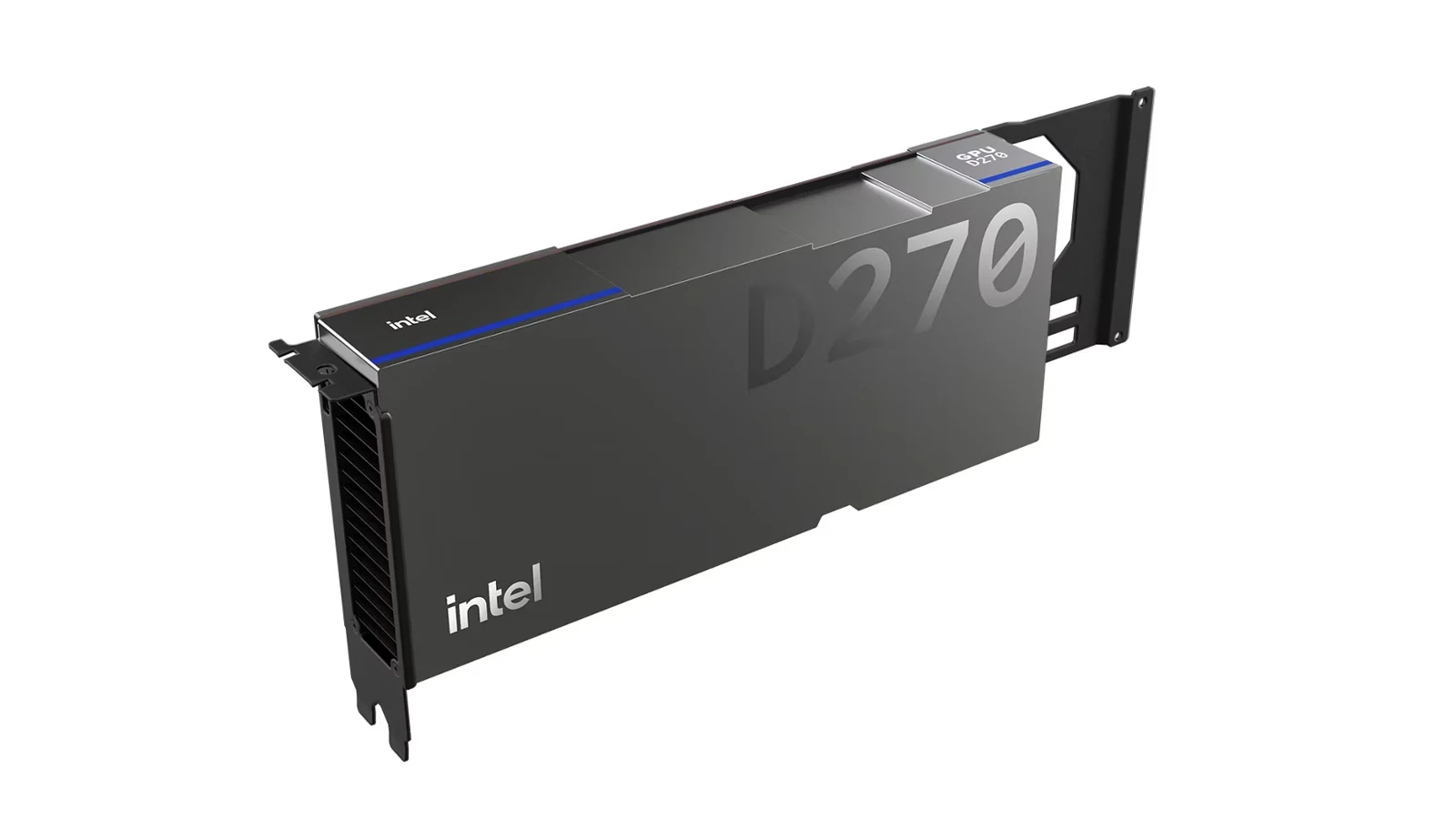
Intel GPU D-Series for Efficient Inference
Previously known under the code name Crescent Island, the new Intel GPU D-series is engineered specifically to improve the economics of sustained, memory-intensive inference tasks. Built on Intel's latest Xe3P architecture, the hardware combines high memory capacity and compute performance within a standard power envelope.
The architecture integrates up to 480GB of LPDDR5X memory alongside 1.5TB/s of memory bandwidth and 1.3 petaflops of FP8 compute power. Designed to support large language models, long-context operations, and concurrent services, a single card can handle models with up to 300 billion parameters, while an eight-GPU configuration scales past one trillion parameters.
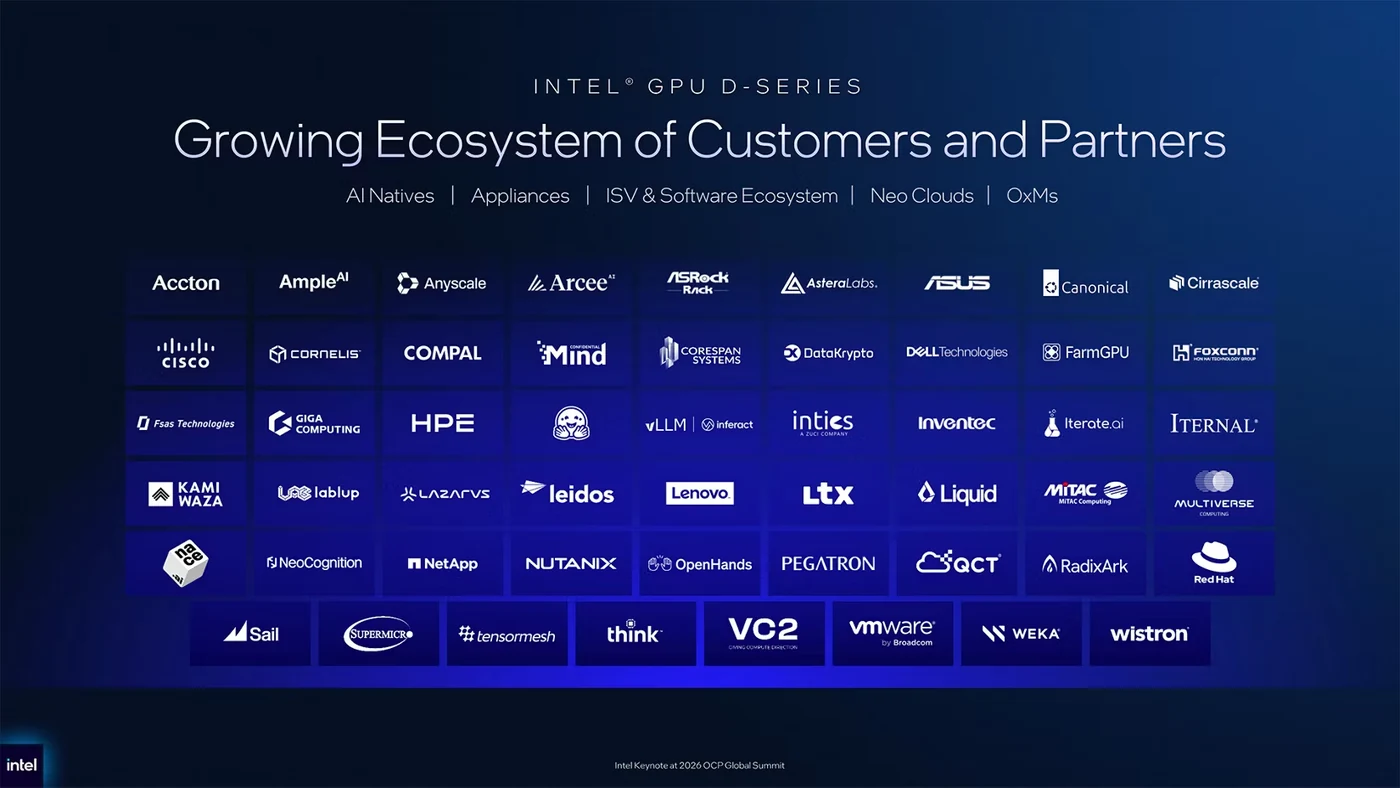
Intel executive Anil Nanduri noted that inference has become a defining AI workload, requiring infrastructure that delivers appropriate performance balanced against operational costs. Customer sampling for the hardware is currently underway across an ecosystem of OEMs, ODMs, and cloud providers.
Xeon Processors and Rack-Scale Designs
Alongside its discrete graphics solutions, Intel showcased new rack designs developed alongside ecosystem partners to satisfy increasing compute requirements. Many of these solutions are built on the Open Compute Project's Open Rack v3 (ORv3) standard to streamline integration within open data centers.
As agentic workflows grow more sophisticated, general-purpose processors remain essential for orchestrating tasks, managing input and output operations, and processing data. Selected configurations leveraging Intel Xeon 6+ processors scale past 46,000 cores per rack while operating at a total power consumption of 133.45 kW.
Nicolas Dubé, corporate vice president for Intel's Data Center Systems and Solutions Group, emphasized that organizations require infrastructure capable of aligning specific workloads with appropriate compute resources and financial parameters.
Open Software and Ecosystem Integration
Delivering heterogeneous AI infrastructure at scale relies heavily on open software frameworks that connect various compute resources and simplify deployment. Intel's software initiatives emphasize native upstream integration with industry-standard frameworks, deployment environments, and inference runtimes.
By utilizing a common software foundation across multiple product categories, the company seeks to maintain application portability and reduce engineering complexity for enterprise customers moving from initial model evaluation to full production deployment.
Sources
- Intel NewsroomIntel Accelerates Open Infrastructure for the Agentic AI Era
Continue chronologically


Related stories
Intel at OCP 2026: Open AI Infrastructure for the AI Era
At the 2026 OCP Global Summit, Intel highlights open, heterogeneous systems, modular infrastructure, and standards to scale next-generation AI workloads.

Intel Launches Inference Microservices for LLMs on Xeon
Intel introduces Inference Microservices to deliver tuned LLM performance on existing Intel Xeon processors without manual hardware optimization.

Software Bridges Open AI Models to Enterprise Systems
Intel executives outline an open software blueprint connecting CPUs, GPUs, and enterprise systems to transition AI models into production applications.

Intel Announces Day-0 Support for Meta Muse Spark Open
Intel announces day-0 support for Meta's 816 billion-parameter Muse Spark Open model across Intel Xeon processors and Intel GPU D-series platforms.