Intel Launches Inference Microservices for LLMs on Xeon
Intel has announced the launch of Intel® Inference Microservices, designed to provide tuned large language model performance on existing Intel® processors while eliminating days of manual hardware optimization.
 Radwan AbdulhadiEditor and technology writer

Streamlining LLM Deployment on Existing Hardware
Getting a large language model to respond is easy, but getting it to respond well repeatedly on hardware you already own can take up to a week of complex configuration. Precision, work distribution across cores, memory layout across NUMA nodes, and instruction sets all depend heavily on both the model and the underlying processor. To address these bottlenecks, Intel has announced the rollout of Intel® Inference Microservices to simplify deployments.
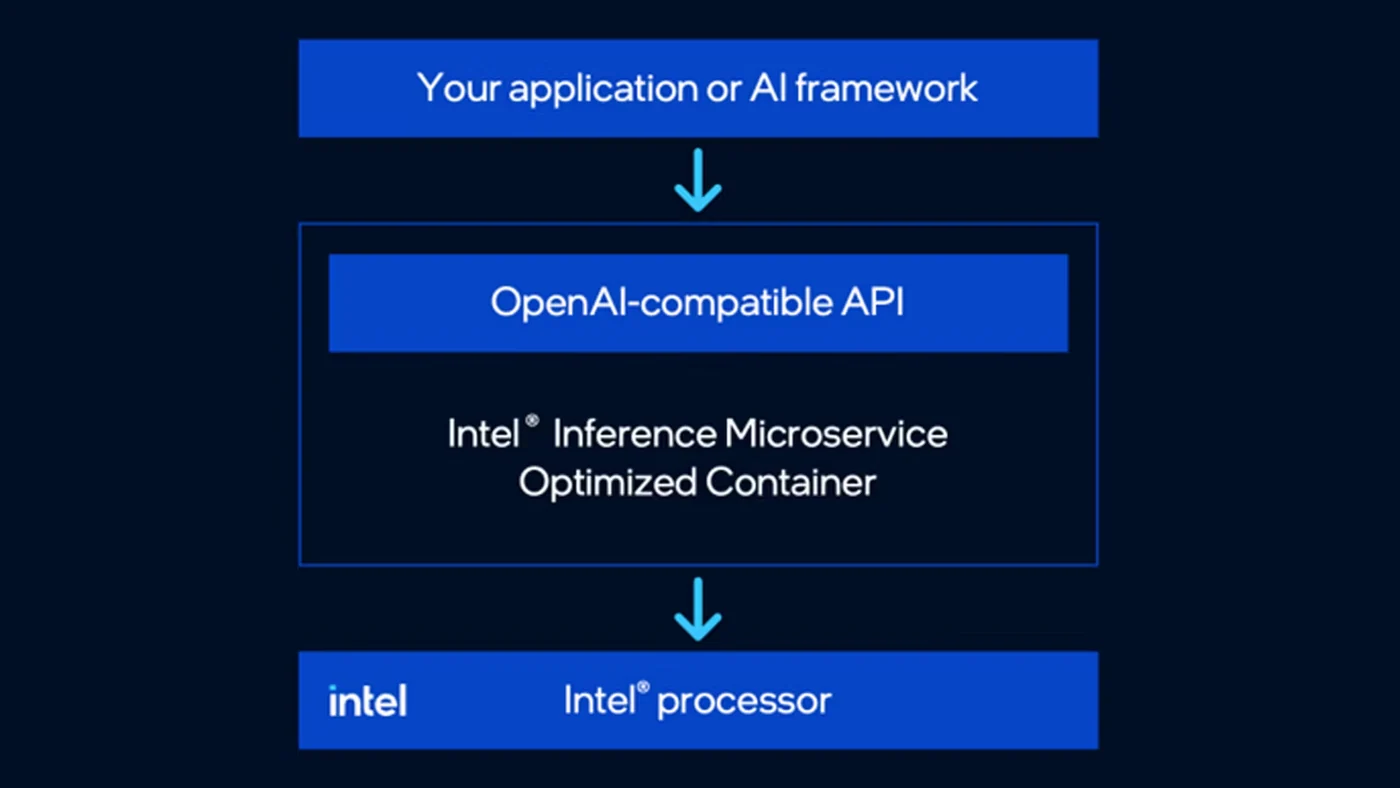
Each microservice runs as a container serving a single model behind an OpenAI-compatible API. Upon startup, the container inspects the host processor and applies pre-tuned, validated settings specific to that silicon. Users can explore available options by checking the Intel® Software Catalog.
Technical Architecture and Hardware Integration
This first release is optimized for 4th, 5th, and 6th Generation Intel® Xeon® processors using Docker or Kubernetes. When the container initializes, it evaluates host parameters such as processor generation, core counts, NUMA nodes, and built-in accelerators. This enables the runtime to properly leverage native hardware features like Intel® Advanced Matrix Extensions (Intel® AMX) for matrix multiplication alongside vector extensions like AVX-512, AVX2, and VNNI.
By utilizing these dedicated on-chip engines, the system achieves significant inference acceleration without requiring a dedicated capital purchase for new hardware. Developers can browse models and read further documentation via the Intel® Software Catalog to align deployments with their specific capacity.
Enterprise Integration and Ecosystem Support
Because the microservices expose an OpenAI-compatible API, most major AI frameworks can connect directly to the base URL without modification. Tools such as the OpenAI SDK, LangChain, LlamaIndex, LiteLLM, and Haystack all work out of the box with full streaming support enabled. Furthermore, fleets of microservices shared across teams with built-in security and routing can be managed via the Intel® AI for Enterprise Inference toolkit.
Bill Pearson, Intel vice president of Data Center Software within the Data Center Group, noted that the underlying optimizations mirror contributions Intel makes upstream in open source frameworks like vLLM. According to Pearson, packaging this work behind a standard API allows enterprise customers to leverage a tuned stack effortlessly while maintaining a consistent interface across hardware platforms.
Future Outlook and Availability
The initial release targets BF16 precision on Intel® Xeon® processors, with tool calling and structured output supported via vLLM pass-throughs. Future updates are planned to introduce Helm charts, a Kubernetes Operator, additional inference engines, and broader precision support. Users can learn more about Intel® Inference Microservices directly through official developer portals.
Sources
- Intel NewsroomAnnouncing Intel® Inference Microservices: Tuned LLM Inference on Intel® Processors
Continue chronologically


Related entity coverage
Related stories
Software Bridges Open AI Models to Enterprise Systems
Intel executives outline an open software blueprint connecting CPUs, GPUs, and enterprise systems to transition AI models into production applications.

Intel Advances Open Infrastructure for the Agentic AI Era
Intel unveils new technical details on the Intel GPU D-series, Xeon-based rack designs, and open software strategies at the OCP Global Summit.
IDC Research Highlights Enterprise Agentic AI Funding Gaps
New IDC research commissioned by Intel reveals that while 89% of IT leaders expect agentic AI to be crucial soon, infrastructure remains underfunded.

Intel Announces Day-0 Support for Meta Muse Spark Open
Intel announces day-0 support for Meta's 816 billion-parameter Muse Spark Open model across Intel Xeon processors and Intel GPU D-series platforms.