Amazon Unveils Conversational Supply Chain Tools with Quick and Bedrock AgentCore
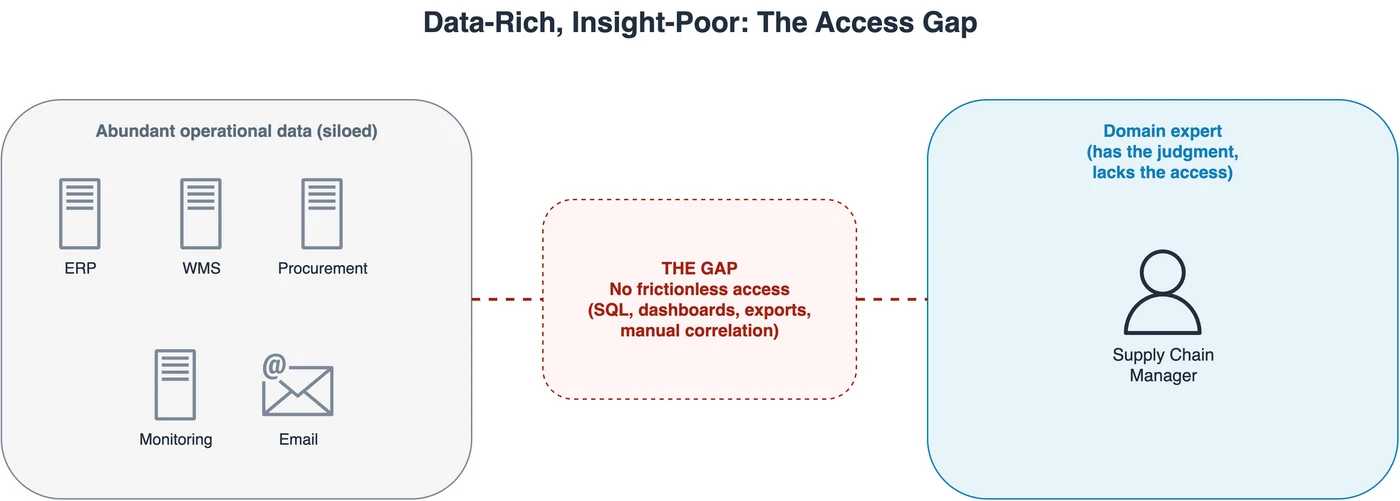
Enterprise supply chains are data-rich but insight-poor, with the data to decide scattered across ERP, monitoring, procurement, and email. This post shows how Amazon Bedrock AgentCore exposes those systems as a governed tool layer, and how Amazon Quick turns them into one conversational experience for business users, with a deploy-it-yourself walkthrough.
 Radwan AbdulhadiEditor and technology writer
Addressing Supply Chain Data Fragmentation
Enterprise supply chains generate constant signals—orders in approval, shifting lead times, slowing ports, and disruptions—but the data to make decisions remains scattered across ERP systems, monitoring tools, procurement platforms, and email. Traditionally, answering questions like 'Which top-revenue SKUs are exposed to the current port closure, and what will it cost?' required manually navigating multiple systems while domain experts waited. Amazon Bedrock AgentCore and Amazon Quick aim to eliminate this friction by turning fragmented data into actionable insights through natural language queries. Further details are available from AWS Machine Learning Blog in the original source material.
Conversational Workflow in Amazon Quick
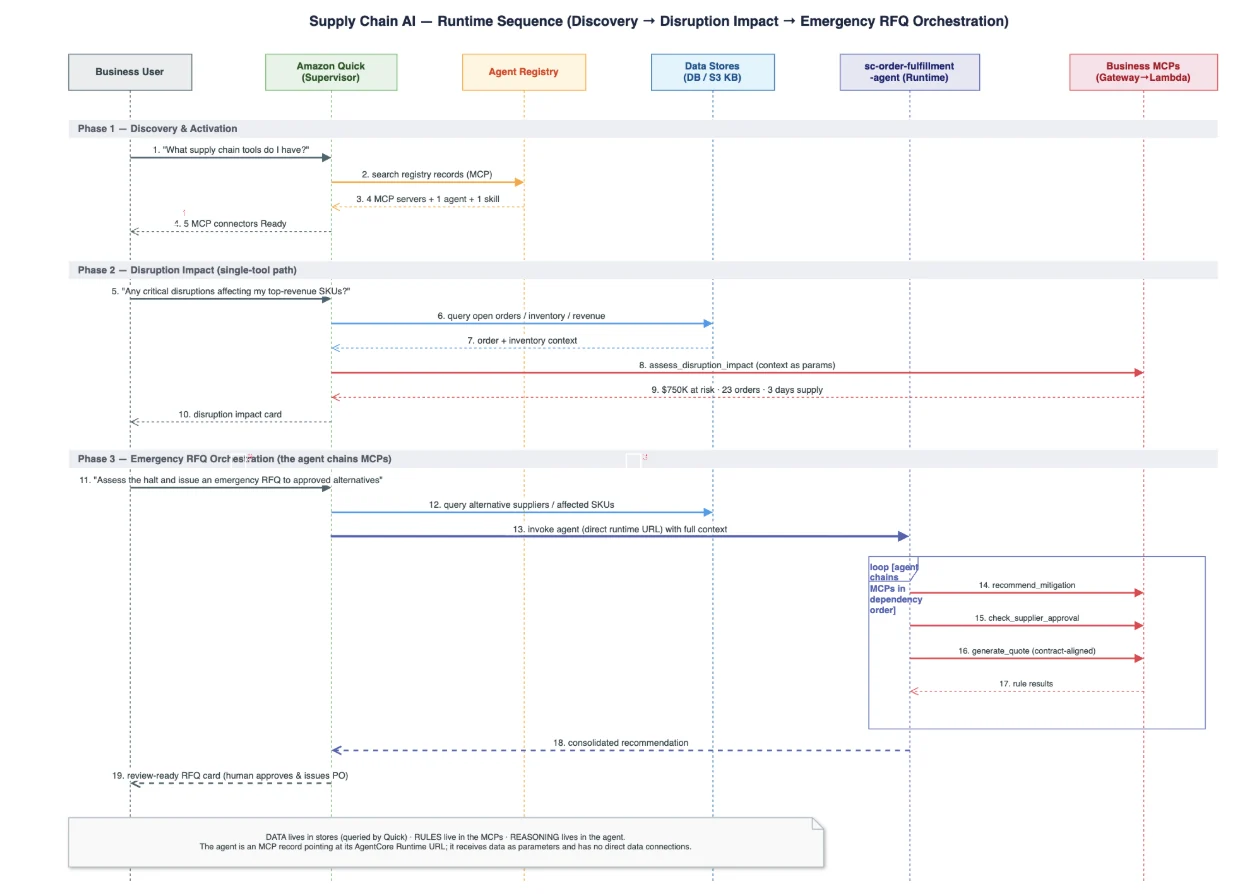
Amazon Quick transforms complex supply chain data into a conversational experience for business users. For example, a manager can ask, 'What supply chain tools do I have?' and receive a list of MCP servers published in the AWS Agent Registry. After selecting relevant tools, they might ask, 'Show me active disruptions,' which routes the request through AgentCore to query backend systems. The system identifies three disruptions with severity, region, and SKU counts, enabling rapid assessment without manual dashboard exploration.
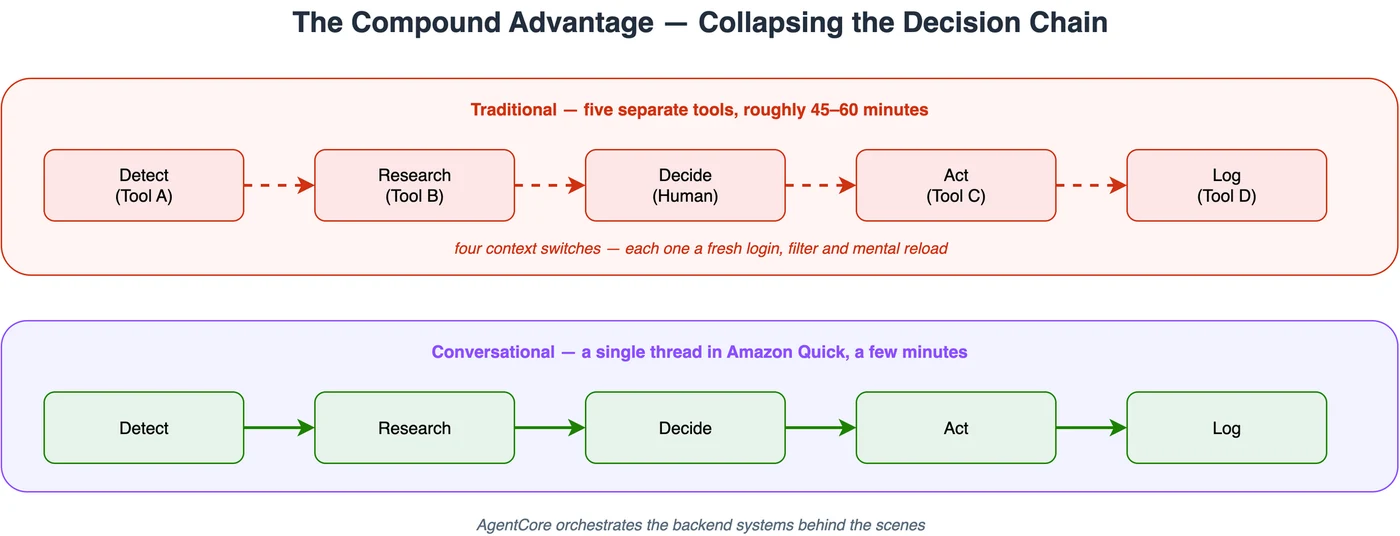
In a demonstration, a user drills down into a TechComp Production Halt, triggering an automated correlation of order, customer, and inventory data to reveal $750K at risk across 23 orders. A follow-up query for mitigation recommendations chains governance and quoting tools to generate an emergency RFQ. This entire process, which traditionally takes 45-60 minutes across five systems, is reduced to minutes through conversational interaction.
Architectural Foundation with AgentCore and MCP
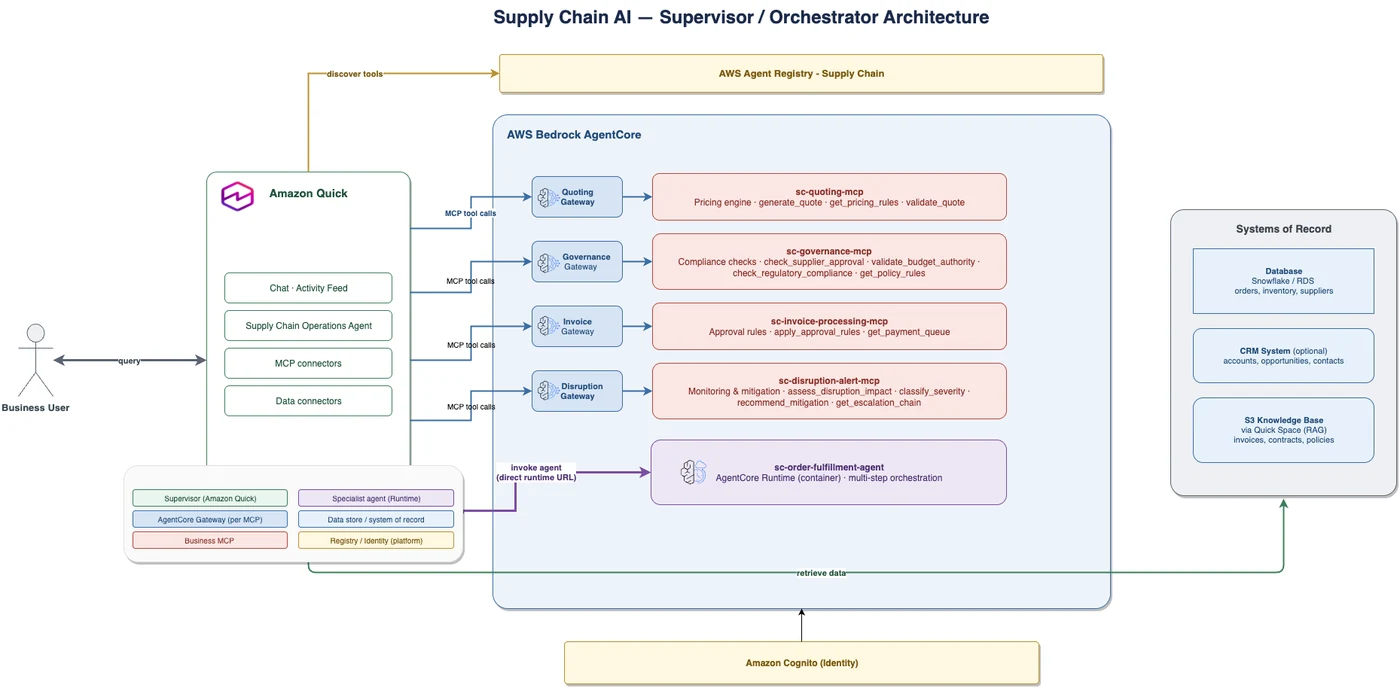
Amazon Bedrock AgentCore serves as the intelligence layer, exposing enterprise Model Context Protocol (MCP) servers as a composable tool layer. The platform includes four key services: Runtime for serverless hosting, Gateway for API standardization, Identity for authentication, and Policy for deterministic authorization. MCP, an open standard, allows AI clients like Amazon Quick to consume tools from backends such as SAP or Oracle, with automatic schema discovery via the AWS Agent Registry.
The AWS Agent Registry acts as a governed discovery layer, where publishers submit records, curators approve them, and administrators link approved tools to Amazon Quick. This ensures secure, pre-populated connector cards without manual URL entry. Each tool call passes through AgentCore's control set, including IAM authentication, input validation, and audit logging, before reaching backend systems.
End-to-End Deployment and Use Cases
The architecture enables a deploy-it-yourself approach, with a sample implementation available in the GitHub repository for quick-for-supply-chain. Users can set up proactive monitoring, such as daily alerts for critical disruptions, which run unattended from supplier emails and post review-ready cards to the Activity Feed. This automation reduces context switching and accelerates decision-making for supply chain managers.
By separating the intelligence layer (AgentCore) from the interface (Amazon Quick), each component evolves independently. The orchestration agent plans tool sequences, ensuring a single request spans disruption assessment, governance verification, and quoting without manual handoffs. This modular design supports scalable, secure AI-driven supply chain operations.
Industry Impact and Future Outlook
Amazon's solution addresses a critical gap in enterprise supply chain management by democratizing access to live data through conversational interfaces. By grounding answers in systems of record rather than model recall, it ensures accuracy and accountability. The ability to correlate data across ERP, procurement, and monitoring tools in real time positions this technology as a cornerstone for agile supply chain operations in an increasingly complex global economy.
Sources
- AWS Machine Learning BlogFrom data to decisions: Conversational supply chain intelligence with Amazon Quick and Amazon Bedrock AgentCore
Continue chronologically
Related entity coverage
Related stories
Automating Cross-Account Amazon Quick Promotion
Learn how to automate cross-account promotion for Amazon Quick resources using an idempotent, auditable MCP server on Amazon Bedrock AgentCore.
Sweep Thousands of Leases Using Amazon Quick and Adjudicated Query
Learn how the Adjudicated Query pattern pairs Amazon Quick with a deterministic rules engine to sweep thousands of leases for compliance.

Amazon Quick and Bedrock Tackle RAG Access Control
Amazon Quick and Amazon Bedrock Knowledge Bases implement real-time ACL enforcement to secure enterprise RAG solutions against stale permissions.
Amazon Quick Unifies Structured and Unstructured Data
Discover how Amazon Quick bridges structured metrics and unstructured documents into a single conversational AI experience for enterprise business intelligence.