Fine-Tuning GPT-OSS-20B for Multilingual Reasoning
Open-weight reasoning models often default to English during chain-of-thought tasks, creating distinct hurdles for non-English users. Recent engineering guidance details how to overcome this capability gap.
 Radwan AbdulhadiEditor and technology writer
Addressing the Multilingual Reasoning Gap
GPT-OSS-20B functions as an open-weight reasoning model that natively thinks in English. When prompted to reason in languages such as French, German, Spanish, or Italian, the base model acknowledges the given instruction but routinely produces its chain-of-thought output in English instead. On a 50-example multilingual reasoning test, the base model successfully reasoned in the correct target language only 22 percent of the time. This performance consisted almost entirely of English examples, while French, Spanish, and Italian scored zero percent, and German scored just 10 percent.
For development teams deploying sophisticated reasoning models to global or non-English user bases, this language restriction represents a critical gap. End users submitting queries in French naturally expect the receiving model to maintain its chain-of-thought and final answer in French, rather than switching back to English mid-thought. Resolving this constraint requires targeted customization, prompting engineering teams to weigh supervised fine-tuning (SFT) against reinforcement learning approaches like Group Relative Policy Optimization (GRPO).
Supervised Fine-Tuning and GRPO Mechanics
Engineering teams can explore these optimization techniques by reviewing comprehensive resources on the AWS Machine Learning Blog, which outlines effective strategies for open-weight customization. The underlying methodology demonstrates that supervised fine-tuning essentially teaches the model a brand-new behavior that it previously lacked. In contrast, reinforcement learning with GRPO acts as a refinement mechanism that optimizes behaviors the model can already occasionally generate.
GRPO functions by sampling a distinct group of responses per input prompt, subsequently pushing the policy toward higher-performing outputs. If a desired capability holds zero probability within the initial base distribution, reinforcement learning leaves very little baseline data for the system to reinforce. Consequently, SFT typically performs the bulk of foundational adaptation, while GRPO refines outcomes where performance headroom remains available.
Infrastructure and Distributed Training Stack
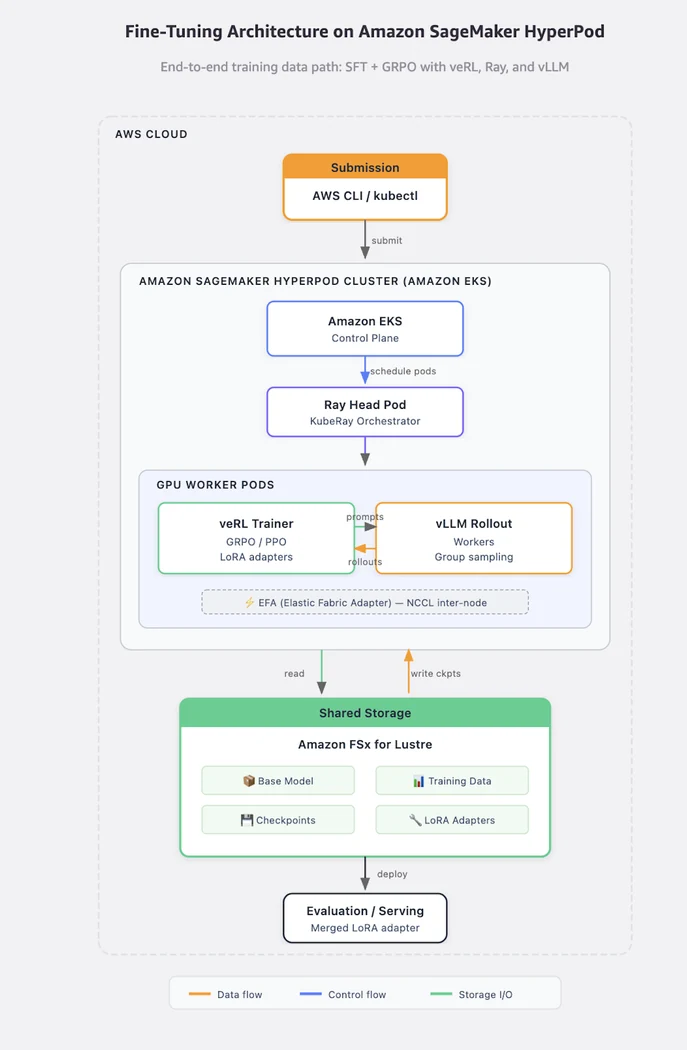
Executing these demanding machine learning workflows requires robust cloud orchestration and high-performance file systems. Developers running these experiments utilized Amazon SageMaker HyperPod configured with Amazon Elastic Kubernetes Service (Amazon EKS) for cluster orchestration. For initial SFT and GRPO operations involving GPT-OSS-20B, teams incorporated the PyTorch TRL library.
To support fast rollout generation and distributed orchestration, experiments leveraged vLLM alongside Ray and KubeRay. Model checkpoints and training datasets resided securely on Amazon FSx for Lustre, while inter-node communication utilized Elastic Fabric Adapter (EFA) technology. Additional reference code, scripts, and deployment manifests are publicly maintained within the awsome-distributed-ai repository for developer reference.
Executing End-to-End Training Workflows
The training architecture establishes an end-to-end data pathway where user submissions arrive via the Amazon EKS control plane of an established Amazon SageMaker HyperPod cluster. The control plane schedules dedicated GPU nodes, launching Ray head pods and worker pods running the training and rollout frameworks. Shared storage via Amazon FSx for Lustre supplies base model weights, training datasets, and active checkpoints throughout the pipeline.
Administrators aiming to scale similar workloads can review the official Amazon SageMaker HyperPod documentation for deeper configuration guidance and best practices. Production environments typically require persistent storage claims, EFA-enabled instance networking, and specific container registries to house custom training images built from reference codebases.
Evaluation Outcomes and Performance Gains
Initial evaluations of the base GPT-OSS-20B model across a 50-case assessment revealed a modest 22 percent success rate for reasoning-language alignment. Following supervised fine-tuning utilizing Low-Rank Adaptation (LoRA), the model achieved a 100 percent success rate across all five target languages. SFT successfully forced the model to override its native English prior, ensuring that both chain-of-thought generation and final answers align with the requested language.
Further experimental insights regarding specialized instance types, such as ml.g6e.12xlarge nodes equipped with L40S accelerators, demonstrate the feasibility of scaling large open-weight models efficiently. By matching appropriate fine-tuning techniques to specific capability gaps, engineering organizations can dramatically expand the multilingual utility of frontier reasoning architectures.
Sources
- AWS Machine Learning BlogFine-tuning GPT-OSS-20B for multilingual reasoning on Amazon SageMaker HyperPod
Continue chronologically


Related entity coverage
Related stories
TorchNeuron Brings Native PyTorch Support to AWS Trainium
TorchNeuron arrives as a public beta, introducing a native PyTorch backend for AWS Trainium with eager execution and torch.compile support.
Hugging Face Launches Space to Check AWS Trainium Support
Discover which Hugging Face models run on AWS Trainium using the new torch-neuronx model support space, checking compatibility, scripts, and more.

Train Qwen3 on AWS Trainium with torchtitan
Learn how to train Qwen3 on AWS Trainium using torchtitan across three distinct configuration approaches on a single trn2.48xlarge instance.
AWS Details Distributed Training on Amazon EKS with Ray Train
Learn how to use Ray Train Deep Learning Containers and EFA on Amazon EKS for distributed PyTorch model training without custom images.