Amazon Quick and Bedrock Tackle RAG Access Control
Enterprise organizations adopting Retrieval-Augmented Generation face complex security challenges when indexing sensitive knowledge sources like SharePoint, Google Drive, and Confluence.
 Radwan AbdulhadiEditor and technology writer
The Enterprise Challenge of RAG Access Control
Enterprise organizations are increasingly adopting Retrieval Augmented Generation (RAG) to unlock valuable insights from company knowledge repositories such as Microsoft SharePoint, Google Drive, and Atlassian Confluence. However, these knowledge sources contain highly sensitive information governed by intricate permission structures. Ensuring that AI-generated responses strictly respect those underlying user permissions remains one of the most formidable hurdles in enterprise artificial intelligence.
A single unauthorized document surfaced mistakenly in an automated AI response can expose confidential strategy documents, unreleased financial data, or restricted human resources information. To address these risks safely, organizations want to democratize access to AI-powered insights without compromising their existing corporate security posture.
Limitations of Traditional Replication Models
A common approach used for RAG access control relies on a replicate-and-filter method to enforce document-level permissions. In this typical model, a data source connector pulls access control lists (ACLs) during periodic sync jobs, storing those replicated ACLs as attributes within an index. At query time, the system maps the logged-in user to the stored attributes to filter results accordingly.
Despite appearing reasonable on the surface, this traditional model exhibits two fundamental weaknesses. First, the AI system takes responsibility for enforcement without acting as the authoritative source of permissions, forcing connectors to accurately replicate complex logic across diverse data sources. Second, stale permissions create security gaps because data connectors operate on pull-based sync schedules. Between synchronization cycles, a user who has had their access revoked might still receive AI-generated answers from restricted documents.
Real-Time ACL Enforcement with AWS
To counter these structural vulnerabilities, AWS implemented real-time ACL checks as an added security layer on top of existing pre-retrieval filtering for Amazon Quick and Amazon Bedrock Knowledge Bases. This architecture ensures the system enforces the most current access controls by verifying permissions directly with the authoritative source at query time, bypassing potentially stale or incorrectly mapped data.
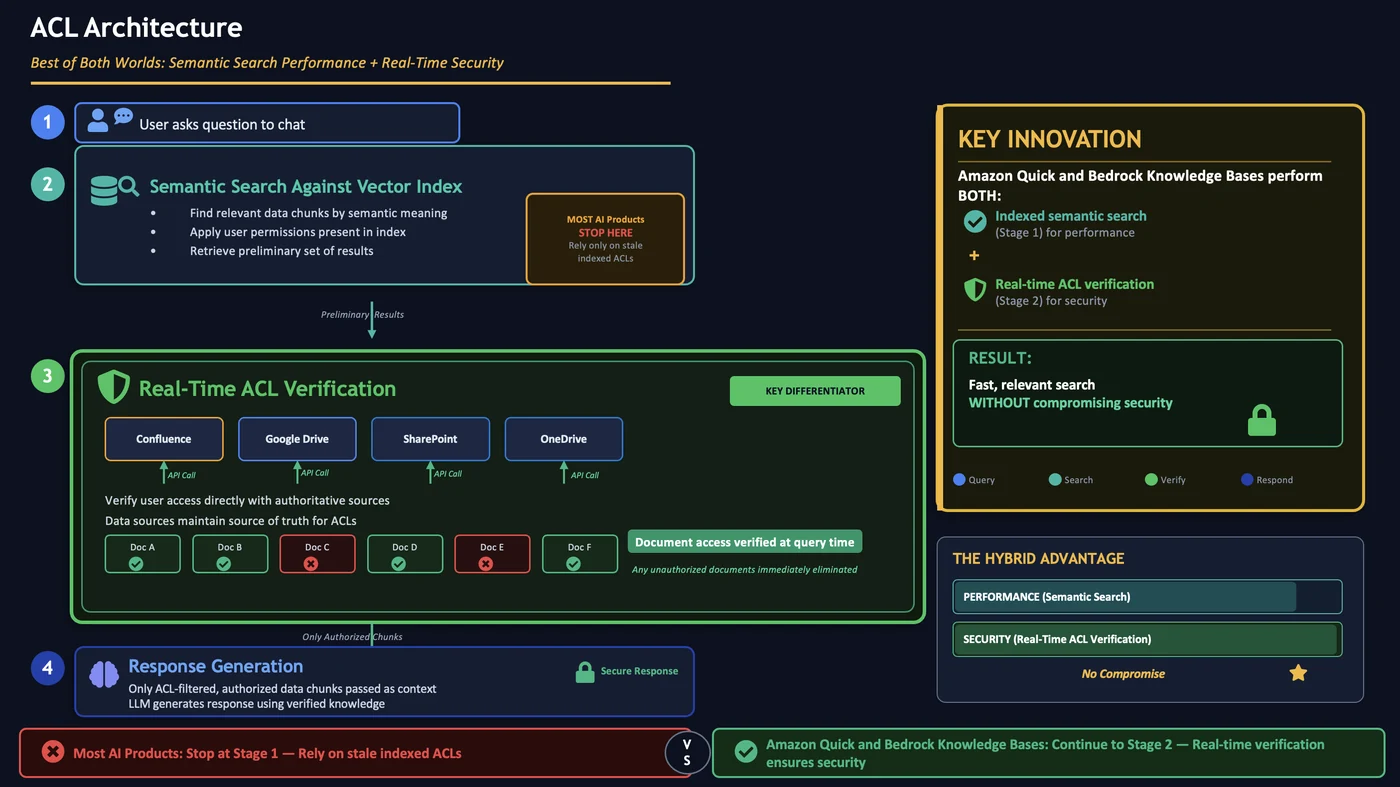
When a user submits a query to an Amazon Quick agent utilizing a knowledge base, the system executes access control in two distinct stages. First, a semantic search against the vector index identifies relevant document passages utilizing pre-stored access control attributes, producing a preliminary set of candidate documents for efficiency.
The Two-Stage Verification Architecture
In the second stage, Amazon Quick verifies the candidate documents in real time by calling authoritative source APIs, such as Google Drive APIs. Using service account credentials provided by administrators, the platform generates user-specific access tokens through impersonation. Documents that the user lacks authorization to view are excluded from the final result set, ensuring only verified and authorized passages pass to the large language model.
This hybrid mechanism successfully balances semantic search performance with strict security correctness. Furthermore, additional platform capabilities detailed on the AWS Machine Learning Blog provide responsible AI controls, including Amazon Bedrock Guardrails for content filtering, grounding checks to minimize hallucinations, and configurable safety policies.
Operational Benefits and Enterprise Adoption
By adopting real-time verification against authoritative sources, organizations eliminate security gaps between synchronization cycles, meaning revoked employee access reflects in AI responses within moments rather than hours or days. Companies gain the confidence to scale their knowledge base coverage while reducing the operational burden associated with managing sync frequencies.
Enterprise validation for this security approach is already underway. Mondelēz International has deployed Amazon Quick for over 35,000 employees across four regions. Jamahl Wiggins, Senior Specialist for M365 Innovation at Mondelēz International, noted that the platform's real-time access control approach successfully answered critical security requirements during their evaluation, providing their internal review board with the confidence to move forward with AI governance.
Exploring AI Innovation and Best Practices
As enterprises continue to refine their internal AI roadmaps, security and compliance teams remain focused on maintaining rigid data boundaries. Industry discussions highlighted on the Artificial Intelligence page continue to explore how organizations can deploy scalable generative AI applications without exposing confidential corporate intelligence or compromising user permissions.
Sources
- AWS Machine Learning BlogRethinking access control for RAG with Amazon Quick and Amazon Bedrock
Continue chronologically

Related entity coverage
Related stories
Claude Haiku 5.5 Launches on Amazon Bedrock and AWS
Anthropic's Claude Haiku 5.5 is now available on Amazon Bedrock and Claude Platform on AWS, offering high efficiency for subagents.
Managing User Role Downgrades in Amazon Quick
Learn how to safely downgrade user roles in Amazon Quick using manual deletion or the AWS CLI while preserving critical assets.
Sweep Thousands of Leases Using Amazon Quick and Adjudicated Query
Learn how the Adjudicated Query pattern pairs Amazon Quick with a deterministic rules engine to sweep thousands of leases for compliance.
Amazon Quick Adds Live Data Support for AI-Built Apps
Amazon Quick introduces Live Data in Apps, allowing AI-built web applications to query governed datasets in real time instead of using static snapshots.