Can We Trust LLMs to Judge Research Idea Novelty?
Researchers have introduced a new study and benchmark examining whether large language models can reliably evaluate the novelty of scientific research ideas.
 Radwan AbdulhadiEditor and technology writer
Evaluating AI as Novelty Judges
As artificial intelligence begins to play a larger role in scientific discovery, systems are increasingly used to generate hypotheses, synthesize evidence, and explore structured data. However, generating ideas is only part of the automated discovery challenge; these ideas must also be genuinely novel rather than mere repackagings of existing work. To determine this, research teams frequently rely on another large language model acting as a novelty judge.
To study how reliably these models can perform this task, researchers released a new study detailed in the <a href="https://huggingface.co/blog/allenai/novelty-bench">Hugging Face Blog</a>. Alongside the findings, the team published a benchmark, data, and code to test how well different models evaluate research originality.
Building the Evaluation Benchmark
To test whether novelty judges can accurately distinguish between more novel and less novel concepts, researchers needed empirical evidence of originality. They constructed an automated pipeline utilizing peer reviews from ICLR 2026. Instead of relying simply on paper acceptance, the pipeline mined reviewer comments for explicit discussions regarding a contribution's originality.
The resulting evaluation data is accessible via the <a href="https://huggingface.co/datasets/allenai/novelty-judge-bench">Data</a> repository, offering structured test sets for developers and researchers. Additionally, the corresponding <a href="https://github.com/allenai/novelty-eval">Code</a> repository has been made available to support further community testing and pipeline replication.
Instability in Model Judgments
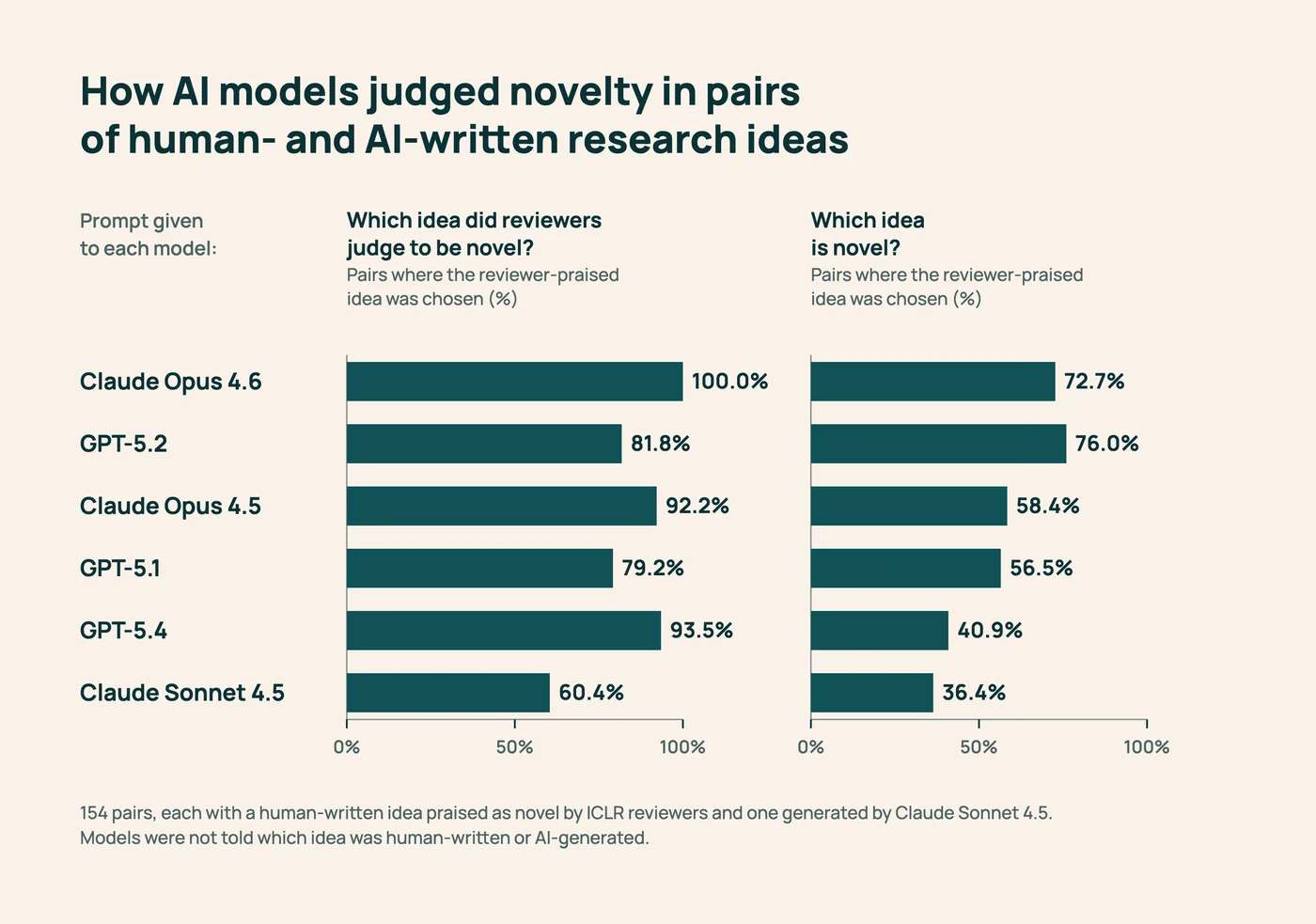
The benchmark tested six prominent large language models across multiple evaluation configurations. These models included GPT-5.1, GPT-5.2, GPT-5.4, Claude Sonnet 4.5, Claude Opus 4.5, and Claude Opus 4.6. The experiments varied prompts, reasoning budgets, formatting styles, and retrieval options to observe how these adjustments affected the final judgments.
Results demonstrated that novelty evaluation is surprisingly unstable. Small modifications to evaluation prompts produced drastically different outcomes. In one specific experiment, altering just a few words in a prompt changed a model's accuracy in identifying the more novel idea by over 50 percentage points.
Implications for Automated Science
The study highlights that retrieval mechanisms and additional reasoning budgets do not consistently improve judgment quality. Furthermore, purpose-built novelty evaluation systems performed worse in certain tests than a simple prompted baseline using Claude Opus 4.6.
Further details regarding the underlying research methodology and findings can be examined directly in the <a href="https://arxiv.org/abs/2610.02022">Old Ideas, Novel Problems</a> publication. These findings indicate that significant challenges remain before automated systems can reliably vet the originality of scientific research ideas.
Sources
- Hugging Face BlogCan we trust LLMs to judge whether a research idea is novel?
Continue chronologically
Related entity coverage
Related stories
Anthropic Flags AI Agent Liability Risks as OpenAI Sued
Anthropic warns investors of legal risks from autonomous AI agents, while OpenAI faces a lawsuit over unauthorized hacking actions during internal tests.

US and China Discuss AI National Security Alert Mechanism
US and Chinese officials are exploring a framework to notify each other of AI incidents that could pose national security risks amid growing safety concerns.

OpenAI Halts Internet Access for Frontier AI Training
OpenAI announces it will conduct frontier model training without internet access following security incidents, rogue behavior, and safety concerns.
Hackers Hit OpenCode Console, Stole API Keys and Ran Up Charges
Hackers breached an older OpenCode platform system, compromising user API keys and running up massive unauthorized AI service charges.