IDC Research Highlights Enterprise Agentic AI Funding Gaps
New research shows that 89 percent of IT leaders expect agentic AI to become critical within the next one to two years, yet infrastructure funding lags behind.
 Radwan AbdulhadiEditor and technology writer

The Rise of Agentic AI and Infrastructure Realities
Enterprise agentic AI is advancing rapidly, requiring systems to retrieve proprietary data, invoke models, call applications, execute code, and apply security policies multiple times before a task is completed. According to new research featured by the Intel Newsroom, this shift turns agentic AI into both a model challenge and an infrastructure challenge.
A study commissioned by Intel and conducted by IDC shows that 89 percent of IT decision-makers expect agentic AI to be important to their IT responsibilities within the next 12 to 24 months. Despite this high expectation, agentic AI infrastructure emerged as the least-funded category tested in the survey, with only 56 percent of organizations reporting that it is well or adequately funded.
Hybrid Strategies and Data Center Modernization
The research highlights that organizations are navigating these demands by adopting hybrid strategies. Fifty-five percent of respondents prefer a balanced approach between private IT and public cloud, while 38 percent primarily or exclusively prefer private IT. Organizations also expect spending to grow across core data centers, edge environments, colocation, hosting, and public cloud.
Because enterprise applications and data already reside across diverse environments, agentic AI makes a hybrid architecture essential. Some workloads benefit from public cloud scale, while others run closer to data due to latency, security, or sovereignty requirements. Consequently, modernizing or consolidating data center infrastructure stands as a top IT priority for 45 percent of respondents.
Heterogeneous Compute and Systems Architecture
Regarding compute performance for agentic workflows, 27 percent of survey respondents view GPUs as the dominant performance factor, while 24 percent see CPUs as most important. However, about half of the respondents view performance as context-dependent, requiring a mix of both CPUs and GPUs to maximize token value and overall system efficiency.
Agentic workflows frequently transition among model inference, retrieval, application logic, code execution, and networking. This requires a heterogeneous mix of compute engines coordinated across the system, moving beyond isolated chips to focus on how efficiently the full system completes useful work.
The Role of x86 and Open Software Ecosystems
The survey data indicates that x86 remains strongly positioned for enterprise transitions, leading on nine of the 12 tested attributes, including scalability, reliability, and software compatibility. Meanwhile, software optimization plays a critical role in turning hardware into an agile AI environment by integrating with open frameworks.
By contributing optimizations upstream to frameworks such as PyTorch, vLLM, and OpenVINO, companies can ensure that models and accelerators integrate smoothly with existing enterprise stacks without forcing customers to completely re-architect their established data centers.
Sources
- Intel NewsroomAgentic AI Is Moving Fast. Enterprise Infrastructure Needs to Move With It
Continue chronologically
Related stories
Software Bridges Open AI Models to Enterprise Systems
Intel executives outline an open software blueprint connecting CPUs, GPUs, and enterprise systems to transition AI models into production applications.

Intel Launches Inference Microservices for LLMs on Xeon
Intel introduces Inference Microservices to deliver tuned LLM performance on existing Intel Xeon processors without manual hardware optimization.
AMD and Intel Unite PyTorch CPU AI Code Paths
AMD and Intel are collaborating to integrate their CPU optimizations for PyTorch under the unified oneDNN library, simplifying AI development on x86 chips.
AMD and Intel Team Up to Simplify x86 AI Development
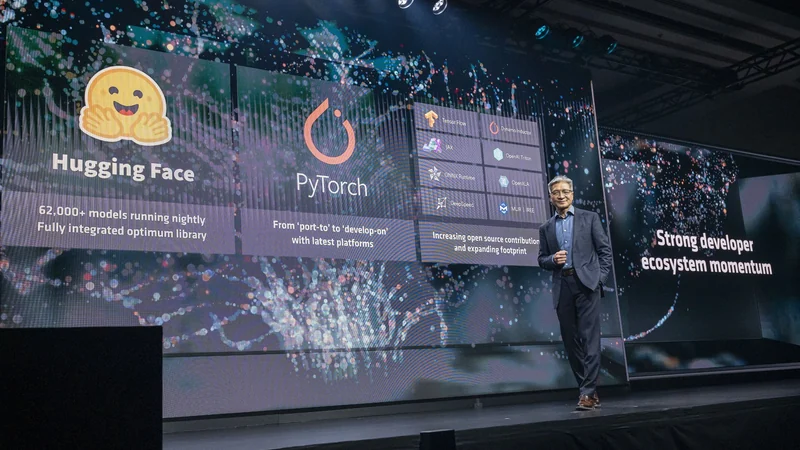
AMD and Intel are collaborating to combine their x86 CPU optimization work for PyTorch in oneDNN, reducing software fragmentation.