Claude Haiku 5.5 Launches on Amazon Bedrock and AWS
Anthropic has introduced Claude Haiku 5.5 on Amazon Bedrock and Claude Platform on AWS, positioning the model as its fastest and most efficient offering in the Claude 5.5 family.
 Radwan AbdulhadiEditor and technology writer
Introduction and Availability
The release of Claude Haiku 5.5 brings Anthropic's latest high-efficiency model to users on Amazon Bedrock and Claude Platform on AWS. According to Anthropic, the new model is designed specifically for subagents and high-volume, cost-sensitive workloads while functioning as the fastest and most efficient option in the Claude 5.5 model family.
Running the model through Amazon Bedrock allows organizations to keep their data within AWS infrastructure using Regional data residency. Teams can utilize existing AWS controls, including AWS Identity and Access Management (IAM) for access management, AWS CloudTrail for auditing, Amazon CloudWatch for monitoring, and Amazon Bedrock Guardrails, with usage reflecting directly on the standard AWS bill.
Performance Improvements and Capabilities
Claude Haiku 5.5 represents Anthropic's most capable Haiku model to date across coding, tool usage, computer use, and agentic workflows. It also introduces effort controls for the first time in the Haiku line, enabling users to tune cost against intelligence for individual tasks rather than applying a single setting to an entire workload. For most tasks, the model costs around 75 percent less than Claude Haiku 4.5.
The improvements are particularly prominent in quick and repeatable tasks at scale. For coding workflows, Haiku 5.5 operates as a subagent that routes requests, reviews code, and classifies long documents. In knowledge work environments, it extracts key insights from small-to-medium documents, performs initial scans, and answers quick questions over a knowledge base. Furthermore, it supports high-resolution images, multi-step tool use, and agentic coding.
Pairing with Claude Opus 5.5
Claude Haiku 5.5 is designed to pair directly with the recently announced Claude Opus 5.5 model. In this collaborative setup, Claude Opus 5.5 breaks down complex problems, makes high-level judgment calls, and handles heavy reasoning tasks such as release debugging, security reviews of large pull requests, and long analytical reports.
Meanwhile, Claude Haiku 5.5 manages the fast layer of subagents by executing high-volume tasks such as request routing, text classification, summarization, and small targeted updates across multiple files. This division of labor allows organizations to run multiple Haiku subagents in parallel to achieve lower cost and latency while reserving deep reasoning tokens for Opus 5.5.
Getting Started on Amazon Bedrock
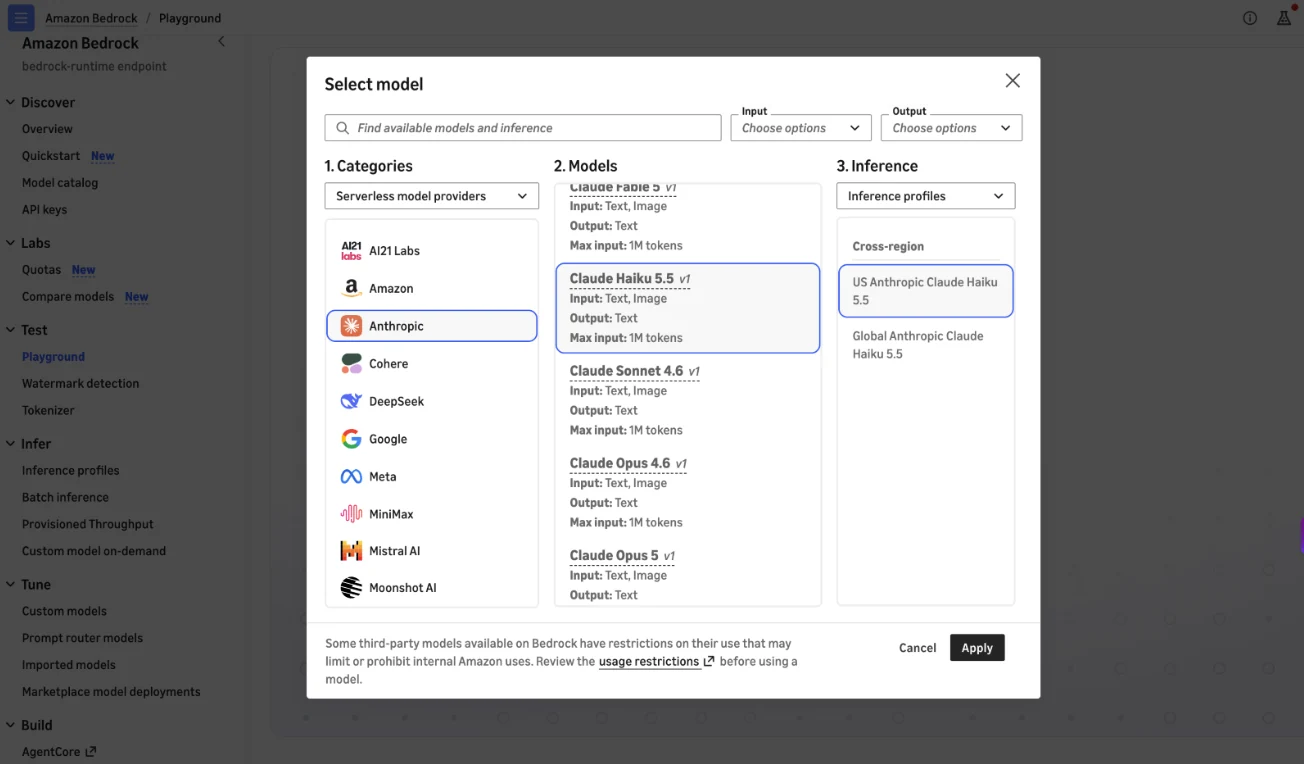
Users looking to test Claude Haiku 5.5 can access the model directly through the Amazon Bedrock console by navigating to the Test and Playground sections. Programmatic access is available via the Anthropic Messages API against bedrock-runtime using the Anthropic SDK. Additionally, developers can leverage the Invoke and Converse APIs through the AWS Command Line Interface (AWS CLI) and AWS SDK.
Prerequisites for getting started include an active AWS account with Amazon Bedrock access, the AWS CLI installed and configured, and the required Python packages installed via pip, including the Anthropic SDK and the Amazon Bedrock Token Generator. Necessary IAM permissions include bedrock:InvokeModel and bedrock:InvokeModelWithResponseStream.
Regional Availability and Resources
Claude Haiku 5.5 is available through US Geo CRIS, EU Geo CRIS, AU Geo CRIS, JP Geo CRIS, and Global CRIS inference profiles on bedrock-runtime. In AWS GovCloud (US), the model is accessible on both bedrock-runtime and bedrock-mantle endpoints. It is also available via Claude Platform on AWS in North America.
Developers can explore more implementation examples by reviewing the Getting Started notebook on GitHub. Usage, performance, and scaling costs can be continuously tracked using Amazon CloudWatch and AWS Cost Explorer as application demands increase over time.
Sources
- AWS Machine Learning BlogIntroducing Claude Haiku 5.5 on AWS
- Hugging Face BlogIntroducing Falcon ASR
Continue chronologically
Related entity coverage
Related stories
Claude Opus 5.5 Arrives on Amazon Bedrock and AWS
Anthropic's Claude Opus 5.5 model is now available on Amazon Bedrock and Claude Platform on AWS, bringing advanced capabilities for agentic coding and knowledge work.

Claude Code and Amazon Bedrock in AWS GovCloud
Discover how Anthropic Claude Opus 5.5 and Claude Sonnet 5.5 on Amazon Bedrock enable compliance-aligned, AI-assisted development for regulated workloads.
Amazon Bedrock Adds Anthropic In-Region Inference in Seoul and Singapore
Amazon Bedrock now supports Anthropic models with in-region inference in Seoul and Singapore for strict local data processing requirements.
NarrateAI Brings LLM Quality Assurance to Amazon Bedrock
NarrateAI implements five advanced quality assurance techniques on Amazon Bedrock to achieve 99% numerical accuracy with real-time streaming.