
Decommissioning Humanoid Robots: The Challenge of Retirement
The global race to deploy humanoid robots has sparked a critical, multi-billion-dollar question: how can we safely and efficiently decommission these complex machines when they reach the end of their lifecycle?
 Radwan AbdulhadiEditor and technology writer
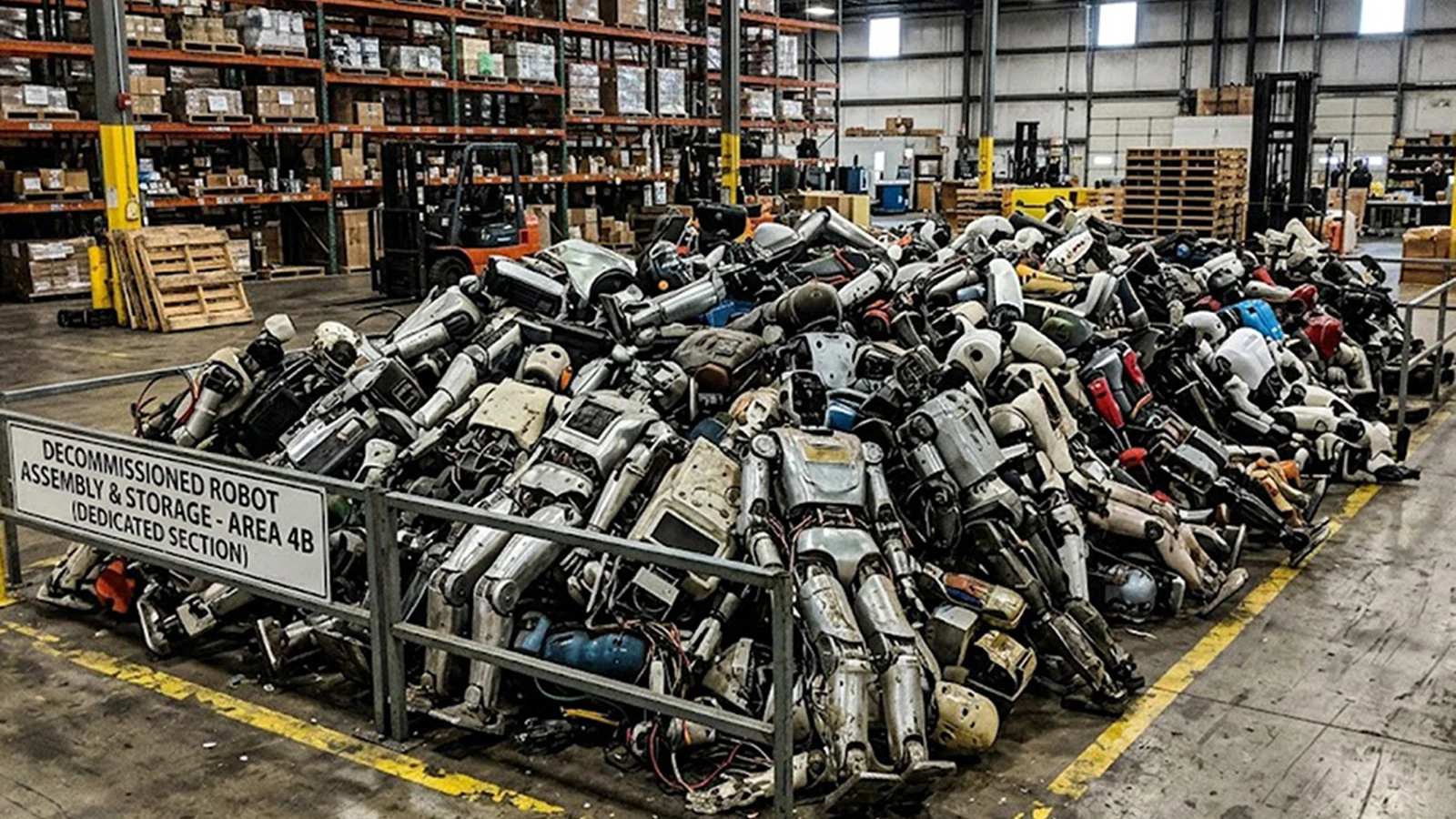
The Architectural Density of Modern Humanoids
The rapid expansion of the robotics industry has focused heavily on deployment, yet the end-of-life process for these machines remains a significant, unaddressed hurdle. Unlike standard consumer electronics, these units are incredibly complex, often containing between 10,000 and 15,000 individual parts. For manufacturers, understanding the lifecycle of humanoids requires a granular look at the subassemblies that define their functionality, including actuation and motion systems that rely on sophisticated gearboxes and motors.
A standard unit comprises 200 to 500 major sub-components organized into four core systems. The kinematic skeleton serves as the primary structural frame, utilizing materials like titanium and carbon fiber, secured by thousands of specialized fasteners. Furthermore, the artificial nervous system—which integrates various sensors and navigation arrays—relies on high-density internal cabling. These systems must be carefully managed during decommissioning to prevent structural damage or safety incidents.
Data Security and Environmental Liabilities
Decommissioning presents significant risks, particularly regarding data privacy and hazardous material management. Retired robots act as repositories for massive amounts of enterprise data, including proprietary navigation maps, facial recognition logs, and behavioral patterns. If the onboard semiconductor core is not properly sanitized or physically destroyed, these devices could serve as backdoors for corporate espionage, exposing sensitive information to bad actors.
Environmental hazards also loom large. Lithium-ion and lithium-polymer battery packs found in these units pose risks of thermal runaway if handled incorrectly, potentially leading to toxic gas releases or explosions. Safe disposal requires that these power sources be reduced to 'black mass' for element recovery. Additionally, high-velocity trapped pressure in hydraulic or pneumatic components must be systematically discharged by specialists to avoid creating deadly projectiles during the dismantling process.
The Magnet Paradox and Material Recovery
One of the most complex technical challenges involves the recovery of rare-earth neodymium magnets. A single unit may contain 3.5 to 4 kg of these materials, exceeding the amount found in an entire electric vehicle chassis. Traditional industrial recycling techniques, which typically rely on bulk crushing, are ineffective here because they cross-contaminate valuable magnets with aluminum, titanium, and other shredded materials.
Extracting these components requires a 'human-in-the-loop' approach, necessitating highly skilled technicians to perform surgical disassembly. This work is inherently dangerous; workers must navigate risks like flying shrapnel, pinch injuries, and the threat of rapid magnet oxidation, which can generate corrosive dust and spontaneous fire hazards. Because of these challenges, the current paradigm for the disposal of humanoids is viewed as unsustainable by industry analysts.
Toward a Circular Economy in Robotics
To move forward, the recycling sector is calling for closer collaboration with robotics original equipment manufacturers (OEMs). Experts suggest that future iterations of these robots must be built using design for recycling (DfR) principles. By replacing permanent industrial adhesives with standardized decoupling joints and modular cartridges, the industry could shift from manual, dangerous surgery to a more efficient, automated circular economy.
Specialized firms are already positioning themselves to manage this transition. Re-Teck, for instance, has developed global expertise in the sterilization of memory and the responsible destruction of robotic hardware. As the market for advanced automation grows, the ability to manage the lifecycle of these units will become a core competency for firms aiming to maintain sustainable and secure operations at scale.
Sources
- The Robot ReportWhat do you do with a humanoid robot when it breaks down?