
Why Humanoid Robot Demos Still Fail the Generalization Test
A recent discussion on [The Robot Report](https://www.therobotreport.com/why-humanoid-robot-demos-still-fail-the-generalization-test/) explores the challenges of moving humanoid robots from controlled demonstrations to reliable real-world performance.
 Radwan AbdulhadiEditor and technology writer
The Challenge of Generalization in Robotics
Humanoid robots and advanced automated systems frequently captivate audiences with polished video demonstrations showcasing impressive feats of dexterity and mobility. However, these controlled showcases often mask underlying vulnerabilities when deployed outside of specific laboratory conditions. As explored in depth on [The Robot Report](https://www.therobotreport.com/why-humanoid-robot-demos-still-fail-the-generalization-test/), closing the gap between a scripted demonstration and robust real-world reliability remains one of the most significant hurdles facing the robotics industry today.
The inability to reliably generalize behaviors across varied, unpredictable environments continues to frustrate developers. While a robot can successfully execute a task under optimal lighting, precise object placement, and heavily curated settings, introducing minor environmental variables often leads to failure. This reality underscores the vital distinction between producing a visually compelling proof-of-concept and engineering a truly dependable autonomous system.
Insights From GenAI Research
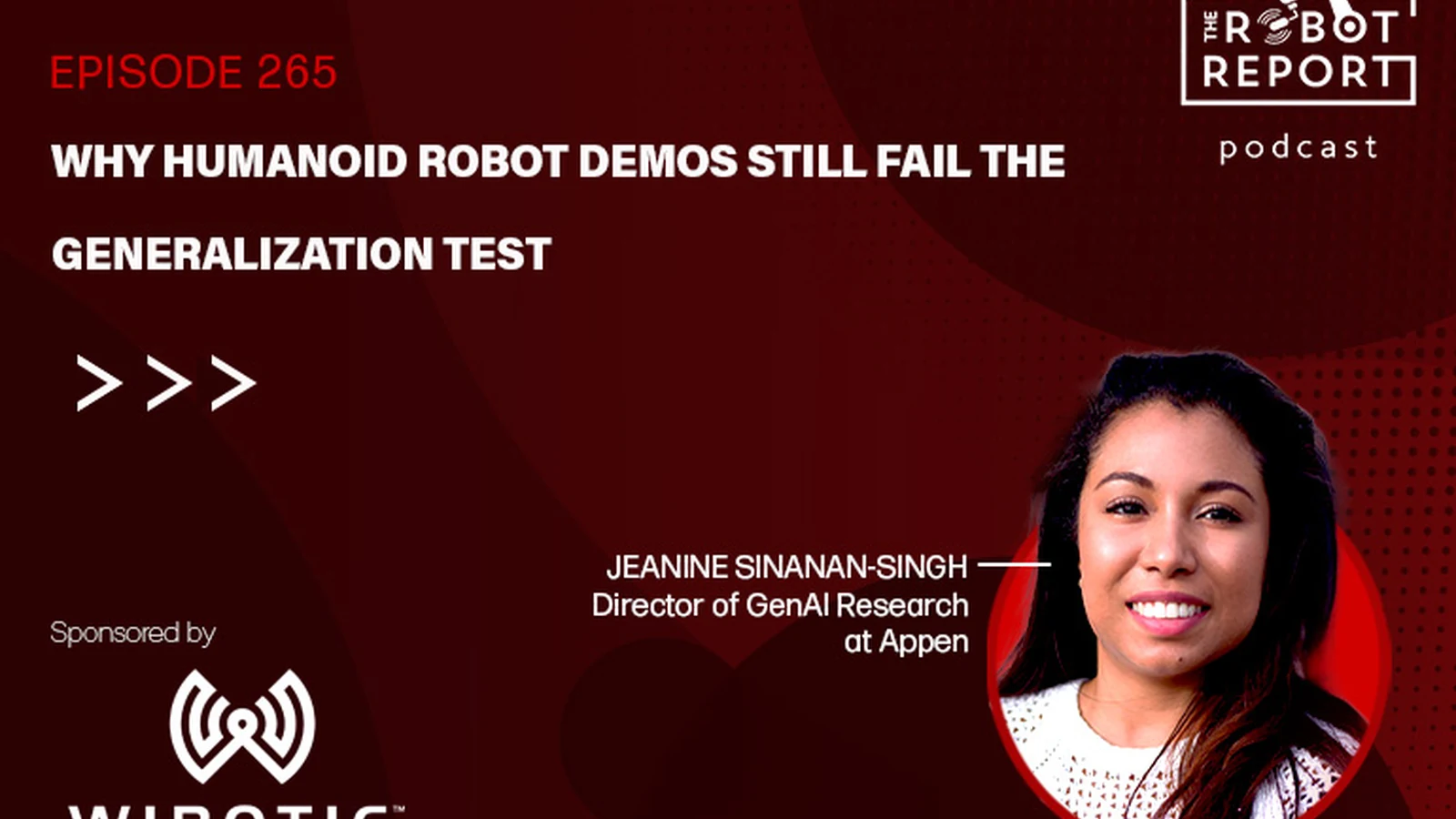
Addressing these limitations requires sophisticated approaches to data curation and model training. In Episode 265 of [The Robot Report Podcast](https://soundcloud.com/robot-report-podcast), guest Jeanine Sinanan-Singh, director of generative AI research at [Appen](https://www.therobotreport.com/tag/appen/), breaks down the core mechanics behind training modern robotic systems. Her work centers on navigating the complexities of post-training frontier AI models.
Sinanan-Singh focuses heavily on agentic evaluations, reinforcement learning environments, and comprehensive dataset design. During the podcast episode, available as [Why humanoid robot demos still fail the generalization test](https://soundcloud.com/robot-report-podcast/generalization-test), she explains why high-profile demonstrations fail to serve as accurate metrics for true behavioral generalization. Her background includes founding a pharmacy automation startup built on a 3D-printing platform for personalized medications, alongside previous experience at Microsoft and Surge.
The Persistent Need for Humans in the Loop
Despite rapid advancements in machine learning and autonomous capabilities, human judgment remains indispensable during the development cycle. Training robotic systems to interpret edge cases, correct alignment errors, and adapt to novel surroundings relies heavily on robust human oversight. Experts emphasize that data quality directly dictates model performance, making expert human feedback crucial for shaping how AI models reason and react.
As artificial intelligence models grow larger and more complex, developers face mounting challenges regarding evaluation standards. Establishing rigorous testing frameworks that mirror unpredictable physical environments ensures that robots can transition safely from controlled testing stages into functional commercial deployments. Without these rigorous evaluation loops, systems risk repeating costly errors in the field.
Broader Ecosystem Impacts and Autonomy
Achieving commercial viability for humanoids and other autonomous mobile robots extends beyond software intelligence and physical manipulation capabilities. Infrastructure components, such as reliable fleet energy management and wireless charging solutions provided by industry partners like [http://www.wibotic.com/robotreport](http://www.wibotic.com/robotreport), play a foundational role in maintaining operational uptime and returning systems safely to service throughout normal workflows.
Ultimately, closing the loop of autonomy requires a synchronized approach combining advanced physical hardware, reliable power infrastructure, and rigorous post-training AI evaluation. By addressing dataset limitations and incorporating continuous human judgment, the robotics community aims to move beyond isolated demonstrations toward scalable, dependable real-world applications.
Sources
- The Robot ReportWhy humanoid robot demos still fail the generalization test
Continue chronologically
Related entity coverage
Related stories
What AgTech Founders Get Wrong About ROI in Agriculture
Farmhand Ventures founding general partner Connie Bowen discusses return on investment challenges and the future of work in agricultural technology.

2026 Robotics Handbook Explores Humanoids and AI
The 2026 Robotics Handbook examines humanoid robots, artificial intelligence, dexterous manipulation, and automation trends in construction.
Nominations Open for 2027 TRR50 Robotics Innovation Awards
Nominations are open for the 2027 TRR50 Robotics Innovation Awards, with winners to be honored at the Robotics Summit & Expo in Boston.

Boston Dynamics Reveals Insights Into Redesigned Humanoid Hand
Boston Dynamics shares new details on its redesigned four-fingered humanoid robot hand, highlighting trade-offs, simulation, and manufacturing goals.