3M Engineering Addresses Modern Robotics Interconnects
As modern robotics systems grow increasingly faster, more precise, and dependent on AI-driven control, hardware designers face unprecedented interconnect challenges regarding motion, density, and long-term uptime.
 Radwan AbdulhadiEditor and technology writer
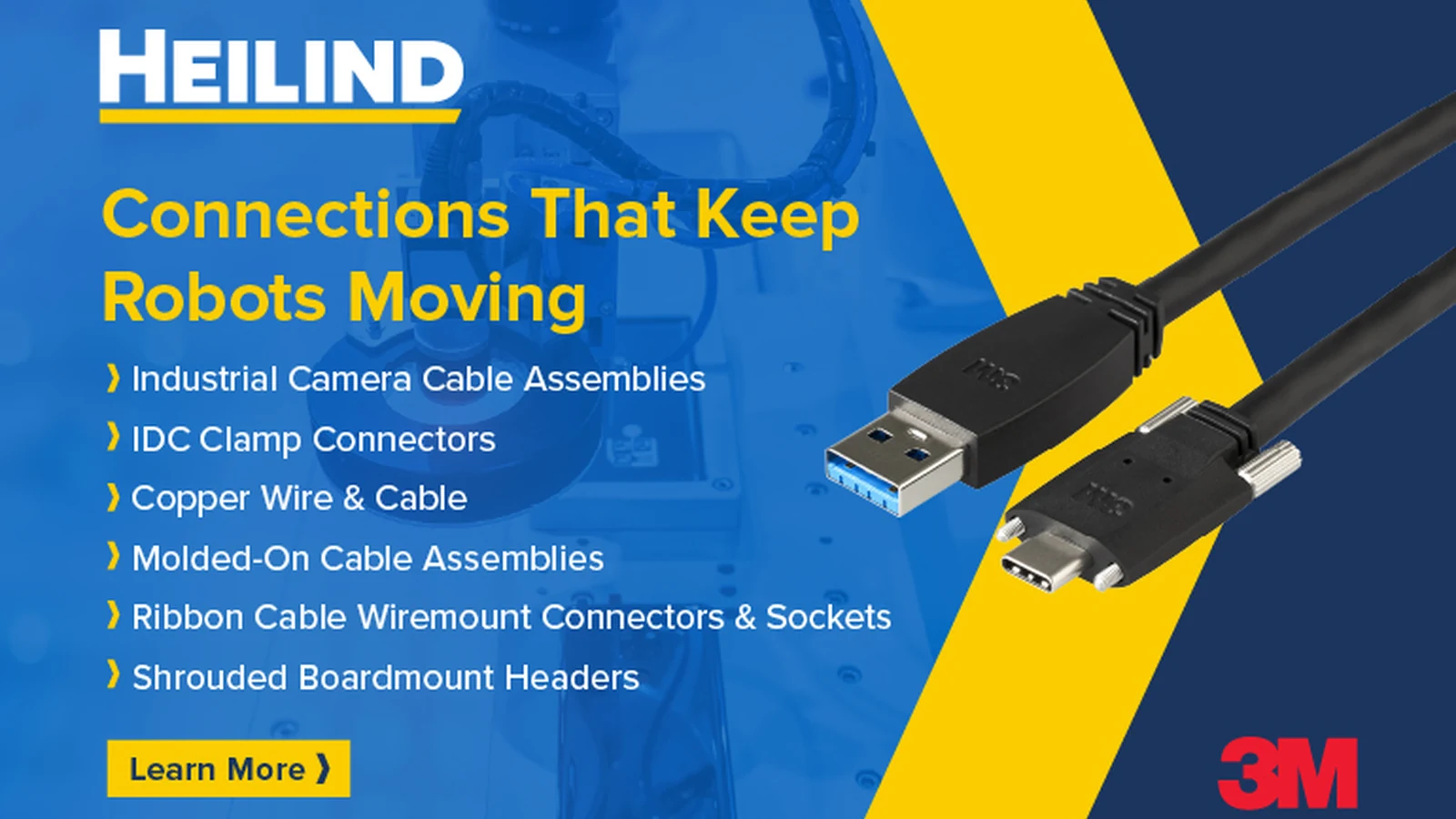
Tackling Motion and Mechanical Stress in Robotic Systems
Robotic joints, arms, and end effectors twist, bend, and cycle continuously for years without a maintenance window. Cabling that fatigues or fails under this ongoing mechanical stress is a leading cause of unplanned downtime in automated platforms. To mitigate these risks, 3M has developed a comprehensive portfolio of connectors, cables, and cable assemblies designed to address signal integrity, mechanical durability, and board real estate limitations. Further details are available from The Robot Report in the original source material.
For motion-intensive applications, the company offers high-flex cable assemblies backed by rigorous testing data. CoaXPress-compatible assemblies are flex-cycle tested up to 45 million cycles, while USB3 Vision-compatible assemblies push that rating to 100 million cycles. Furthermore, flat-ribbon options span roughly 1 million to 100 million flex cycles, allowing engineers to accurately match cable durability to specific axis or joint duty cycles.
Streamlining Production With IDC Termination
Originally invented by 3M in 1961, Insulation Displacement Contact (IDC) termination remains a critical asset in high-mix robotics manufacturing. Instead of crimping or soldering individual conductors, IDC connectors displace wire insulation during a single mass-termination step. According to company metrics, 3M IDC solutions can save up to 80% in wiring time compared with traditional crimp-style connectors.
This efficiency advantage delivers benefits across both manufacturing and field service operations. On the production floor, IDC simplifies mass termination for ribbon cables and multi-conductor harnesses carrying heavy I/O and sensor loads. In the field, many IDC-based connectors support one-hand mating and unmating to shorten service windows on production lines where extended downtime is unacceptable.
Maximizing Board Density and Footprint Efficiency
As robotic controllers and sensor modules integrate more compute and I/O into restricted footprints, connector real estate has emerged as a primary design constraint. 3M addresses this challenge through reduced-pitch options such as the Cable Socket 451 and Header 452 Series. Built at half the pitch of standard 0.100-inch grids, these components effectively double contact density within the exact same board area.
For lower pin-count applications, such as the ubiquitous two- to four-wire sensor connections found throughout modern machinery, Mini-Clamp connectors provide a compact footprint without necessitating a full IDC harness. Additionally, the Mini Stack header and socket family pushes footprint reduction even further for tight engineering specifications.
Combating Vibration, EMI, and Environmental Factors
Constant motion inevitably generates continuous vibration, which can turn marginal connections into intermittent faults. To maintain contact integrity in high-disturbance environments, several connector lines incorporate screw-lock retention mechanisms. Simultaneously, engineers must manage electromagnetic interference and crosstalk—critical variables when high-speed data lines run close to motor and power cabling.
To handle demanding environments featuring washdown, particulates, or extreme vibration, 3M provides Molded-On Cable Assemblies. These single-piece, ruggedized solutions replace traditional discrete connector-and-cable interfaces where conventional assemblies might otherwise introduce operational liabilities.
Engineering for Next-Generation Automation
As robotic systems adopt increasingly autonomous, safety-critical, and continuous roles, interconnects linking sensors, controllers, and actuators serve as crucial points of engineering leverage. Design teams looking to evaluate these validated flex ratings, IDC options, and dense board connectors can explore the complete lineup by visiting Discover Heilind & 3M to review component specifications ahead of design freezes.
Sources
- The Robot ReportSolving the Interconnect Challenge in Modern Robotics: How 3M Is Engineering for Motion, Density, and Uptime
Continue chronologically

Related stories
Why Modern Headsets and Smart Glasses Finally Make 3D Movies Worth Watching
Smart glasses and VR headsets are revitalizing 3D movies by delivering independent screens to each eye, bypassing traditional cinema limitations.
The State of Robots and Automation in Modern Manufacturing
Explore the latest advances in manufacturing robotics, covering growth in industrial automation, collaborative robots, and global adoption trends.
Asimov's Laws and Modern AI Safety Concerns
Tech leaders and lawmakers are examining whether Asimov's Three Laws of Robotics and advanced safeguards are enough to keep modern AI and robotics safe.
Microsoft Authenticator Replaces Backup With Google One
Microsoft Authenticator for Android is replacing its own password and account backup system with Google One starting in January.