Groceryshop 2026 Showcases Scaling Retail Robots Powered by AI
Recent developments displayed at Groceryshop 2026 indicate that retail robotics are expanding at scale, leveraging artificial intelligence to transform store execution and inventory management.
 Radwan AbdulhadiEditor and technology writer
The Evolution and Scale of Retail Automation
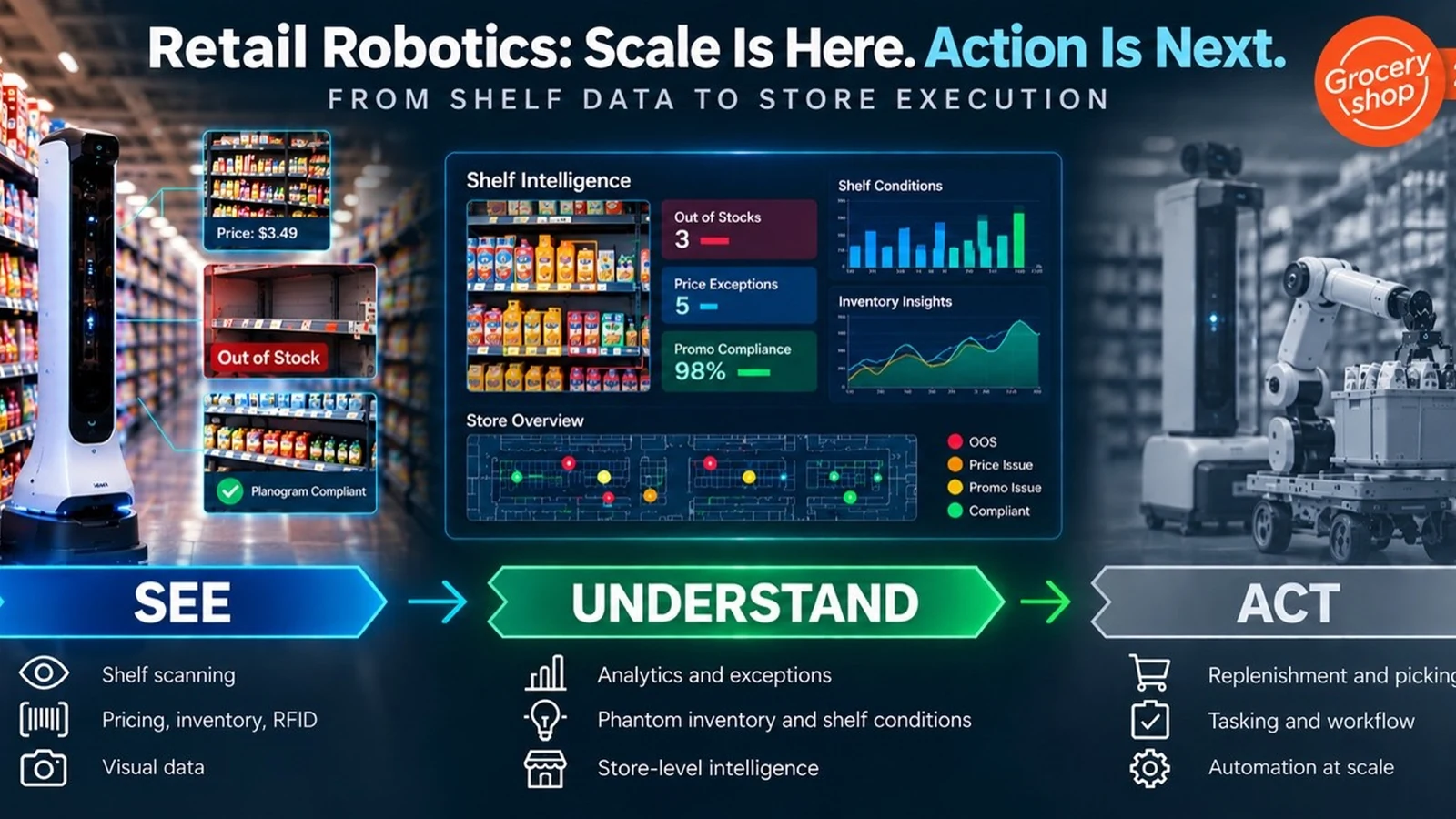
Retail automation has evolved significantly over the past decade, moving past early concerns regarding store disruption, safety, and workforce impacts. Assessments of the industry landscape at Groceryshop 2026 demonstrated that mobile inventory robots are no longer novelties but operational fixtures scaling across the retail sector. With broader deployment, developers and operators are increasingly leveraging near-real-time shelf insights across a wider variety of commercial applications.
A notable milestone highlighted during the event involved Simbe Robotics, which confirmed the completion of its global deployment scaling past 3,000 Tally units across international retailers and countries. An ongoing rollout with a Tier 1 retailer indicates that this footprint will continue to expand rapidly. Alongside hardware deployment, the company has focused on building supporting analytical capabilities, including analytics dashboards and virtual store tours, to ensure the gathered data translates into actionable insights for store operations.
Transitioning Toward Comprehensive Retail Intelligence
Industry participants are increasingly aligning their hardware offerings with data-driven software layers. Badger Technologies, supported by the manufacturing and engineering capabilities of Jabil, is executing a strategic transition under newly appointed CEO John Gehre. Rather than operating strictly as a robotics hardware provider, the company is positioning itself as a comprehensive retail intelligence enterprise.
While autonomous platforms continue to capture essential store and shelf data, the emphasis has shifted toward optimizing store-level decision-making and execution. Beyond identifying out-of-stock items and verifying price tags, the company is exploring advanced estimations regarding remaining shelf inventory, optimal replenishment windows, and product freshness tracking. This data-centric evolution reflects a broader push across the technology sector to utilize continuous data feeds efficiently.
Adapting Deployment Models for Diverse Retail Formats
Different market segments require distinct economic and deployment strategies to support automation. ShelfOptix addresses smaller-format retail environments—such as drug stores, convenience outlets, dollar stores, and regional grocery chains—using a unique deployment model. The company utilizes a foldable robot that can be transported between multiple store locations while escorted by a human worker.
This operational approach eliminates the requirement of dedicating a permanent robotic asset to a single store, thereby reducing capital hurdles and allowing for recurring audits across an expanded geographic footprint. The computer vision and actionable intelligence capabilities embedded within these deployments rely on underlying software frameworks designed to support scalable operations.
Emerging Startups Pursuing Complex Physical Automation
While observation and data collection remain dominant commercial use cases, emerging companies are beginning to tackle more complex physical tasks within retail environments. Blue Collar Robotics participated as a finalist in the startup pitch competition, focusing on the challenging task of physically picking products inside a store. The startup is developing a mobile robot intended to transfer items between shelves and shopping carts, with initial customer trials planned to validate its navigation, vision, and control systems.
Similarly, MUSE returned to Groceryshop following its previous startup pitch success to showcase expanded capabilities for its modular robotic platform. The system is designed to transport products through stores to assist with restocking, while new functional modules guide customers to specific items and support in-store promotions. Additional modules targeting picking, replenishment, security, and floor cleaning are currently in development as the company pursues wider market penetration.
The Future of End-to-End Shelf Automation
As mobile systems become increasingly proficient at continuously gathering visual, inventory, RFID, and pricing data, delivering standard application programming interfaces is no longer sufficient for market differentiation. The upcoming competitive phase will center on translating raw intelligence into direct operational changes that improve store execution. Integrating this continuous stream of physical store data into legacy systems is expected to replace reliance on traditional compliance checks and planograms, ultimately driving the development of comprehensive end-to-end shelf automation.
Sources
- The Robot ReportGroceryshop 2026 shows that retail robots are ready to scale, use AI
Continue chronologically


Related stories
Jabil Shares Insights on Humanoid Robot Scaling and Production
Jabil engineering and technology leader Thomas Brown discusses scaling humanoid robot production, managing cost structures, and physical AI integration.
Meta’s Muse AI Agent Stirs Big Hopes But Low Business Impact
Meta’s new Muse AI agent has sparked intense corporate discussion, but major companies report minimal transaction volume and low early disruption.

Meta Re-Enables Muse Sharing After Security Fix
Meta has turned Muse sharing back on and issued new URLs for shared artifacts following security researcher reports regarding public links.

Meta's Mark Zuckerberg Says Muse Enters New Monetization Phase
Meta CEO Mark Zuckerberg expects the Muse personal AI agent to generate more revenue per user than the company's existing apps.