Google DeepMind Unveils Gemini 4 Argon for Robotics
Google DeepMind has introduced Gemini 4 Argon, a new general-purpose physical reasoning model designed to improve capabilities across the entire robotics stack.
 Radwan AbdulhadiEditor and technology writer

Introduction to Gemini 4 Argon
Google DeepMind has officially announced Gemini 4 Argon, marking a step change in physical understanding, code generation, and visual-semantic reasoning. According to official details published by Google DeepMind, the new model is built to unlock new workflows across the robotics stack and accelerate progress toward physical AGI.
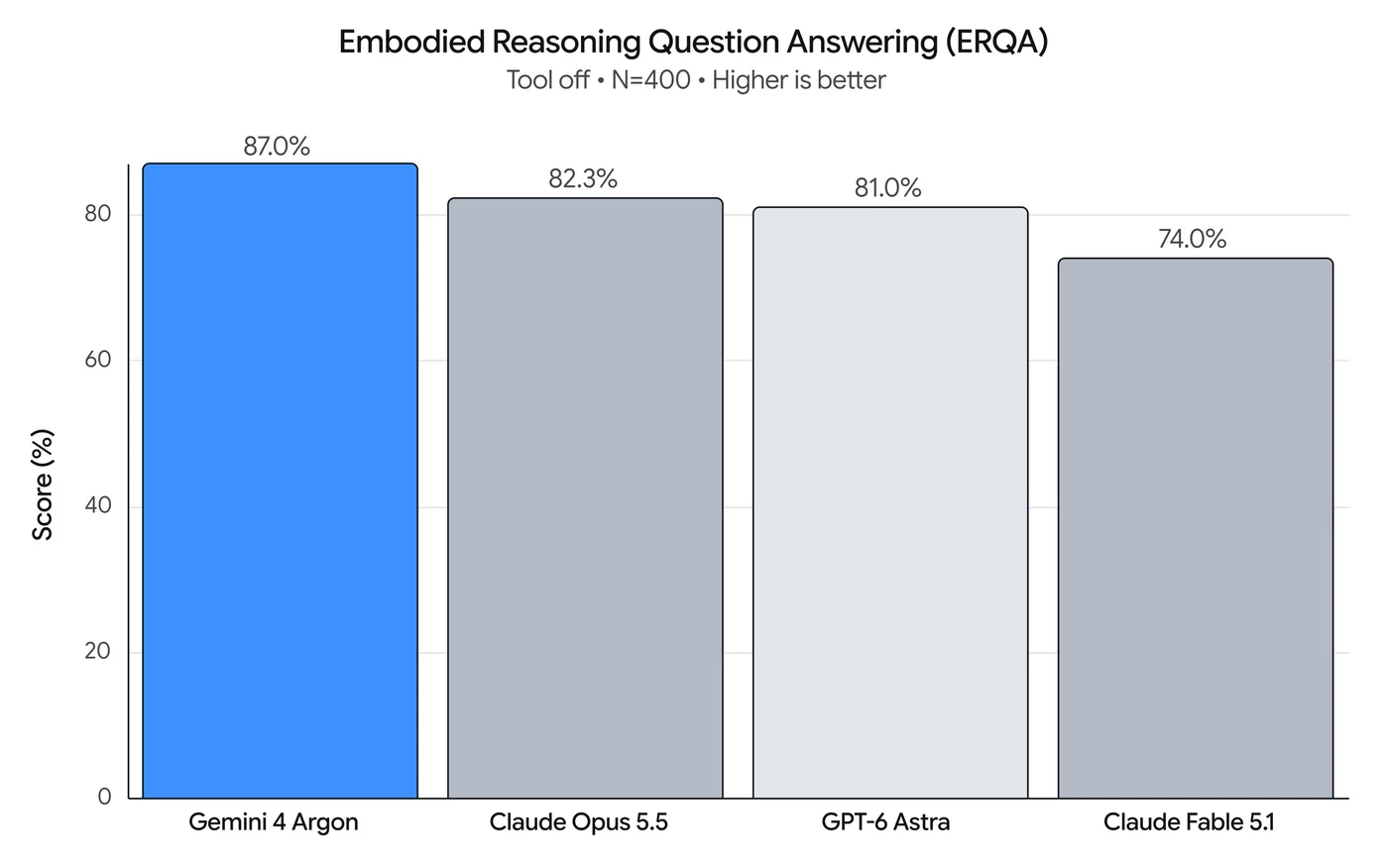
The capabilities of the new model are highlighted on the Embodied Reasoning (ERQA) benchmark, which measures a model's ability to understand and solve physical, spatial problems in 3D environments. Operating entirely on pure reasoning, Argon achieves a score of 87%, outperforming every other frontier model evaluated on the benchmark.

Robot Control and Real2Sim Capabilities
As a general-purpose physical reasoning model, Argon is applicable across the entire robotics lifecycle. In the domain of robot control, it enables mobile manipulation with practice in environments like MuJoCo, zero-shot robot control, and closed-loop steering of video world models. For example, Argon can control a Boston Dynamics Spot quadruped to step on a foot-pedal trash bin and throw away soda cans after practicing on an articulated digital twin.
In the area of Real2Sim reconstruction, Argon builds physically calibrated simulation twins from robot camera feeds, egocentric human video, or hand-drawn paper sketches. Developers can snap a photo of a rough pen-and-paper sketch showing a humanoid throwing a ball along a parabolic arc, allowing Argon to automatically construct the simulation scene and synthesize a balanced whole-body throw trajectory.
Physical Understanding and Agentic Workflows
Argon features a precise physical understanding of dexterous manipulation, providing detailed segmentation and text labeling from video data. It can identify poor manipulation segments such as pauses, unstable grasps, and fumbles. Given an overhead video of a robot folding paper into an origami fox, Argon can produce a time-aligned hierarchy ranging from episode goals down to contact-level atomic primitives.
Research and Self-Improvement
The model also supports research and self-improvement by generating new data in simulation to boost the performance of generalist vision-language-action models. Starting from a single RGB photo of a real tabletop, Argon can autonomously build a calibrated simulation twin, define new tasks, and synthesize a closed-loop motion generator to collect domain-randomized episodes.
Furthermore, Argon can read robotics control manuscripts and released checkpoints, porting physics models and closed-loop controllers into self-contained browser labs using MuJoCo WebAssembly. By natively reasoning over multi-view video, 3D geometry, contact mechanics, and proprioceptive telemetry, Argon understands how objects physically interact with agents to accomplish complex tasks.
Sources
- Google DeepMindGemini 4 Argon for Robotics
Continue chronologically


Related entity coverage
Related stories
Google DeepMind Details Gemini 4 Argon Safety and Security
Google DeepMind outlines safety, security, and mitigation measures for Gemini 4 Argon, addressing misuse, alignment, and real-time safeguards.
Google DeepMind Unveils Gemini 4 Argon Frontier AI Model
Google DeepMind announces Gemini 4 Argon, a new frontier AI model designed for real-world coding, enterprise workflows, and cyber defense.
Google Launches Gemini 4 Argon Frontier AI Model
Google has announced the global availability of Gemini 4 Argon, its latest frontier AI model designed for complex real-world tasks and deep work.

Google Introduces Gemini 4 Argon Frontier Model
Google DeepMind launches Gemini 4 Argon, a new frontier model built for complex tasks in coding, science, finance, and legal workflows.