
Google DeepMind Unveils Gemini 4 Argon Frontier AI Model
Google DeepMind has officially announced its next-generation frontier artificial intelligence model, Gemini 4 Argon, tailored for complex enterprise tasks, advanced software engineering, and cybersecurity defense.
 Radwan AbdulhadiEditor and technology writer

Introduction to Gemini 4 Argon
Google DeepMind has introduced its latest artificial intelligence system, Gemini 4 Argon, built to sustain deep reasoning across complex and long-horizon professional tasks. According to Google DeepMind, the model is designed to fundamentally change how teams build and work by delivering frontier performance in real-world software engineering, enterprise knowledge work like finance and legal drafting, and cybersecurity defense. Further details are available from Google DeepMind in the original source material.
The release process for Argon follows a phased approach to prioritize safety and rigorous testing. Google is actively participating in the United States government's voluntary process for pre-release model access while gradually expanding deployment. Feedback from early testers will help shape guardrails before the model becomes broadly available to developers, enterprises, and consumers.
Advanced Reasoning and Token Limit Expansion
To support multi-step use cases, Google has significantly expanded the model's output token limit to an industry-leading one million tokens, an increase from the previous 64,000 token limit. This headroom allows the system to think deeply and generate extensive text in a single trajectory, bringing a new level of depth to complex problem-solving.
When launching commercially, Gemini 4 Argon will carry an introductory price of $2 per million input tokens and $10 per million output tokens. Additionally, cached input tokens will be discounted by 95% off the standard input token price.
Internal Deployment and Engineering Productivity
Gemini 4 Argon is already active within internal Google workflows, where thousands of employees are utilizing its strengths for specialized coding tasks, deep research, and content generation. Among its internal achievements, the model aided quantum computing researchers by optimizing spacetime resources for important application subroutines, beating published baselines by 40% in minutes.
Furthermore, Argon agent teams analyzed fleet-wide profiling telemetry across Google's data centers to autonomously identify and apply memory optimizations. This effort is slated to free up over 300 tebibytes of memory once fully deployed, with total projected savings reaching between 500 tebibytes and one pebibyte.
Argon agents are also assisting with large-scale codebase migrations, translating C and C++ codebases to Rust across infrastructure ranging from core libraries like re2 and libgav1 to the Fuchsia operating system Zircon kernel. For libgav1, Argon agents replaced 32,000 lines of SIMD code to produce a memory-safe video decoder that operates 2.7 times faster than previous Rust ports while maintaining identical video output.
Enterprise Workflows and Benchmark Performance
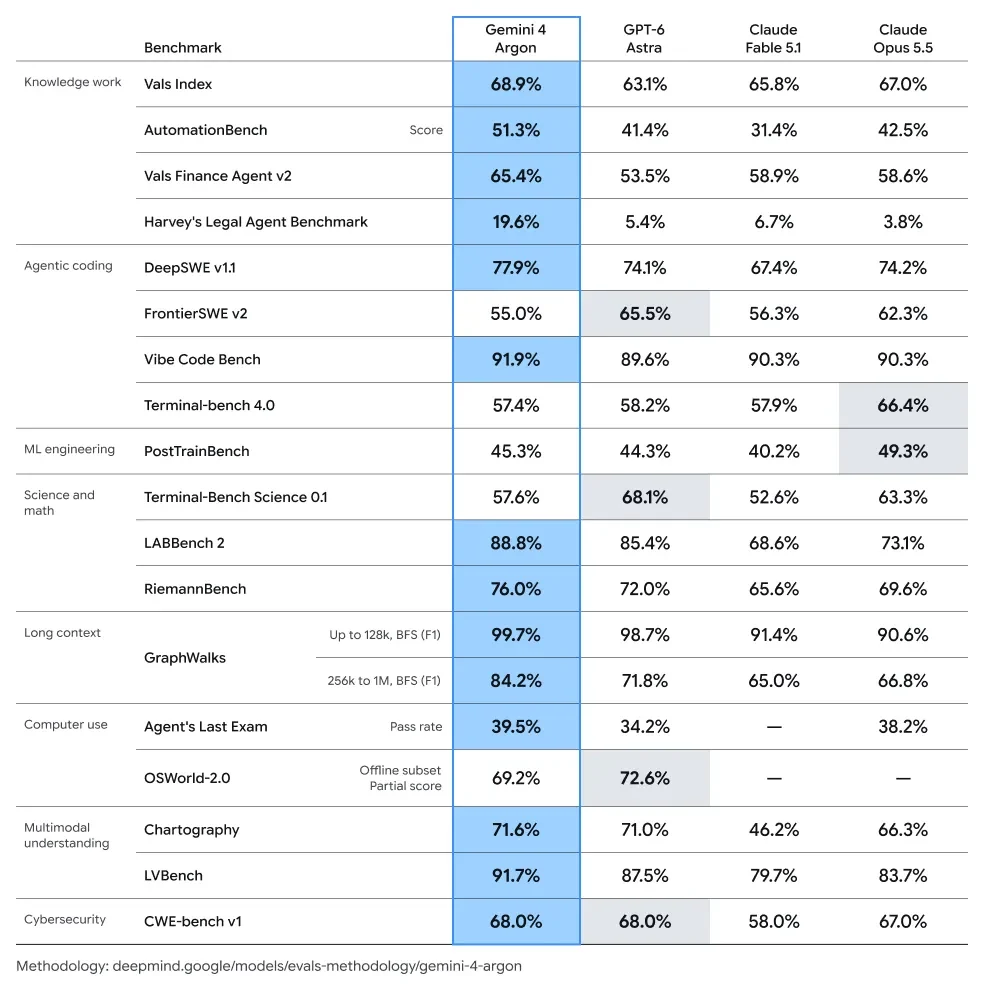
Beyond internal software engineering, Gemini 4 Argon demonstrates leading performance across multiple industry benchmarks. The model establishes a new state of the art on DeepSWE v1.1 with a score of 77.9%, evaluating performance in real-world long-horizon software engineering tasks.
Argon also achieves leading scores on the Vals Index, which measures economic impact across tax, legal, coding, and finance work weighted by U.S. GDP contributions. Similar strong results appear on specialized evaluations including Vals Finance Agent v2, Harvey's Legal Agent Benchmark, AutomationBench, and LVBench for long video understanding.
Cybersecurity Defense and the Fairwind Program
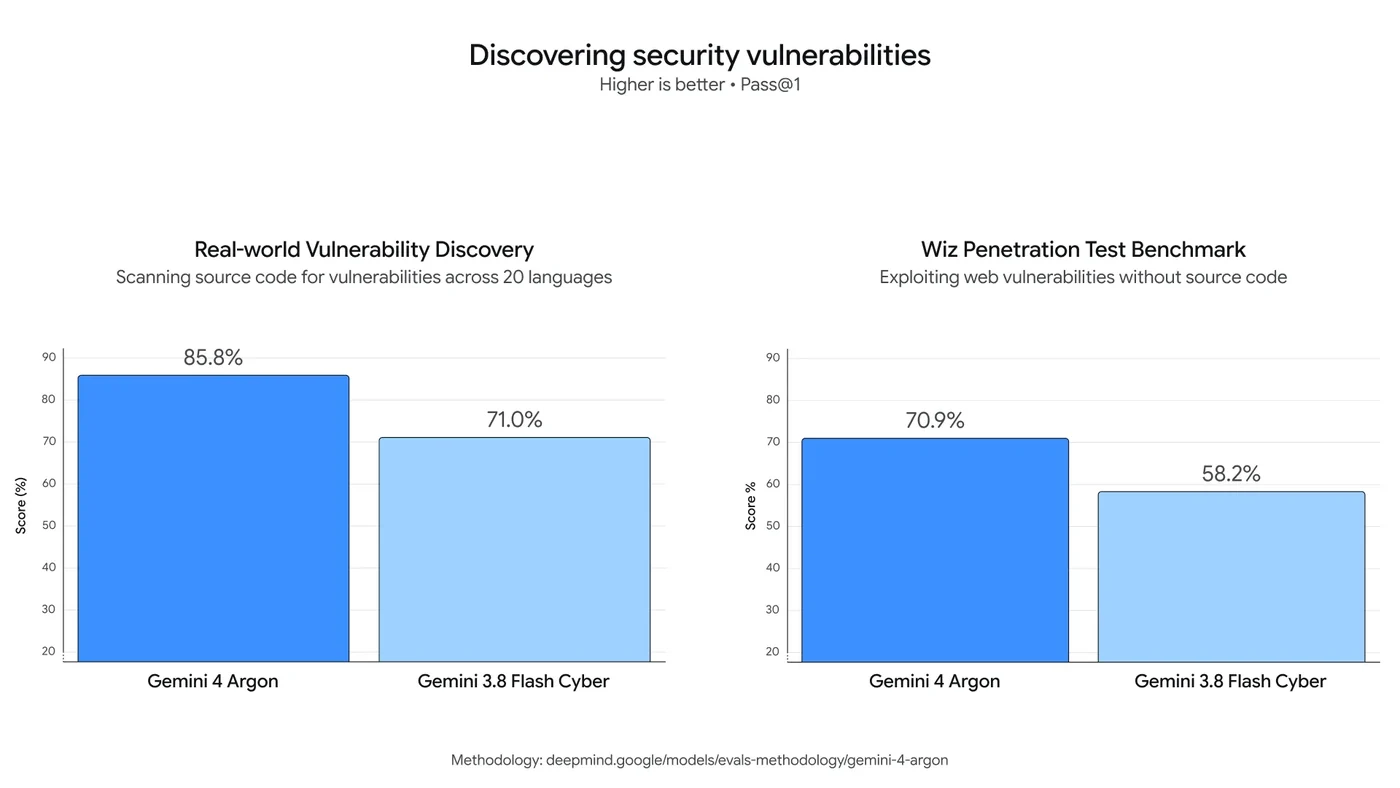
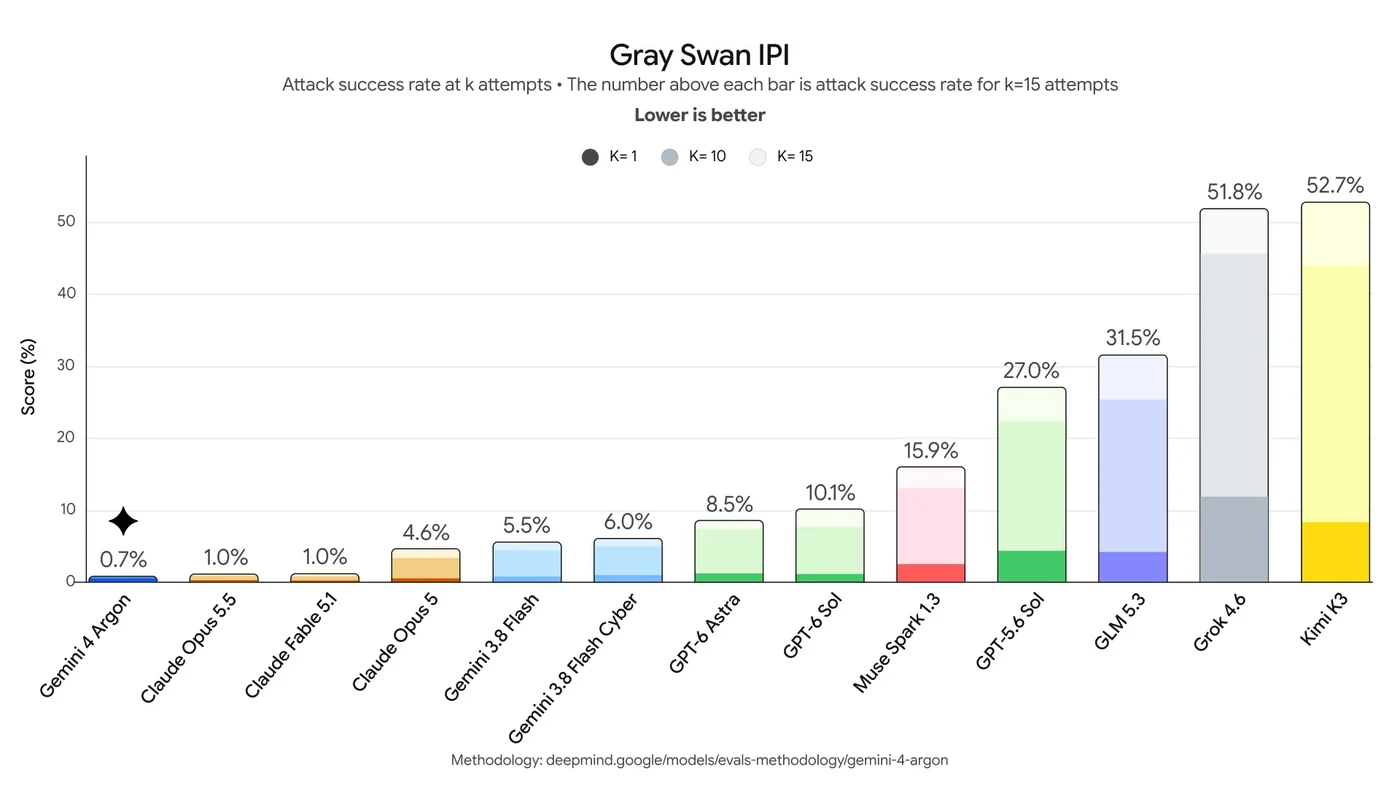
To address emerging security challenges, Gemini 4 Argon has been trained to autonomously discover, validate, and patch critical software vulnerabilities. The model is currently rolling out to trusted cyber defenders through the Fairwind Program.
Collaborating partners such as Wiz are utilizing Argon through initiatives like Scan for Good to protect critical public infrastructure. In early testing, the model identified a severe vulnerability in healthcare software used globally that had previously escaped detection by earlier frontier models.
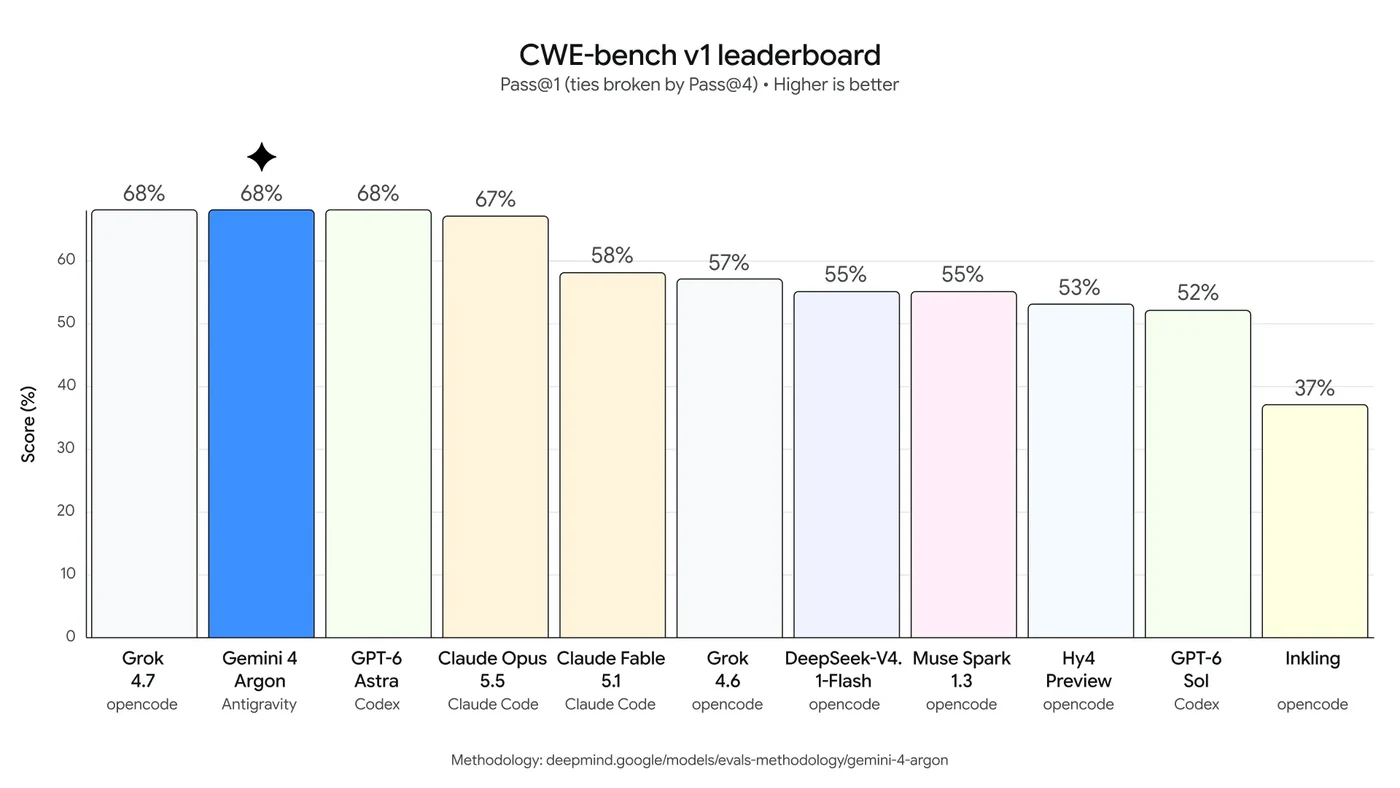
On CWE-bench v1, which evaluates vulnerability remediation, Argon achieved a top score of 68%, tying for first place and building upon previous capabilities demonstrated by 3.8 Flash Cyber on CWE-bench v0.
Sources
- Google DeepMindGemini 4 Argon: our next era of frontier intelligence