
Boston Dynamics Reveals Four-Fingered Hand for Atlas
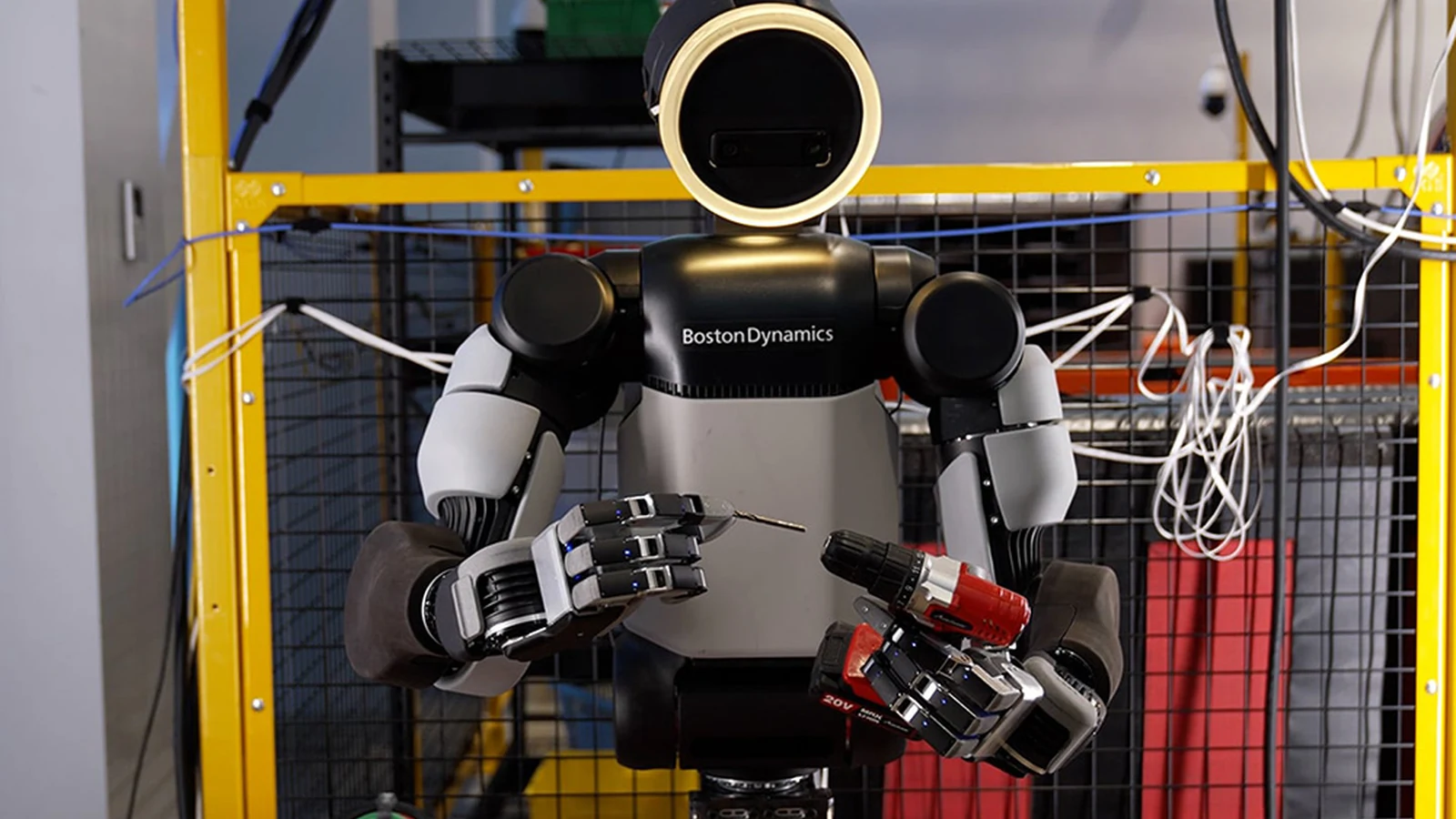
Boston Dynamics has introduced a new four-fingered hand for its Atlas humanoid robot, prioritizing reliability, direct actuation, and tool usage over mimicking a complete human hand.
 Radwan AbdulhadiEditor and technology writer
Shift from Grasping to Manipulation
Boston Dynamics has unveiled the newest hand for its Atlas humanoid, shifting focus from grasping a variety of objects to actively manipulating them. Previous versions of the Atlas hand featured seven degrees of freedom, whereas the latest iteration includes four fingers, 13 degrees of freedom, and direct actuation designed for mass manufacturing.
Alberto Rodriguez, director of robot behavior for Atlas, noted that the development involved considering many designs, including questions regarding thumb and pinky configurations. According to the company, the resulting four-fingered hand was built specifically for high-fidelity simulation to enable sim-to-real reinforcement learning.
The Decision Behind Four Fingers
When deciding on the digit count for the new robotic hands, the engineering team weighed the extra dexterity provided by a pinky against the added complexity, size, and power consumption of extra actuators. Before finalizing the design, chief product and technology officer Zachary Jackowski asked the team to tape their pinky and ring fingers together for a day to evaluate what tasks they could not accomplish.
Ultimately, the team agreed that the robot hand did not need a pinky finger. The final configuration maintains transparent direct actuation at the joints using a single actuator type, avoiding fragile cables crossing joints.
Capabilities and Tool Handling
With its 13 degrees of freedom and four fingers, the hand is capable of in-hand reorientation, recovering from slipping grasps, and handling triggered tools like drills, power torque drivers, grinders, nail guns, and welding torches. Size was a key constraint during development, requiring the hand to be similar in size to a large human hand to ensure it can reach into small spaces and grasp objects of varying dimensions.
To support agile and dexterous behaviors, Boston Dynamics equipped the hand with dense pressure tactile sensors covering the fingertips and palm. These sensors enable the system to pick up small contact signals during manipulation tasks.
Simulation and Sim-to-Real Transfer
Boston Dynamics emphasized that fast and dexterous manipulation relies on high-rate closed-loop control and force regulation alongside visual data collection. The rigid-drive actuation and backdrivable transmission allow the hand to be simulated with high dynamic fidelity, making reinforcement learning more effective at training robust control policies.
The company has reported initial results demonstrating promising sim-to-real transfer in dynamic tasks. These behaviors are trained directly in simulation with domain randomization before being deployed to hardware relying on actuator proprioception.
Integration and Industry Events
The hand reveal follows the opening of Boston Dynamics' Robotics Metaplant Application Center at Hyundai Motor Group Metaplant America in Georgia, which serves as a training center for integrating Atlas humanoids into manufacturing operations.
Industry discussions regarding robotics and automation policy will continue at events such as RoboBusiness 2026, where company representatives are scheduled to participate in panel sessions.
Sources
- The Robot ReportBoston Dynamics drops pinkie on new humanoid hand