
NVIDIA Launches Kumo Tabular Foundation Models
NVIDIA has released Kumo Tabular, a new collection of open foundation models designed to perform tabular classification and regression in a single forward pass without prior training or feature engineering.
 Radwan AbdulhadiEditor and technology writer
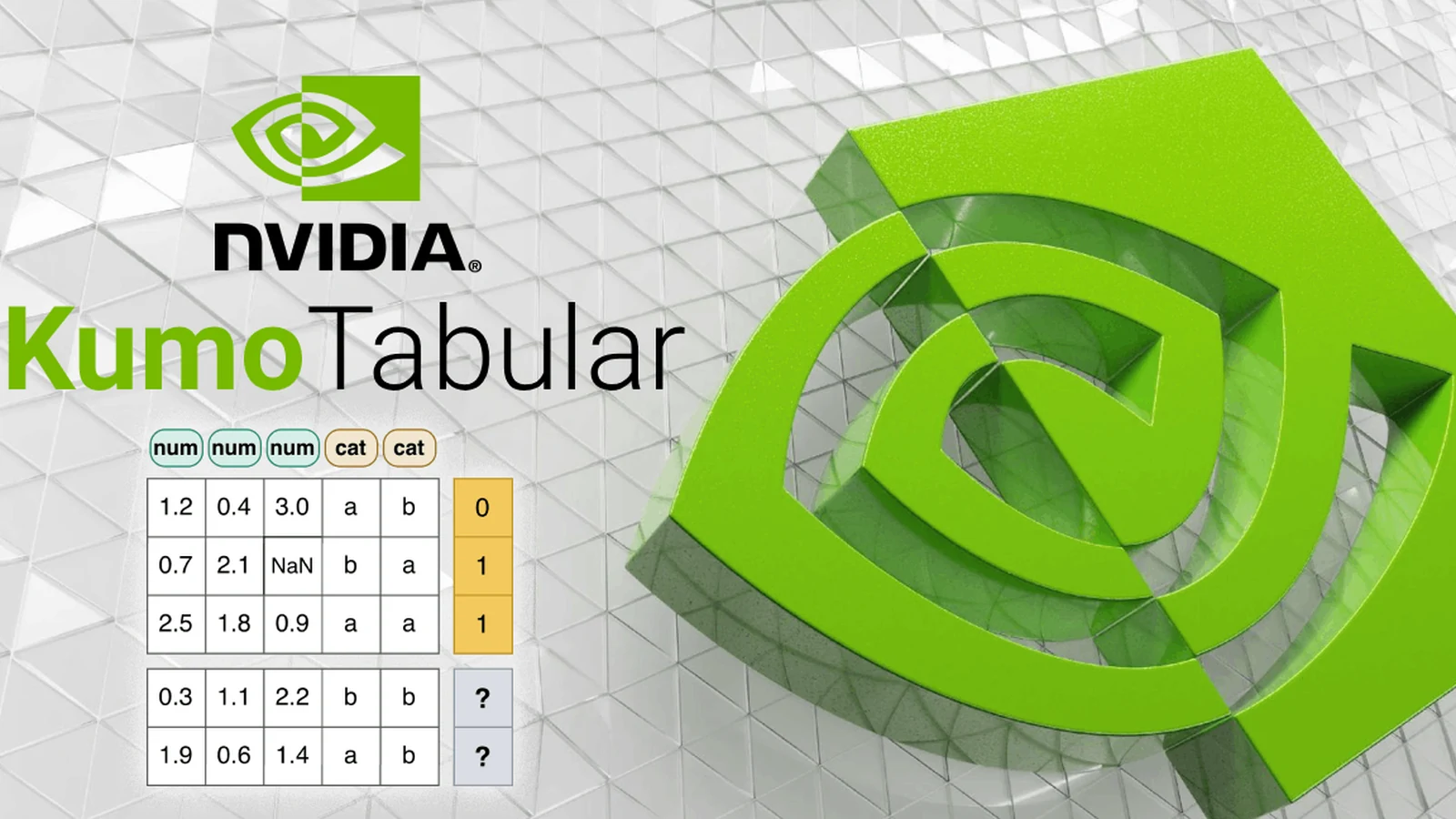
Introduction to NVIDIA Kumo Tabular
NVIDIA has announced the release of NVIDIA Kumo Tabular, an open foundation model for tabular data that is now available on the Hugging Face Blog. Part of the broader NVIDIA Kumo Structured model collection, the system is designed to predict the labels of new rows in a single forward pass given a table of labeled rows.
The new model operates without requiring any training, tuning, or feature engineering for both classification and regression tasks. Available in three different sizes spanning from 28 million to 215 million parameters, the model is released under the OpenMDW-1.1 license for commercial use and runs through an open-source library.
Architecture and In-Context Learning
Traditional enterprise machine learning has relied heavily on gradient-boosted trees for two decades, requiring extensive data collection, feature engineering, and hyperparameter tuning for every new task. Kumo Tabular introduces an in-context learning approach inspired by large language models, allowing a pretrained model to read a labeled table as its context and directly predict the labels of new rows.
Built as a Transformer around the structure of a table, Kumo Tabular utilizes column, row, and in-context attention mechanisms. To generate predictions, the model executes cell embeddings using Fourier features, row embeddings via alternating attention mechanisms to handle feature interactions, and a final Transformer operating on the row embeddings to maintain efficiency as tables scale.
Pretraining on Artificial Data and Benchmarks
Kumo Tabular was pretrained entirely on artificial tables sampled from a Structural Causal Model. This procedural generator produces an endless supply of tables featuring varied sizes, mechanisms, missing values, and outliers, allowing the model to learn how to handle real-world data imperfections without requiring manual cleanup.
Following its training phases across millions of artificial tables, Kumo Tabular has demonstrated top-tier performance on major evaluation tracks. According to evaluations, the model ranks first overall on the TabArena, BeyondArena, TALENT, and ScoringBench benchmarks.
Availability and Resource Access
Developers and enterprise users looking to deploy or evaluate the models can access the official resources and community updates hosted online. Further discussions and updates regarding the architecture can be followed via contributors on platforms like Hugging Face.
The release aims to streamline machine learning workflows for customer records, transaction logs, and industry predictions by bypassing traditional multi-step model lifecycles in favor of direct, zero-shot tabular inference.
Sources
- Hugging Face BlogNVIDIA Kumo Tabular Sets a New Accuracy-Efficiency Frontier for Tabular Prediction