NVIDIA Kumo Relational Outperforms Supervised ML
NVIDIA has introduced Kumo Relational, a pre-trained foundation model designed to make direct predictions on enterprise databases without requiring task-specific training or table flattening.
 Radwan AbdulhadiEditor and technology writer
Introduction to Relational Foundation Models
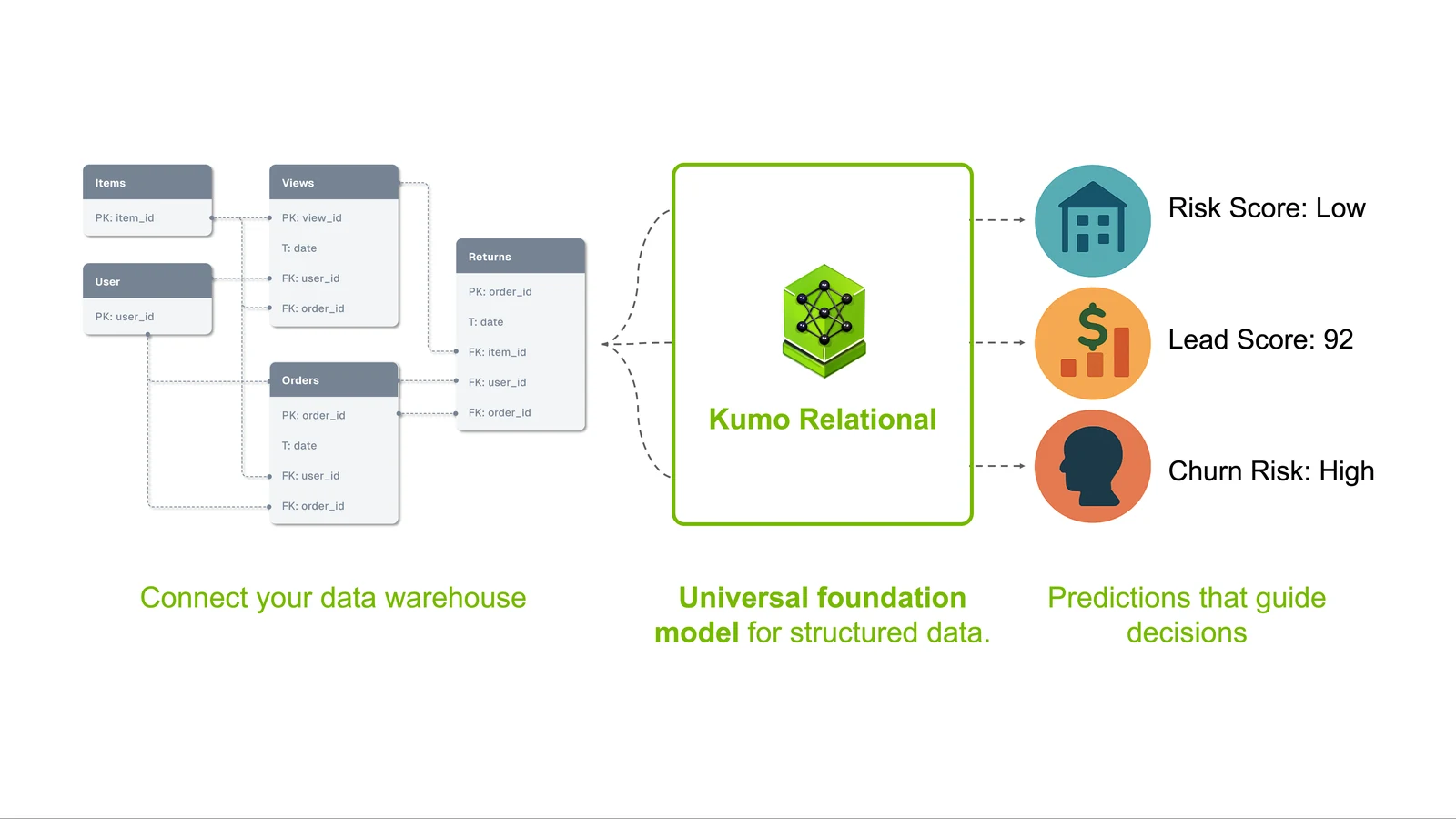
NVIDIA has announced the introduction of a new pre-trained relational foundation model designed to make predictions directly on enterprise databases. Detailed in the official announcements, the system is engineered to handle tasks such as predicting customer churn, demand, or fraud in a single forward pass without requiring task-specific training or manual feature engineering. Further details are available from Hugging Face Blog in the original source material.
While foundation models have previously transformed natural language processing and vision tasks, structured data workflows have historically relied on extensive preprocessing and pipeline tuning. The introduction of structured data foundation models aims to bring similar agility to enterprise relational databases, which power critical business decisions across industries. Further details are available from Back to Articles in the original source material.
Architecture and Automated Context Generation
Traditional predictive modeling on relational data often requires flattening complex multi-table structures into a single row, a process that can discard fine-grained structural signals. Kumo Relational operates directly on the underlying database, respecting existing tables, foreign keys, and timestamps without the need to flatten datasets.
Tasks within the framework are defined using the Predictive Query Language, a declarative interface that allows users to specify predictive goals rather than manual execution steps. For temporal tasks, the system automatically replays historical database states to sample entity-centric subgraphs up to an anchor timestamp, utilizing past data while preventing data leakage.
Multi-Stage Reasoning Within and Across Tables
To deliver accurate forecasts, the model processes inputs through a structured reasoning architecture. A lightweight network first processes each table independently by alternating column attention and row attention, filtering out noise before it spreads through the network.
Following individual table processing, a larger network distributes row embeddings across the relational layout using graph attention over primary-key and foreign-key relationships. This is combined with cross-sample attention across context examples to execute complex relational reasoning, such as linking user profiles to their historical transactions.
Benchmark Performance and Enterprise Scale
According to benchmarks highlighted by NVIDIA, Kumo Relational is the first few-shot foundation model to surpass traditional supervised machine learning on common relational benchmarks. Across multiple tasks, it reportedly exceeds the performance of expert-engineered gradient-boosted tree pipelines and supervised relational deep learning models.
Furthermore, the system demonstrates strong results on enterprise standards, outperforming competing ensembles on benchmark mean reciprocal rank metrics. Designed for large-scale production environments, the architecture scales to handle databases containing upwards of 500 billion rows.
Accessibility for Humans and AI Agents
The foundation model is built to support both human operators and autonomous agent workflows. Large language models and AI agents can interface with the system to anticipate future events, such as identifying likely customer churn patterns, and take proactive measures.
Developers can deploy and integrate the capabilities through NVIDIA's open-source, GPU-native structured-data-models library or consume the functionality directly as an NVIDIA NIM, broadening its utility across enterprise software stacks.
Sources
- Hugging Face BlogNVIDIA Kumo Relational Outperforms Supervised Machine Learning on Relational Data, No Training Required
Continue chronologically

Related entity coverage
Related stories
NVIDIA Launches Kumo Tabular Foundation Models
NVIDIA introduces Kumo Tabular, an open foundation model collection for tabular prediction delivering zero-shot accuracy and efficiency.
NVIDIA Expands Nemotron 3.5 with New Retrieval Models
NVIDIA expands its Nemotron collection with open models for embedding, reranking, and document parsing to enhance enterprise agent workflows.

NVIDIA and UW Introduce RFD4-Proteina for Programmable Protein Design
Explore RFD4-Proteina, a new BioNeMo open model co-developed by NVIDIA and the University of Washington to streamline programmable protein design.
NVIDIA and AI4Bharat Launch Indic Pretraining Corpus
NVIDIA and IIT Madras lab AI4Bharat introduce Nemotron-pretraining-Indic-v1, featuring 2.8 trillion tokens and an open data generation pipeline.