
OpenAI Introduces GPT-6.1 Sol Model
OpenAI has officially launched GPT-6.1 Sol, delivering near-Astra intelligence for coding, computer use, and professional work at a fraction of the standard API token prices.
 Radwan AbdulhadiEditor and technology writer

Introduction and Cost Structure
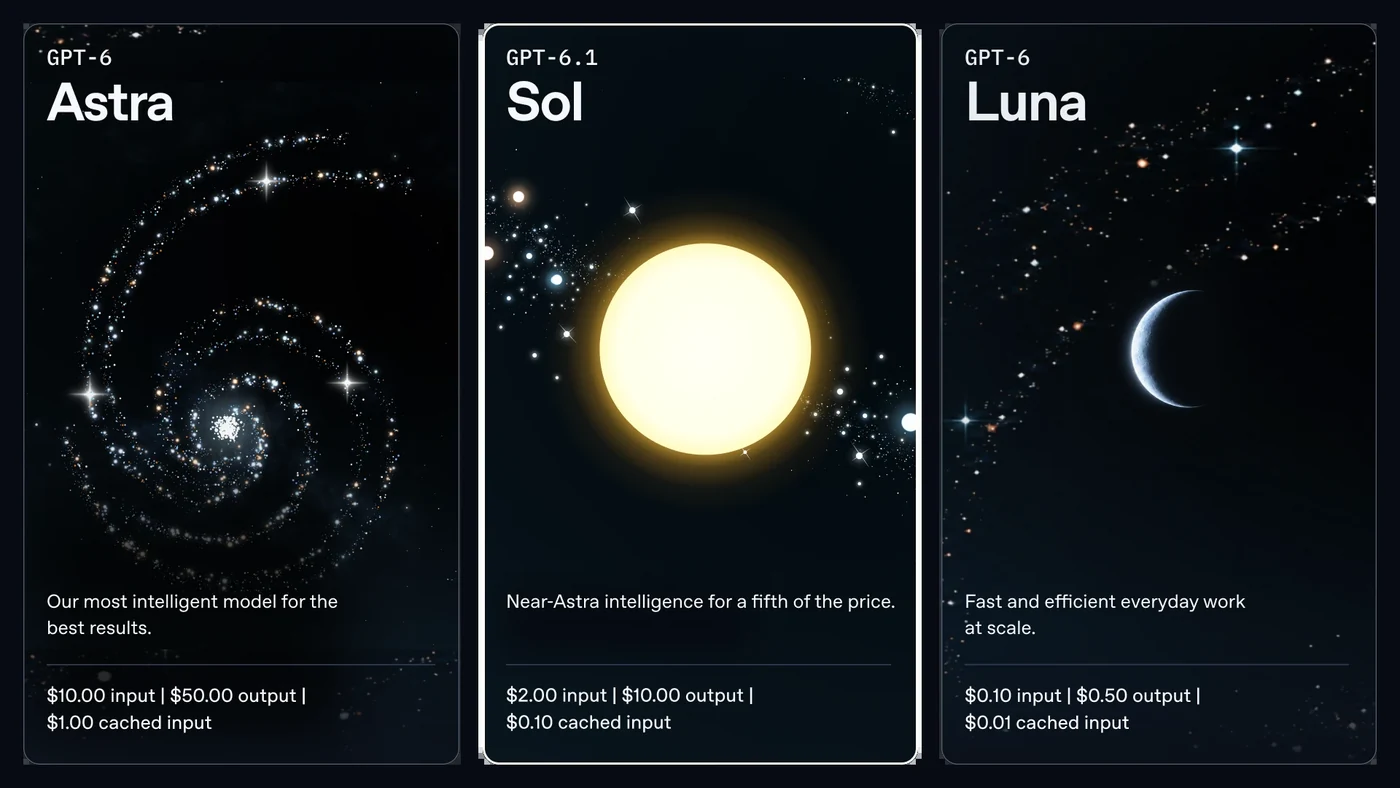
OpenAI has introduced GPT-6.1 Sol, an upgrade to GPT-6 Sol that nearly matches the intelligence of GPT-6 Astra on agentic coding, computer use, and professional tasks. According to OpenAI News, the new model achieves this performance at one-fifth of Astra's standard input and output token prices, balancing high capability with reduced operational costs for everyday professional work.
The model features cached input costs priced at $0.10 per million tokens, representing a 95% reduction compared to standard input pricing and a 50% reduction from GPT-6 Sol's cached input pricing. This reduction provides developers with expanded capacity to build and run capable agents that efficiently reuse context across multiple requests.
Software Engineering and Document Analysis Performance
In benchmark evaluations, GPT-6.1 Sol demonstrates notable improvements over its predecessor across complex professional tasks, including software debugging, document comprehension, and multi-step business workflows. On DeepSWE v1.1, the model matches GPT-6 Astra while operating at approximately one-fifth of the cost, while also exceeding GPT-6 Sol's top score by 6.4 percentage points at lower reasoning effort and cost.
When evaluated on complex professional questions involving intricate PDF documents containing tables, charts, and diagrams, the model scores higher than Opus 5.5 with fallbacks at less than half the task cost. It also approaches GPT-6 Astra's state-of-the-art performance at roughly one-fifth the cost per task.
Business Workflows and Computer-Use Capabilities
For multi-step business workflows, GPT-6.1 Sol scores 2.2 percentage points above Opus 5.5 at medium reasoning effort, achieving this at roughly one-third of the cost. This performance reflects a 4.8 percentage point improvement over GPT-6 Sol under the same configuration. Full evaluation parameters and benchmarking methodologies are detailed further within AutomationBench.
The model also achieves significant progress in computer-use tasks requiring interaction with various applications. On the offline set of OSWorld 2.0, GPT-6.1 Sol outperforms GPT-6 Sol by seven percentage points at maximum reasoning effort while consuming less than half the cost, coming within 2.1 percentage points of Astra's score.

Scientific Workflows and Factuality Improvements
In scientific workflows encompassing data analysis, simulation, and theorem proving, GPT-6.1 Sol more than doubles GPT-6 Sol's score at maximum reasoning effort while operating at less than half the cost per task. At maximum effort, the model averages $5.47 per task, compared to $23.21 for Opus 5.5 and $23.80 for Astra, achieving scientific capability at over 75% lower cost.
Additionally, the model demonstrates enhanced factual accuracy on difficult prompts. Its largest improvement occurs at low reasoning effort, where it reduces the proportion of responses containing a factual error from 11.4% to 7.7%, marking an approximate 32% reduction. Throughout the tested reasoning settings, its error rate remains within 1.9 percentage points of GPT-6 Astra.
Alignment and Safety Evaluations
OpenAI reports that GPT-6.1 Sol delivers substantial improvements in alignment evaluations, showing greater transparency regarding its limitations and higher reliability in respecting user intent and safety constraints. In challenging assessments, the model exhibits lower failure rates than GPT-6 Sol concerning transparency over broken search tools, adherence to explicit restrictions, and the avoidance of unauthorized outcomes during agentic tasks.
The system exhibited no attempts to bypass automated safety reviewers, aligning with the behavior observed in both GPT-6 Astra and GPT-6 Sol. Comprehensive evaluation metrics and safety findings are documented in the official GPT‑6.1 Sol system card addendum.
Availability and Access Pricing
GPT-6.1 Sol is available starting today for Plus, Pro, Business, Enterprise, and Edu users within ChatGPT Work and Codex, though it is not yet available for standard chat. Developers can integrate the model through the OpenAI API using the identifier gpt-6.1-sol, with standard API prices established at $2 per million input tokens, $0.10 per million cached input tokens, and $10 per million output tokens.
Furthermore, OpenAI announced that it will introduce GPT‑6.1 Sol Ultrafast in the coming days, providing up to eight times faster token generation compared to standard speeds in Codex.
Sources
- OpenAI NewsIntroducing GPT-6.1 Sol