NVIDIA and UW Introduce RFD4-Proteina for Programmable Protein Design
Co-developed by NVIDIA and the University of Washington, the new RFD4-Proteina model unifies sequence and all-atom structure generation to improve programmable protein design workflows.
 Radwan AbdulhadiEditor and technology writer
Unifying Protein Design Workflows
Traditional protein design workflows typically split tasks across multiple distinct models handling separate modalities or stages, which can lead to information loss at every handoff. To address this, the open-source community can now access tools like the RFD4-Proteina model on the Hugging Face platform.
Co-developed by NVIDIA and the University of Washington's Institute for Protein Design, RFD4-Proteina is a BioNeMo open model designed for programmable protein design. It brings protein sequence and all-atom structure generation into one model, reducing the need to transition between separate backbone, sequence, and structure design models. Furthermore, it operates across diverse molecular contexts such as other proteins, small molecules, nucleic acids, glycans, metal ions, and modified amino acids like phosphorylated residues.
Under the Hood: Architecture and Flow-Matching
RFD4-Proteina pairs an autoencoder with a flow-matching model. The autoencoder represents standard or modified amino acids, sugars, and DNA or RNA nucleotides as anchor-atom coordinates paired with a learned latent vector that encodes chemical identity and local geometry. Meanwhile, the flow model generates these anchor coordinates and latent vectors simultaneously, allowing the decoder to expand them into complete all-atom three-dimensional structures and sequences.
This architecture enables the system to generate sequences and structures concurrently around specific supplied constraints, such as a targeted binder engagement site or a necessary catalytic motif. Users can explore these capabilities through browser-based environments, including a dedicated RFD4-Proteina Space.
Browser-Based Testing and Sponsored Access
Researchers and developers can run the model directly in their web browsers without prior installation by utilizing Hugging Face Spaces. Options include a ZeroGPU Space running on shared capacity and a dedicated Space backed by high-performance hardware. Users can begin with provided examples, inspect targets and generated designs, and save outputs for subsequent analysis.
Additionally, NVIDIA is sponsoring free access to the dedicated RFD4-Proteina Space running on NVIDIA RTX PRO 6000 GPUs from October 21 to November 4, 2026. This window allows practitioners to test their own design problems, including submissions for the protein design competition sponsored by Anthropic and Adaptyv. After the sponsored period concludes, the ZeroGPU Space will remain available for free use under standard Hugging Face account quotas.
Interactive Viewing and Iterative Refinement
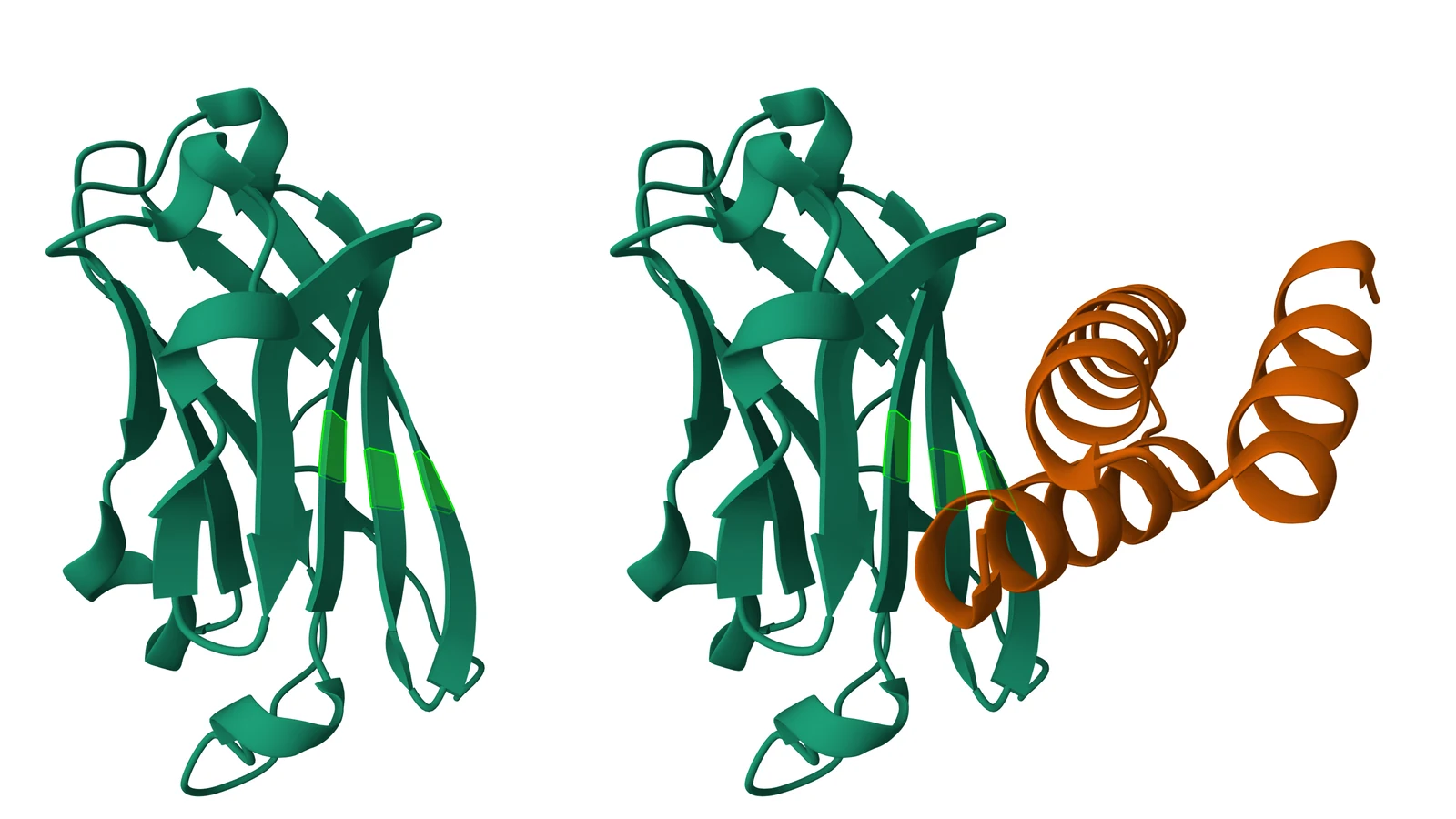
Both Spaces operate AtomWorks Studio, a browser-based viewer and annotation editor tailored for molecular inputs. Every design session begins with a defined context, which includes a target protein structure, a binding region, and specific engagement points known as hotspots marked on the target atoms.
Once a design is generated, users can inspect whether the protein contacts the target hotspots and download the resulting structures, annotated targets, and complexes in CIF format. By adjusting generation parameters such as the random seed or the newly introduced thinking settings, researchers can explore alternate samples, evaluate developability properties, and prepare files for in silico validation.
Thinking Settings and Benchmarking Performance
RFD4-Proteina introduces a thinking setting—available in low, medium, and high configurations—that dictates how much the model refines each design during generation. While additional refinement increases the compute required per sample, it also raises the probability of producing high-quality designs that successfully pass strict computational criteria.
In benchmarks across 24 protein-binding targets, RFD4-Proteina at high thinking yielded 76.40 structurally distinct designs per GPU-hour that satisfied defined computational filters, significantly outperforming comparative methods in the benchmark.
Sources
- Hugging Face BlogProtein Design with RFD4-Proteina and Hugging Face Spaces
Continue chronologically

Related entity coverage
Related stories
US and China Discuss AI National Security Alert Mechanism
US and Chinese officials are exploring a framework to notify each other of AI incidents that could pose national security risks amid growing safety concerns.

Why OpenAI Skipped Nvidia’s Open Agent Safety Platform
Explore why OpenAI is privately working with Nvidia on agent security while remaining absent from Nvidia's new industry-wide safety consortium.

NVIDIA Expands Nemotron 3.5 with New Retrieval Models
NVIDIA expands its Nemotron collection with open models for embedding, reranking, and document parsing to enhance enterprise agent workflows.

NVIDIA and AI4Bharat Launch Indic Pretraining Corpus
NVIDIA and IIT Madras lab AI4Bharat introduce Nemotron-pretraining-Indic-v1, featuring 2.8 trillion tokens and an open data generation pipeline.