NVIDIA Introduces Cosmos3-H-Dreams for Surgical Simulation
NVIDIA has expanded its generative simulation capabilities into clinical surgery with the introduction of Cosmos3-H-Dreams, a system designed to model complex anatomical interactions and surgical procedures in real time.
 Radwan AbdulhadiEditor and technology writer
Advancing Generative Simulation in Clinical Surgery
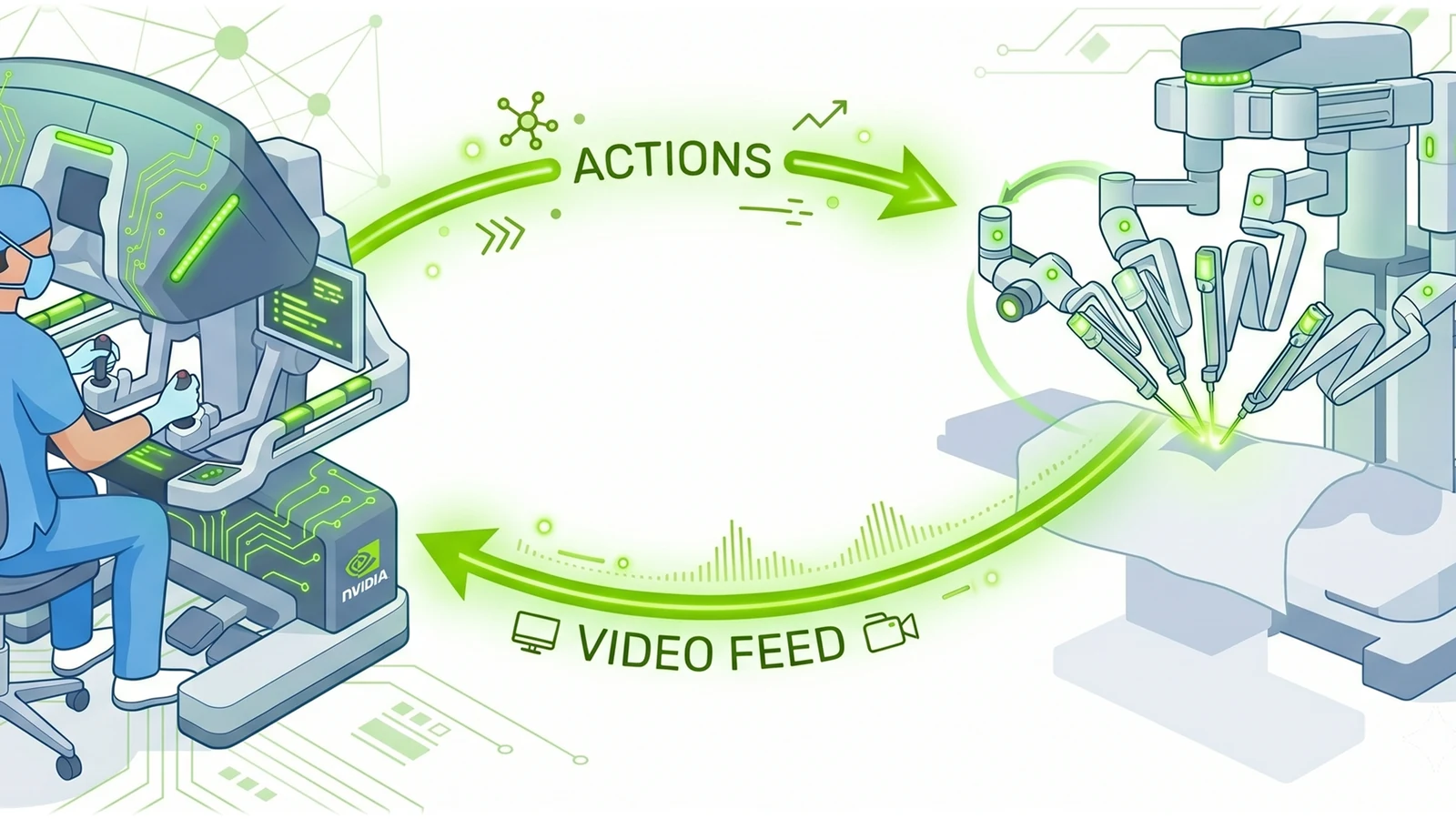
Moving beyond basic tabletop environments, NVIDIA has introduced Cosmos3-H-Dreams to bring interactive generative simulation to the visual and procedural complexity of clinical surgery. Detailed in the official [Hugging Face Blog](https://huggingface.co/blog/nvidia/cosmos3-h-dreams), the technology delivers convincing in-body imagery that responds dynamically to user actions.
The initial release in this domain, [Cosmos-H-Dreams](https://huggingface.co/blog/nvidia/cosmos-h-dreams), focused on tabletop suturing using the dVRK platform to establish a foundational proving ground for surgical robotics. Rather than explicitly modeling complex scene geometry, tissue deformation, and physical interactions, that world foundation model learned visual dynamics directly from synchronized video and robot kinematics to achieve high realism in tabletop task simulations.
Training on Clinical Cholecystectomy Recordings
Expanding on previous iterations, Cosmos3-H-Dreams learns directly from video and robot kinematics recordings captured during clinical procedures executed on the CMR Surgical Versius platform. According to the development team, this marks the first real-time generative surgical simulator trained on clinical cholecystectomy recordings capable of supporting live kinematic control.
Operating inside the human body presents significant technical challenges compared to controlled tabletop environments. Small instrument movements can alter an entire scene as tissues stretch under traction, reflections shift, structures experience occlusion, and smoke impacts visibility. To preserve anatomical and instrument consistency over time, the generative simulator must accurately capture these responses while mitigating the accumulation of errors across sequential video blocks.
Architecture and Real-Time Streaming Inference
Under the hood, Cosmos3-H-Dreams builds upon Cosmos3-H-Embodied-Nano, a 16-billion-parameter model pretrained on Open-H-Embodiment. The system specializes a bidirectional teacher model using curated cholecystectomy video and kinematics data, sampling specifically for two visible and engaged instruments—a left Cadiere grasper and a right monopolar hook—while limiting camera commands to emphasize instrument-driven interaction.
Powered by Cosmos 3 and accelerated via FlashDreams, NVIDIA’s streaming-inference library, the model operates interactively on a single NVIDIA RTX PRO 6000 GPU. Maintaining low latency in a live control loop is essential for ensuring that translation, rotation, and gripper commands produce coherent and physically accurate anatomical consequences.
Teacher-to-Student Distillation and Checkpoints
The platform utilizes a structured training pipeline that adapts the bidirectional teacher across extended horizons before distilling it into a causal student model. This causal student is capable of generating video in short blocks as new actions arrive, utilizing causal teacher forcing and self-forcing techniques guided by a learned critic to prevent error accumulation during long rollouts.
Cosmos3-H-Dreams provides developers with both four-step and two-step student checkpoints for cholecystectomy procedures. While fewer denoising steps reduce inference time, they may affect overall visual quality, allowing developers to fine-tune the balance between performance and fidelity. Furthermore, an adapted FadeMem module consolidates the growing key/value cache to manage attention history effectively during extended streaming generation sessions.
Generalization and Future Research Directions
To handle complications and novel surgical movements not explicitly present in the training data, the simulator successfully generalizes to produce coherent frames conditioned on instrument actions recorded via VR headsets. Demonstrations indicate that distinct control sequences can yield physically accurate tissue deformations from the same initial frame.
Looking ahead, NVIDIA has provided a complete step-by-step guide and recipe for teacher fine-tuning and self-forcing distillation, enabling researchers to adapt the model to alternative datasets and embodiments. Future research directions include modeling entire clinical procedures comprehensively and combining learned visual realism with explicit numerical geometry, contact mechanics, and tissue physics.
Sources
- Hugging Face BlogNVIDIA Cosmos3-H-Dreams: Bringing Clinical Surgery to Life Through Generative Simulation
Continue chronologically

Related entity coverage
Related stories
NVIDIA Launches Kumo Tabular Foundation Models
NVIDIA introduces Kumo Tabular, an open foundation model collection for tabular prediction delivering zero-shot accuracy and efficiency.
NVIDIA Expands Nemotron 3.5 with New Retrieval Models
NVIDIA expands its Nemotron collection with open models for embedding, reranking, and document parsing to enhance enterprise agent workflows.

NVIDIA Launches Nemotron 3.5 Transcribe and Granary v2
NVIDIA introduces Nemotron 3.5 Transcribe and Granary v2, delivering advanced multilingual transcription, speaker attribution, and promptable audio tools.
NVIDIA and UW Introduce RFD4-Proteina for Programmable Protein Design
Explore RFD4-Proteina, a new BioNeMo open model co-developed by NVIDIA and the University of Washington to streamline programmable protein design.