Meta’s Muse Spark Open Available in SageMaker JumpStart
Meta's new coding-optimized open-weight reasoning model, Muse Spark Open, has arrived in Amazon SageMaker JumpStart, bringing a 1 million-token context window and multi-modal support to AWS users.
 Radwan AbdulhadiEditor and technology writer
Introduction to Muse Spark Open on AWS
Muse Spark Open, Meta’s coding-optimized open-weight model, is now available in Amazon SageMaker JumpStart, the machine learning (ML) hub of Amazon SageMaker AI. The model was trained on real developer workflows, such as multi-file refactors and long debugging sessions, supporting a massive context window of 1 million tokens. Developers can deploy the model to a SageMaker AI endpoint in their own AWS account without managing the underlying serving infrastructure.
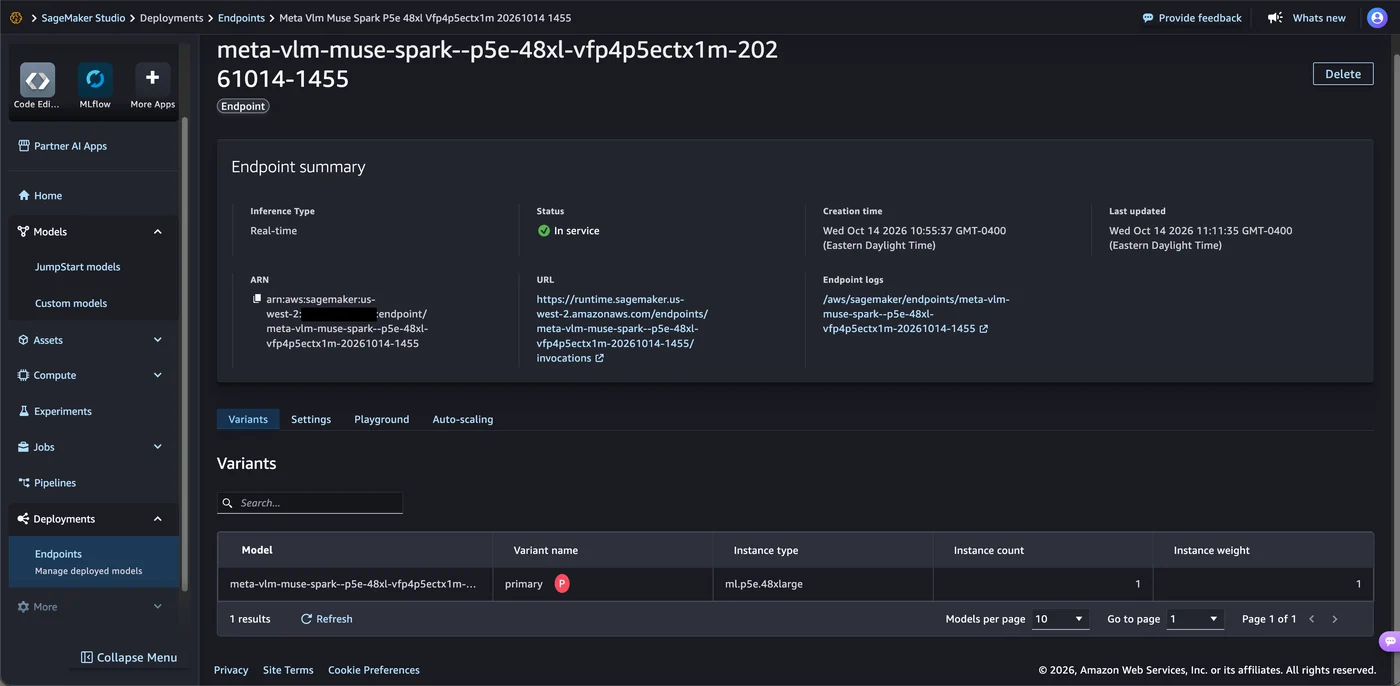
SageMaker JumpStart offers two distinct variants for deployment: the BF16 variant (Muse-Spark-Open-816B-A42B) and the NVFP4 quantized variant (Muse-Spark-Open-816B-A42B-NVFP4). Users can choose to deploy the model using Amazon SageMaker Studio or the SageMaker Python SDK to run their initial inference requests.
Model Architecture and Capabilities
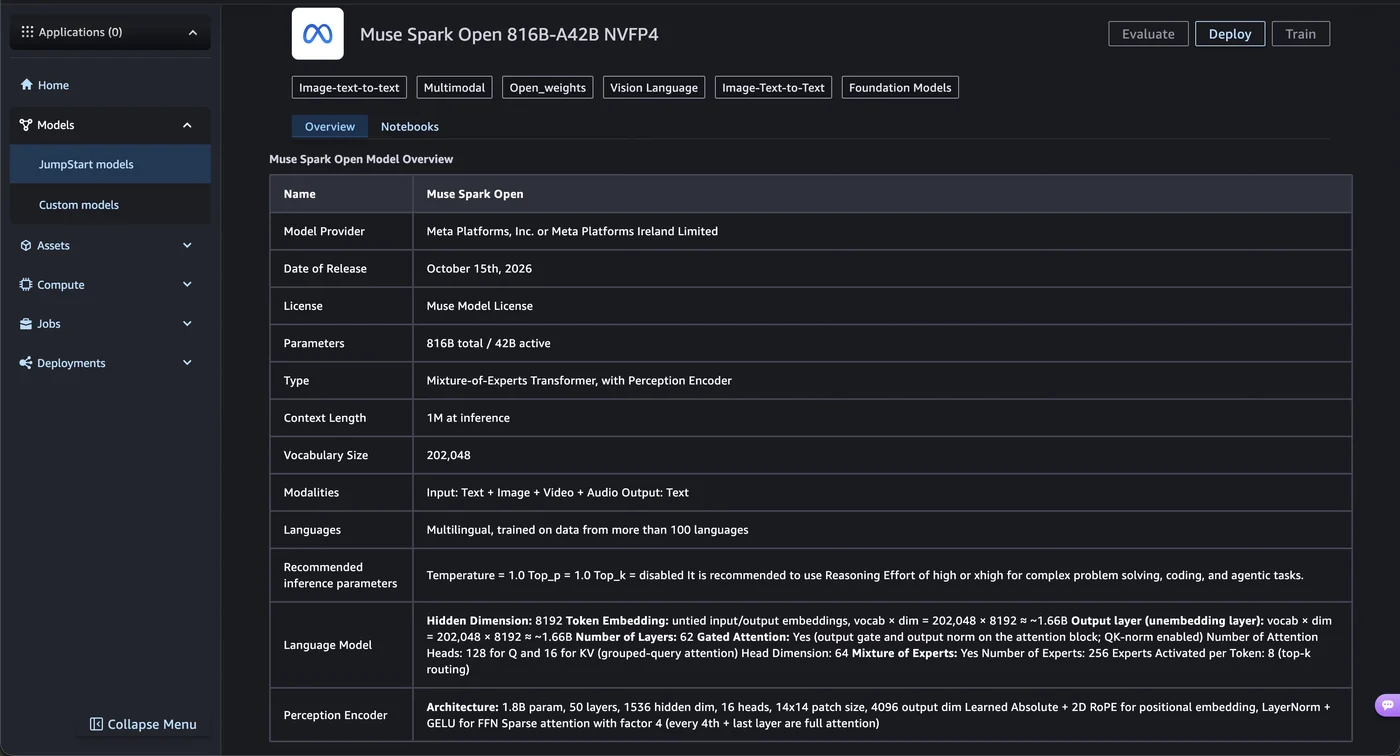
Meta describes Muse Spark Open as a coding-optimized model specifically trained for agentic coding workflows, emphasizing first-attempt accuracy, tool calling, and deep understanding of large codebases. Operating as a reasoning model, it accepts text, images, documents, audio, and audio-video as input while returning text outputs.
The model utilizes a mixture-of-experts (MoE) architecture comprising 816 billion total parameters, with 42 billion active parameters for each processed token. This design provides the capacity of a very large network while keeping per-token compute closer to a much smaller dense model. Meta releases the model weights under the Muse Model License, which includes the Muse Spark Usage Policy.
Developer Workflows and Agentic Design
Meta trained Muse Spark Open on real repository work patterns, including code generation, debugging, multi-file refactors, and extended tasks. Thanks to its 1 million-token context window, the model can ingest an entire project alongside its dependencies, legacy code, and thousands of files without requiring tasks to be broken down.
Designed as an agentic model from inception, Meta reports that the system can plan, act, observe results, and self-correct over long horizons rather than relying on isolated tool calls. As a reasoning model, it processes tasks thoroughly before acting, and the SageMaker AI endpoint returns this internal reasoning alongside the final response.
Deployment Options and Instance Requirements
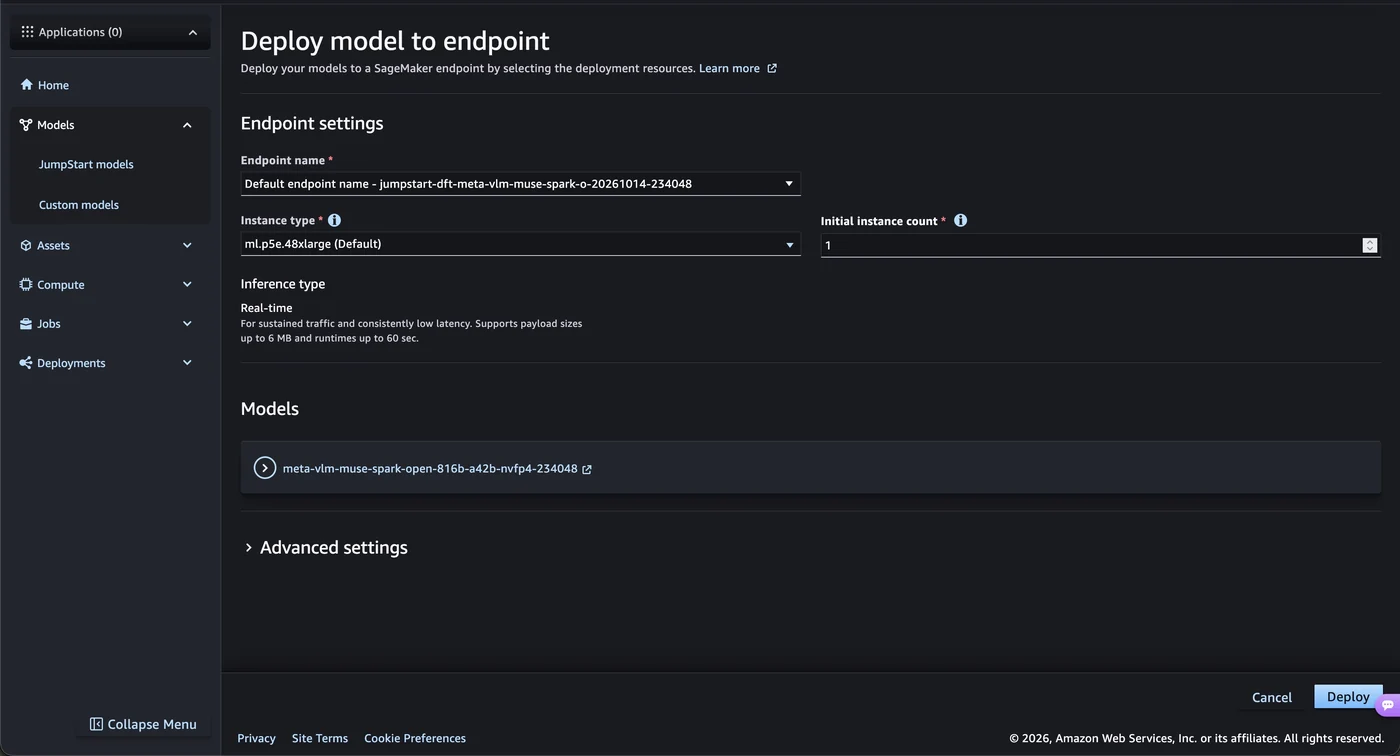
Serving Muse Spark Open requires careful instance selection because the infrastructure must hold all 816 billion parameters in GPU memory. The NVFP4 variant stores its weights in NVIDIA’s 4-bit floating point format, consuming roughly a quarter of the memory required by the BF16 weights.
On SageMaker AI, these requirements dictate the necessary hardware: the NVFP4 variant operates on ml.p5e.48xlarge instances, while the BF16 variant requires ml.p6-b300.48xlarge instances. This makes the NVFP4 variant an efficient option to evaluate first when sizing for cost.
Security and Control within AWS Accounts
Deploying open weights on SageMaker AI allows organizations to retain full control over their infrastructure. Endpoints run directly inside the user's AWS account, meaning source code and prompts are processed on securely configured resources.
Administrators can attach endpoints to their own Amazon Virtual Private Cloud (Amazon VPC), encrypt storage volumes using keys from AWS Key Management Service (AWS KMS), and enforce network isolation for the underlying container. Furthermore, teams can manage access permissions using AWS Identity and Access Management (IAM) execution roles.
Sources
- AWS Machine Learning BlogMeta’s Muse Spark Open now available in Amazon SageMaker JumpStart
Continue chronologically


Related entity coverage
Related stories
Amazon SageMaker JumpStart Expands With 100 Models in 2026
Amazon SageMaker JumpStart added over 100 new models from 30 providers in the first three quarters of 2026, expanding enterprise AI options.
Migrating Multi-Model AI Agents to Amazon Bedrock AgentCore
AWS introduces a streamlined path to migrate multi-model AI agents from self-managed ECS to Amazon Bedrock AgentCore, reducing operational complexity.

Intel Announces Day-0 Support for Meta Muse Spark Open
Intel announces day-0 support for Meta's 816 billion-parameter Muse Spark Open model across Intel Xeon processors and Intel GPU D-series platforms.

Meta Releases Muse Spark Open, an 800B-Parameter AI Model
Meta has introduced Muse Spark Open, an 800-billion parameter open-weight AI model optimized for Apple's hardware, requiring 1TB of unified RAM.