Agentic AI Joins the Search for Extraterrestrial Signals
The search for extraterrestrial intelligence has taken a major technological leap forward with the integration of agentic artificial intelligence, enabling real-time data processing and automated telescope operations.
 Radwan AbdulhadiEditor and technology writer
Integrating Agentic AI into the Search for Extraterrestrial Intelligence
Science fiction has long portrayed humanity's first potential encounters with extraterrestrial life as physical meetings, but modern scientific efforts are increasingly focusing on a different possibility: listening for artificial intelligence built by advanced civilizations. Because some civilizations could be billions of years older than humanity, their technologies may have evolved far beyond human capabilities, potentially leaving behind AI signatures in the cosmos.
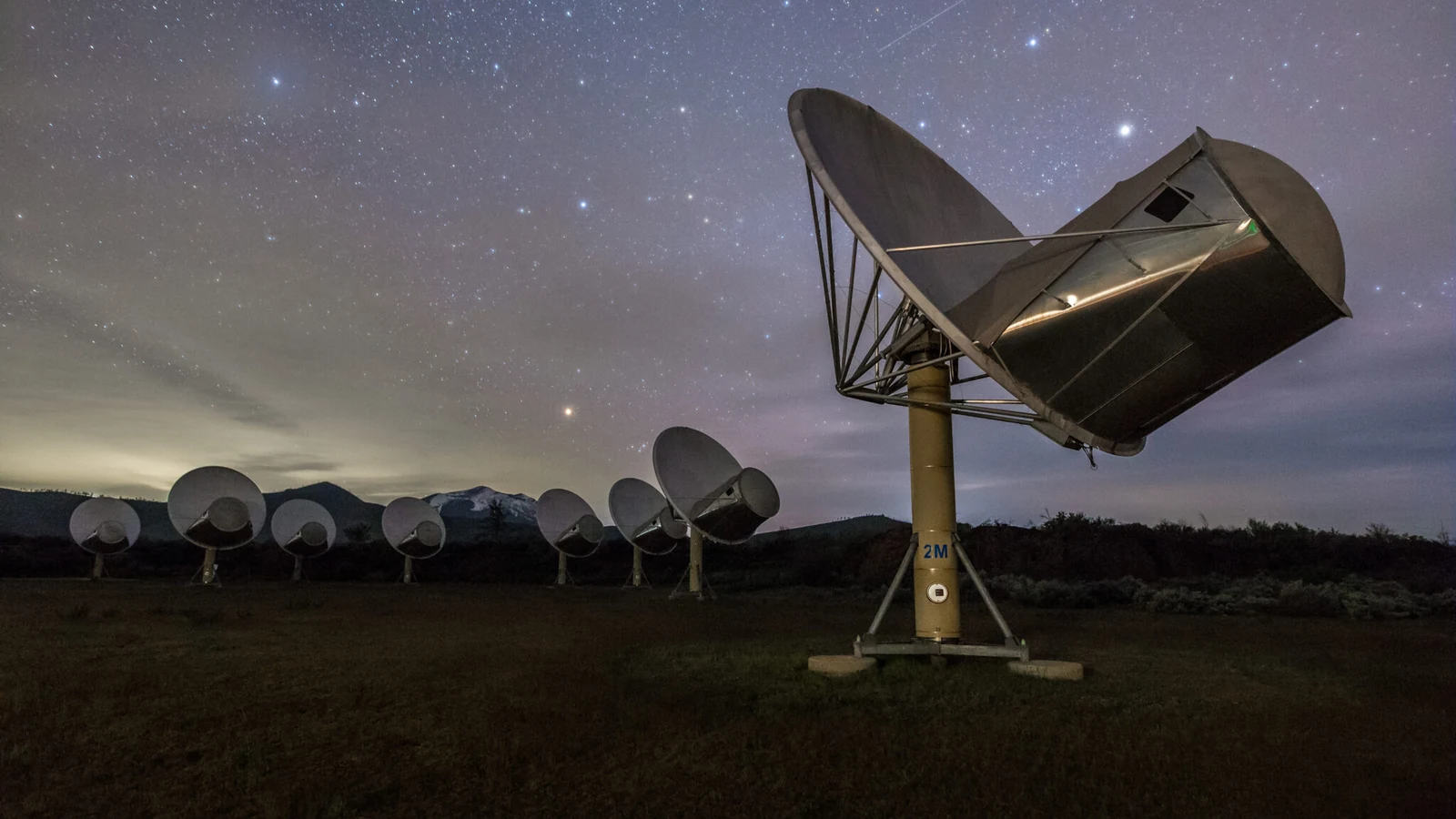
To address this cosmic scale of data and possibility, Breakthrough Listen and the SETI Institute are bringing agentic AI into the daily search for extraterrestrial intelligence. At the Allen Telescope Array in Northern California, AI agents can now steer the instrument, enhance and correct incoming data, and apply AI models to the incoming stream using a single natural language request. The NVIDIA Holoscan platform processes massive streams of sensor data, providing agents with live data to act upon in real time.
Transforming Observatory Operations Through Natural Language
Radio telescopes generate enormous volumes of data, historically creating significant bottlenecks for scientists trying to identify interesting signals while observations unfold. At the Allen Telescope Array, specialized software libraries and processing frameworks help overcome this challenge by pulling vast amounts of sensor data straight into GPU memory, allowing observations to be processed in flight rather than filling physical hard drives.
Observatory orchestration is managed through Nexus, a web-based tool acting as the agent harness. It provides agents with a unified source of truth regarding instrument states, compute resources, and pipelines. Researchers can monitor packet loss, read live spectrograms, and rewrite signal-processing blocks simply by prompting in natural language. The system handles 2.4 terabits per second on NVIDIA RTX PRO 6000 Blackwell GPUs, with inference running entirely on premises next to the instrument.
Accelerating Discoveries and Real-Time Pulsar Detection
Combined across hardware and software frameworks, the system enables an agent to independently steer telescope antennae, calibrate and focus the instrument for a clean signal, catch and fix data errors, and plot the final results. Tasks that previously required weeks or years of human labor can now be compressed into hours.
This advanced pipeline has already demonstrated its effectiveness by achieving the first real-time AI detection of a pulsar—a rapidly spinning stellar remnant pulsing like a cosmic lighthouse—within the Crab Nebula.
"As our new agentic observatories reach out into the universe, what they find may have much more in common with themselves than with the humans who created them," said Andrew Siemion, Bernard M. Oliver chair for SETI at the SETI Institute and principal investigator of Breakthrough Listen. "But this isn’t something to fear. Rather, it’s a breakthrough in translation."
Future Outlook and Open Models
Looking ahead, the research team is actively evaluating open models including NVIDIA Nemotron for use cases where data locality and turnaround time are critical. These models could eventually support observatories operating entirely offline on locations such as the far side of the moon, expanding the reach of automated astronomical exploration.
Sources
- NVIDIA BlogThings That Go Beep in the Night: Agentic AI Joins the Search for Extraterrestrial Signals
Continue chronologically

Related entity coverage
Related stories
Cities Scale Physical and Agentic AI Services With NVIDIA
Cities worldwide are building and scaling physical and agentic AI services using NVIDIA platforms to improve infrastructure planning and public operations.

NVIDIA and CoreWeave Launch Vera Rubin for Agentic AI
NVIDIA and CoreWeave announce the production availability of NVIDIA Vera Rubin systems, accelerating agentic AI workflows and token throughput.

NVIDIA and EBU Expand Sovereign AI Framework for Media
NVIDIA and the European Broadcasting Union have expanded their sovereign AI standards for media, alongside new Adobe Frame.io GPU-accelerated video search tools.

NVIDIA AI Factories Maximize ROI Through Productivity and Durability
NVIDIA details how AI factories maximize return on investment by delivering high throughput, extending hardware useful life, and supporting diverse workloads.