
NVIDIA AI Factories Maximize ROI Through Productivity and Durability
NVIDIA states that AI factories maximize return on investment by engineering for high earning capacity, extended hardware durability, and broad workload versatility.
 Radwan AbdulhadiEditor and technology writer
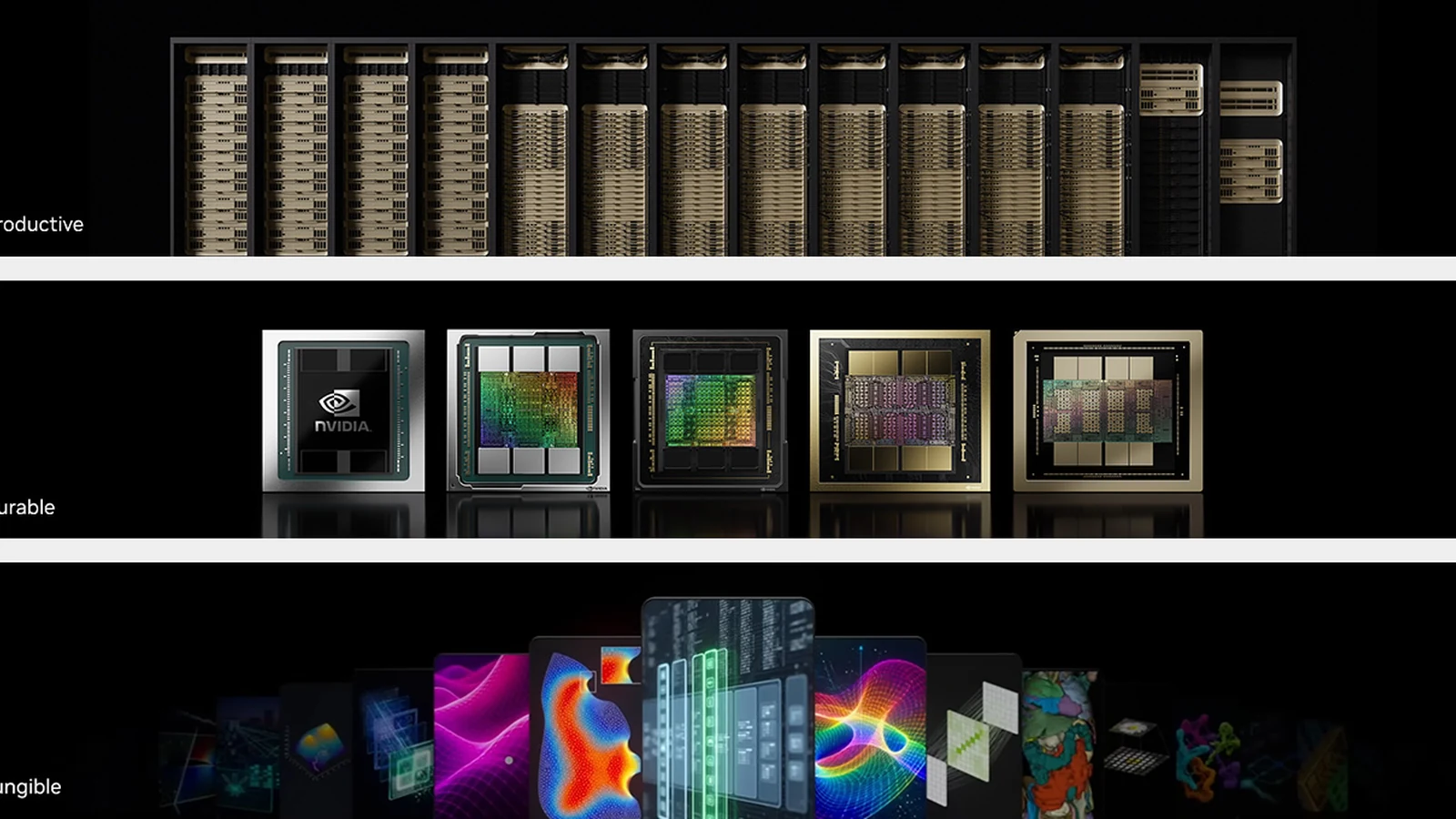
Capital Commitment and Return Metrics
AI factories are constructed at a scale measured in megawatts and sometimes gigawatts, with each megawatt facility costing approximately $60 million. Operators committing capital at this magnitude require a clear understanding of return on investment. According to NVIDIA, three primary factors shape these returns: earning capacity, which represents the potential annual revenue if all produced tokens are sold; useful life, indicating how long the hardware continues to generate value; and demand, which reflects the market appetite for those tokens. These factors are interdependent, as a factory capable of running diverse workloads attracts broader demand, thereby sustaining revenue streams over multiple years.
Engineering for Maximum Productivity
Power consumption serves as the primary constraint for AI factories, making tokens per second per megawatt the critical metric for earning capacity. NVIDIA asserts that its systems are engineered to deliver the highest throughput within fixed power envelopes while minimizing the cost per token. Data from SemiAnalysis AgentX indicates that NVIDIA Vera Rubin NVL72 systems provide over 30 times higher throughput per megawatt compared to NVIDIA GB300 NVL72 systems. Additionally, these newer systems achieve up to 45 times lower cost per million tokens when processing the DeepSeek V4 Pro model. These performance gains result from extreme codesign across the entire stack, optimizing models, software, compute, networking, and memory simultaneously.
As token costs decrease, more use cases become economically viable, leading to increased consumption that offsets efficiency savings. This dynamic ensures that demand for compute does not shrink despite technological advancements. The transition between generations also supports durability, as not every workload requires the latest hardware. The appropriate system depends on the complexity and shape of the workload, allowing previous generations to continue earning revenue after newer systems are deployed.
Extending the Useful Life of Hardware
The economic value of AI hardware extends significantly beyond its initial deployment. The NVIDIA A100 GPU, launched in 2020, remains in commercial service six years later, demonstrating sustained economic viability. CoreWeave recently extended bookings for units introduced in 2020 through 2029. Major operators have consistently extended depreciation schedules for their servers, reflecting a growing confidence in the longevity of hardware assets. A September 2026 analysis by Sprout, titled "The Productive Life of a Data Center GPU," tracks how these depreciation schedules have shifted across the industry, showing a trend toward longer useful lives.
Market data further supports the durability of these assets. Barkr estimates the useful life of an eight-GPU H100 system at five to six years and a GB300 NVL72 system at nine to 10 years, based on resale values. Silicon Data reports that a six-year-old A100 GPU retains approximately 25% of its original cost, whereas a five-year depreciation schedule would have valued it at zero. Furthermore, Ornn Data finds that the market pays 80% as much to rent an A100 GPU on a five-year contract as it does on a one-month contract, highlighting the persistent demand for established hardware.
Software Continuity and Fungibility
NVIDIA’s software platform, CUDA, ensures that existing hardware is not stranded when new architectures arrive. The platform runs across generations, and continuous optimization of software and kernels improves the capabilities of installed hardware over time. This continuity supports fungibility, a key attribute of NVIDIA AI factories. The more types of work a system can handle, the longer it remains productive. The same platform supports machine learning, deep learning, generative AI, reasoning, agentic AI, and physical AI, allowing new workloads to run on previously installed infrastructure.
Versatility Across Workloads and Locations
NVIDIA AI factories are designed to run every type of AI model, including open and proprietary systems, across domains such as language, vision, biology, physics, and robotics. They support all phases of the AI lifecycle, from data processing and pretraining to post-training and inference. These factories operate in diverse environments, ranging from hyperscale clouds and sovereign programs to enterprise data centers and edge devices. Beyond AI, the infrastructure handles data processing, scientific computing, simulation, and graphics, all of which reduce to parallel math executed across thousands of cores.
The versatility of these systems is underpinned by the CUDA-X library suite, which includes over 1,000 ready-made libraries. These libraries cover applications from deep neural networks and computational lithography to quantum circuit simulation and climate modeling, utilized by more than 10 million developers. This general-purpose accelerated computing approach allows a single chip to simulate light, fold proteins, and predict tokens. Tensor Cores and the Transformer Engine provide AI-optimized hardware within a programmable architecture, ensuring both specialization and flexibility.
Production Examples and Customer Adoption
Several major organizations are leveraging this versatility in production environments. Lilly is building and running protein, small-molecule, and genomics models on a 1,016-GPU on-premises cluster, while also deploying chatbots and agentic workflows for internal teams. Pinterest is post-training and deploying a vision language model on a hyperscale cloud, utilizing 14,000 GPUs spanning NVIDIA Blackwell, Hopper, and earlier architectures. Revolut processes data for billions of transaction records using NVIDIA cuDF and trains foundation models on an AI cloud. Runway trains world models on NVIDIA Hopper and serves them on the NVIDIA Blackwell platform.
Texas A&M University runs molecular simulation and AI drug discovery on its supercomputer, achieving 95-98% utilization across 26 projects and seven institutions. Beyond AI, Dassault Systèmes uses the infrastructure for virtual twin simulation in aircraft certification at Wichita State and vehicle design at Lucid Motors. These examples illustrate how a standardized architecture allows operators to deploy validated reference designs that serve a wide array of complex and varied workloads, maximizing the return on the substantial capital invested in AI factory construction.
Sources
- NVIDIA BlogProductive, Durable, Fungible: How NVIDIA AI Factories Maximize Return on Investment