Intel Xeon 6 CPUs Scale Sandboxed Agentic AI Workflows
Intel showcases how its Xeon 6 and Xeon 6+ processors support secure, high-concurrency sandboxed agentic AI workflows while maintaining strict response SLAs.
 Radwan AbdulhadiEditor and technology writer
The Rise of Agentic AI and Sandboxing Security
Modern artificial intelligence systems are rapidly evolving beyond basic question-and-answer interactions. Today's advanced AI agents can execute code, process files, query databases, interact with application programming interfaces, and execute complex multi-step workflows on behalf of users. While these capabilities unlock powerful new automation possibilities, they simultaneously introduce critical infrastructure and security challenges. Direct execution of agent-generated code on a host system can expose organizations to severe risks, including software bugs, prompt-injection attacks, data leakage, and privilege escalation.
To mitigate these security concerns, AI frameworks rely heavily on isolated execution environments known as sandboxes. As the adoption of agentic AI accelerates, sandboxing functions as much more than a routine security feature. Because AI agents dynamically create, utilize, and destroy execution environments within seconds, the efficiency of sandbox provisioning becomes a vital component of system responsiveness and scalability. Combining robust isolation with rapid provisioning is therefore essential for large-scale enterprise deployments.
Understanding the Sandbox Provisioning Lifecycle
Various sandboxing technologies are deployed across modern infrastructure, including standard virtual machines, traditional containers, lightweight microVMs, and the open-source Tencent Cloud Cube Sandbox. Although these technologies offer strong isolation guarantees, they demand underlying infrastructure capable of efficiently provisioning and managing isolated environments at scale.
In typical agentic AI deployments, sandbox creation sits directly on the critical path of task execution. Before any agent can run code or invoke external tools, a sandbox must be provisioned, initialized, and made available. The typical workflow moves from an agent request to sandbox creation, task execution, result return, and finally sandbox teardown. Because sandbox creation and teardown occur continuously at scale, lifecycle efficiency directly impacts application responsiveness, overall infrastructure utilization, and total throughput.
Evaluating Provisioning Performance Under Load
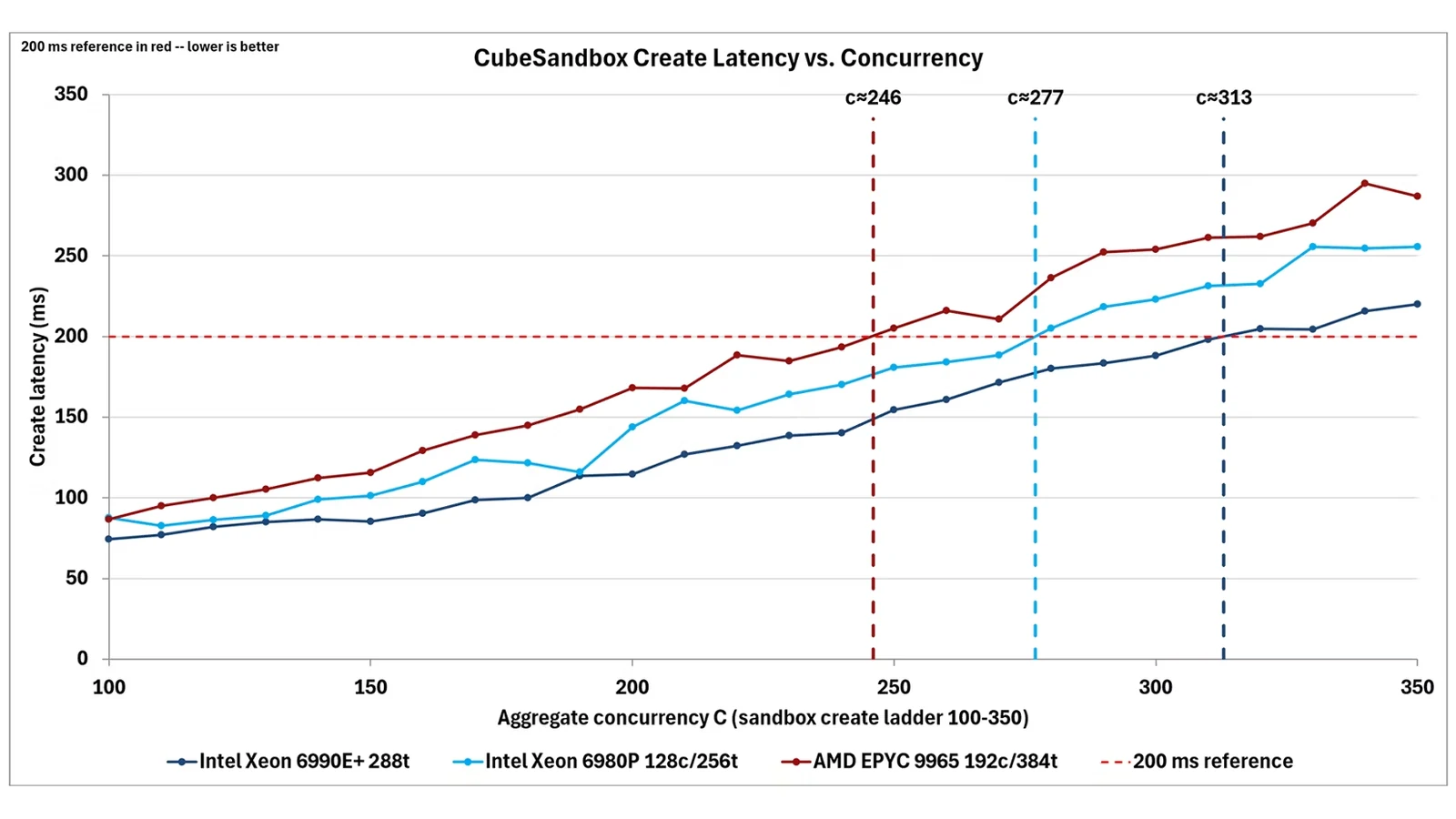
To measure sandbox provisioning performance under realistic operating conditions, Intel engineers utilized the cube-bench create/delete workload. This benchmark measures how efficiently a given platform can provision new sandbox environments under increasing stress. The workload continuously issues creation requests through the CubeSandbox API while scaling aggregate concurrency upwards, revealing how effectively platforms handle growing provisioning demands.
A primary metric in this evaluation is the 200-millisecond sandbox creation service-level agreement (SLA), which defines the target responsiveness threshold for delivering a usable sandbox environment. By examining average create-latency alongside throughput and tail-latency metrics, engineers can determine how well a platform preserves responsiveness under heavy operational loads.

Intel Xeon Processors Outperform Alternatives in Concurrency
According to data published by the Intel Newsroom, platforms powered by Intel processors maintained lower creation latency and sustained higher provisioning concurrency within the target 200-millisecond service-level objective when compared to competing configurations.
Specifically, the Intel Xeon 6990E+ processor remained below the 200-millisecond SLA threshold up to approximately 313 concurrent provisioning requests. Meanwhile, the Intel Xeon 6980P processor stayed below the threshold until reaching 277 concurrent requests. By contrast, the competing AMD EPYC 9965 processor crossed the 200-millisecond limit at approximately 246 concurrent requests.
Implications for Enterprise AI Infrastructure
Compared directly with the AMD EPYC 9965 processor, the Intel Xeon 6990E+ processor supports roughly 27% higher provisioning concurrency within the 200-millisecond SLA, while the Intel Xeon 6980P processor delivers approximately 12% higher concurrency. Both Intel-based platforms demonstrated strong scalability and predictable latency behavior under rising loads.
These findings highlight that the latest Intel® Xeon® 6+ processors provide a robust structural foundation for large-scale sandboxed agent deployments. As action-oriented AI systems continue to scale, the capability to efficiently orchestrate, isolate, and provision large fleets of agents remains a foundational requirement for enterprise architectures.
Sources
- Intel NewsroomScaling Sandboxed Agentic AI on Xeon CPUs
Continue chronologically

Related stories
Intel Xeon 6 Boosts Agentic AI Throughput Performance
Intel demonstrates how Xeon 6 processors deliver superior agentic AI throughput compared to alternative processor architectures in real-world workflows.

Intel at OCP 2026: Open AI Infrastructure for the AI Era
At the 2026 OCP Global Summit, Intel highlights open, heterogeneous systems, modular infrastructure, and standards to scale next-generation AI workloads.

Intel Shifts Production to Server CPUs Amid AI Demand
Intel reallocates manufacturing capacity from consumer to server CPUs to address unprecedented AI-driven demand and ongoing supply constraints.

Intel Advances Open Infrastructure for the Agentic AI Era
Intel unveils new technical details on the Intel GPU D-series, Xeon-based rack designs, and open software strategies at the OCP Global Summit.