Intel Xeon 6 Boosts Agentic AI Throughput Performance
Intel highlights the growing importance of throughput in agentic AI deployments, positioning its Intel Xeon 6 processors as high-performance solutions for complex workloads.
 Radwan AbdulhadiEditor and technology writer

The Evolution of AI Workloads and Throughput
For years, infrastructure discussions surrounding artificial intelligence primarily concentrated on model quality, accelerator performance, and inference latency. This approach aligned with early AI applications that relied on simple interactions where users submitted a prompt and models generated immediate responses. However, the emergence of modern agentic AI workflows is transforming this paradigm across enterprise deployments.
Modern AI systems are increasingly designed to reason, plan, retrieve information, invoke tools, execute actions, validate results, and iteratively refine their behavior. A single user interaction can trigger dozens of independent tasks across multiple software components before delivering a final result. Consequently, organizations are prioritizing system throughput over simple latency metrics to determine overall productivity in complex agentic deployments.
Infrastructure Challenges in Agentic AI
Traditional AI applications typically follow a straightforward execution pipeline from prompt to model and response. In contrast, agentic AI introduces intricate stages including planning, tool selection, execution, validation, and iteration. These modern workloads generate significantly higher activity across the entire system stack, shifting performance bottlenecks away from mere model generation speed.
Organizations deploying coding agents, enterprise copilots, research assistants, and operational automation systems often encounter limitations in task orchestration, tool execution, memory access, storage operations, and runtime management. Because agents must maintain conversation history, execution context, retrieved knowledge, and workflow states across multiple execution stages, overall performance relies heavily on how efficiently platforms handle heterogeneous tasks.
Advantages of Intel Xeon Processors
A common misconception in the industry is that agentic AI performance depends solely on model inference speed. While strong CPU performance remains essential for reasoning, tool execution, orchestration, and security operations, agentic workloads also impose substantial demands on memory, storage, and I/O resources.
Enterprise-scale agent deployments are defined by high concurrency, heavy memory utilization, and continuous task execution. Utilizing Intel® Xeon® 6 processors helps organizations address these demands by combining robust compute capabilities with large memory capacity, substantial memory bandwidth, and comprehensive I/O features designed to minimize execution bottlenecks.
Evaluating Real-World Workflows
Benchmarking dynamic agent behavior presents inherent challenges because different prompts can generate distinct execution paths and tool selections. To overcome this, engineers adopted a record-and-replay methodology. During the recording phase, representative agent workflows captured exact execution characteristics, while the replay phase ensured every platform processed identical workload traces.
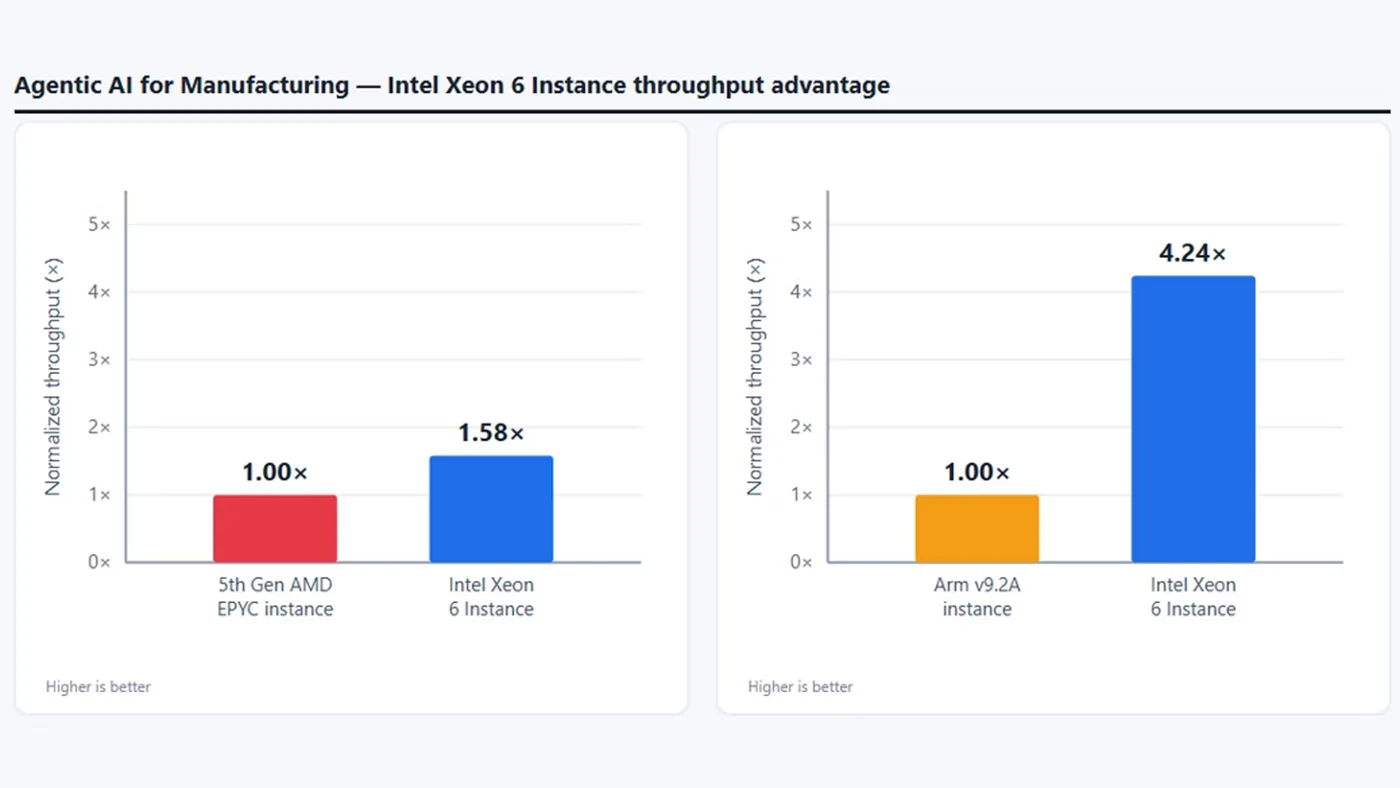
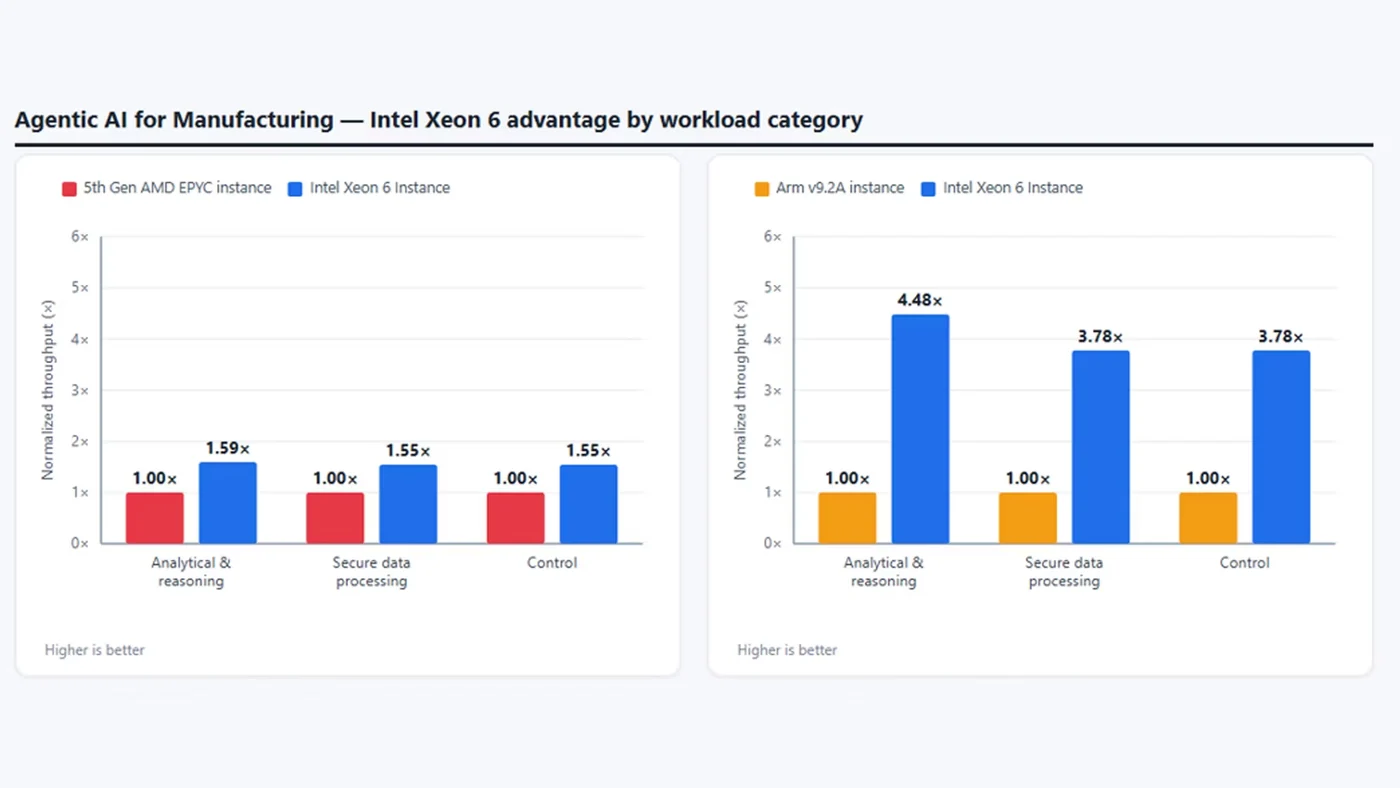
Evaluations assessed the deterministic Terminal-Bench workload across Intel Xeon 6 processor-based, 5th Gen AMD EPYC processor-based, and Arm v9.2A-based instances. Tests maintained 24-way concurrency over a 60-minute evaluation window across three key industry verticals: healthcare, banking and financial services, and manufacturing.
Healthcare Benchmark Results and Throughput Gains
The healthcare benchmark incorporated representative agent workflows spanning clinical documentation, evidence retrieval, diagnostic analysis, fraud detection, risk assessment, molecular research, genomic analysis, and laboratory diagnostics. These tasks reflect core agentic characteristics such as reasoning, retrieval, analytics, and document processing.
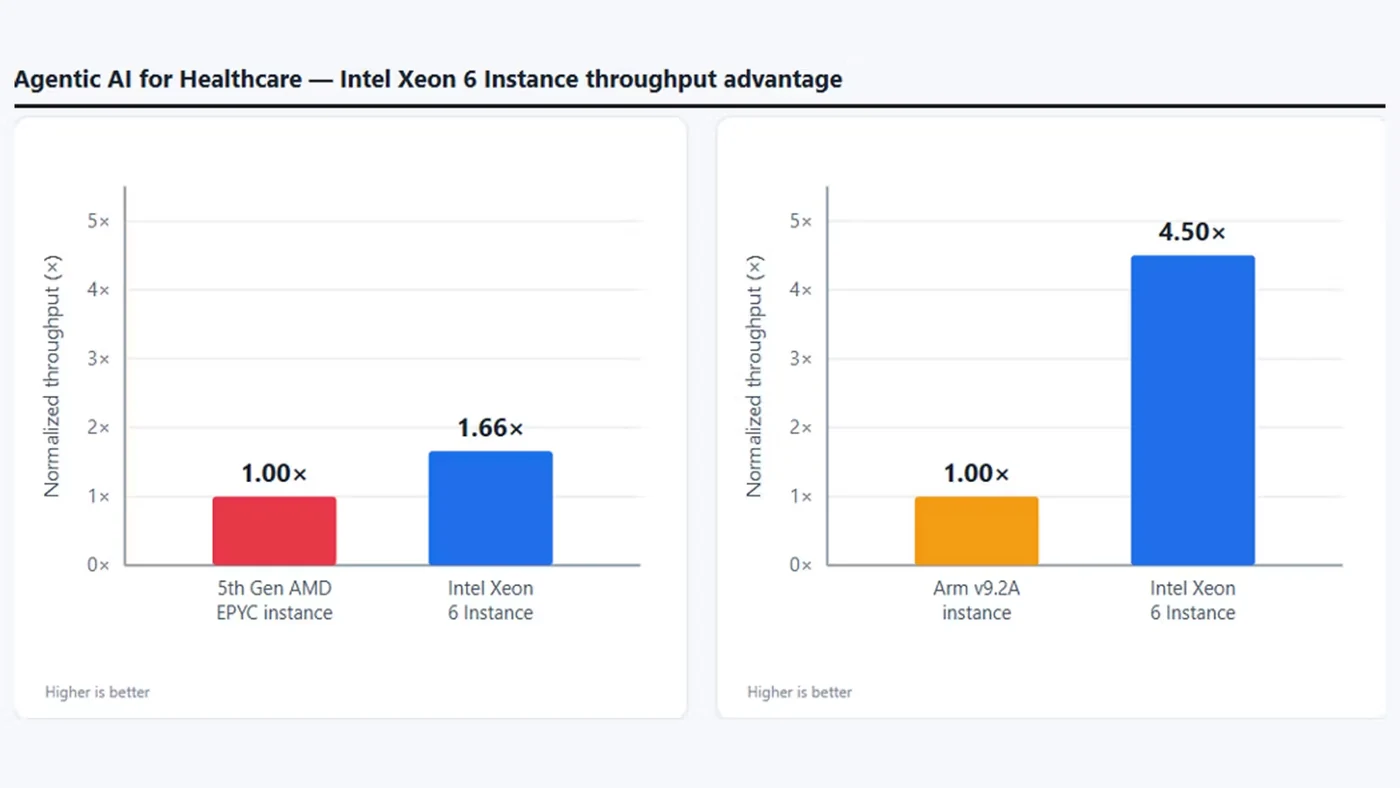
According to performance evaluations detailed by the Intel Newsroom, the Intel Xeon 6 processor-based instance achieved the highest normalized agent-task throughput during the 60-minute evaluation window. It delivered 1.66 times the throughput of the 5th Gen AMD EPYC processor-based instance and 4.5 times the throughput of the Arm v9.2A-based instance.
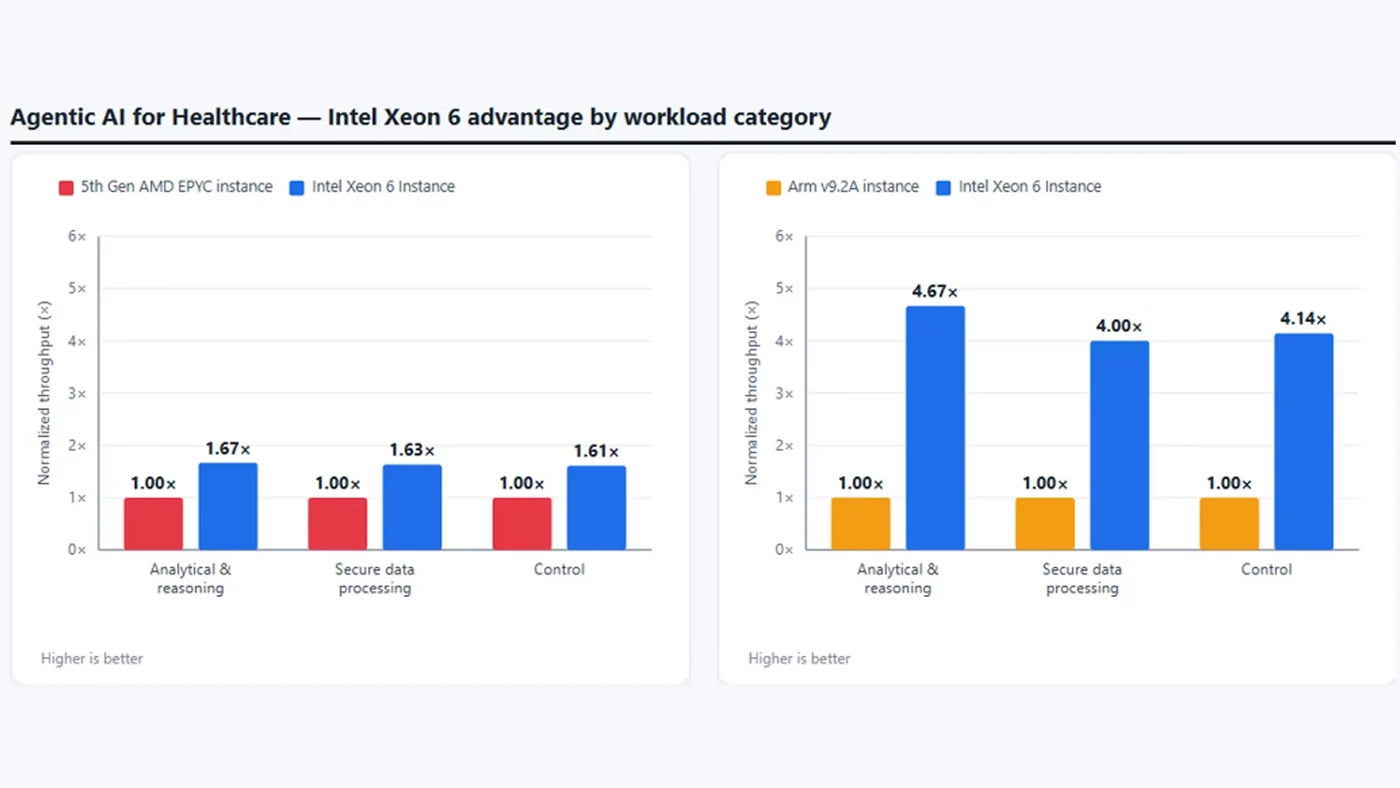
Furthermore, the throughput advantage extended across multiple operational categories. The Intel Xeon 6 instance achieved 1.67 times higher throughput for analytical and reasoning workloads, 1.63 times higher throughput for secure data processing, and 1.61 times higher throughput for control operations compared to the 5th Gen AMD EPYC instance. These results highlight the ability of Intel data center technologies to sustain high task completion rates under continuous enterprise load.
Sources
- Intel NewsroomBoosting Agentic AI Throughput with Intel® Xeon® CPUs
Continue chronologically

Related stories
Gears of War E-Day Pushes Unreal Engine 5 CPU Limits
An in-depth benchmark of 25 Intel and AMD processors reveals that Gears of War E-Day is an uncharacteristically CPU-heavy Unreal Engine 5 title.

AMD Surpasses $1 Trillion Market Cap Milestone
AMD has officially joined the elite trillion-dollar market cap club, outpacing Intel following a significant surge in stock price fueled by data center demand.

Intel at OCP 2026: Open AI Infrastructure for the AI Era
At the 2026 OCP Global Summit, Intel highlights open, heterogeneous systems, modular infrastructure, and standards to scale next-generation AI workloads.

AMD Shares Gorgon Halo Benchmarks Ahead of RTX Spark
AMD showcases new Gorgon Halo AI benchmarks for the Ryzen AI Max+ Pro 495 ahead of the anticipated Nvidia RTX Spark launch.