Run Multi-Node LLM Inference Using Ray LLM Containers
AWS introduces multi-node Ray LLM Deep Learning Containers designed to streamline the deployment of large language models across multiple GPU nodes behind a single OpenAI-compatible endpoint.
 Radwan AbdulhadiEditor and technology writer
Introduction to Multi-Node Ray LLM Containers
AWS has published a guide on how to deploy one large language model across two GPU nodes on Amazon Elastic Kubernetes Service (Amazon EKS) utilizing multi-node Ray LLM Deep Learning Containers. This architecture places separate prefill and decode nodes behind a single OpenAI-compatible endpoint, making it common for tensor, pipeline, and data parallelism as well as disaggregated inference workloads.
In a previous post, the AWS Machine Learning Blog introduced the Ray Serve DLC to stand up smaller models behind an HTTP endpoint on a single GPU node. Building upon that foundation, the new multi-node approach addresses environments where foundation or open-weight models exceed the capacity of a single GPU, or where workloads require higher throughput and phase separation.
Solving Infrastructure Complexity with Deep Learning Containers
Distributed compute frameworks like Ray allow deployments to span multiple nodes. However, customers previously had to build the underlying dependency chain themselves by selecting compatible libraries for the GPU stack and debugging component drift. AWS Deep Learning Containers (DLCs) solve this by bundling frameworks, dependencies, and GPU stacks into tested, patched Docker images.
The introduction of the Ray LLM DLC extends this pre-built approach to multi-node distributed serving. Maintained and tested by AWS, these purpose-built containers allow users to configure deployments rather than assemble the entire inference stack from scratch.
Prefill and Decode Disaggregation Architecture
LLM inference consists of two distinct phases: prefill, which processes the input prompt in parallel to build the key-value cache, and decode, which generates responses token by token. Because prefill is compute-bound and decode is memory-bandwidth-bound, sharing a single GPU causes resource contention where bursty prompts interfere with latency-sensitive generation.
By placing prefill and decode phases on separate GPU nodes, infrastructure teams can scale each phase independently. This disaggregated approach is particularly beneficial for Retrieval Augmented Generation (RAG), document summarization, and agentic applications where maintaining consistent generation speeds is critical.
Container Stack and Network Interconnects
The Ray LLM DLC incorporates vLLM as the inference engine, Ray Serve’s HTTP serving layer, the NVIDIA Inference Transfer Library (NIXL) for fast KV-cache transfers between nodes, and the Elastic Fabric Adapter (EFA) stack for high-bandwidth node-to-node communication. Because the Ray Serve LLM library features a built-in application builder, deployments can be defined using straightforward YAML configurations without writing custom handler classes.
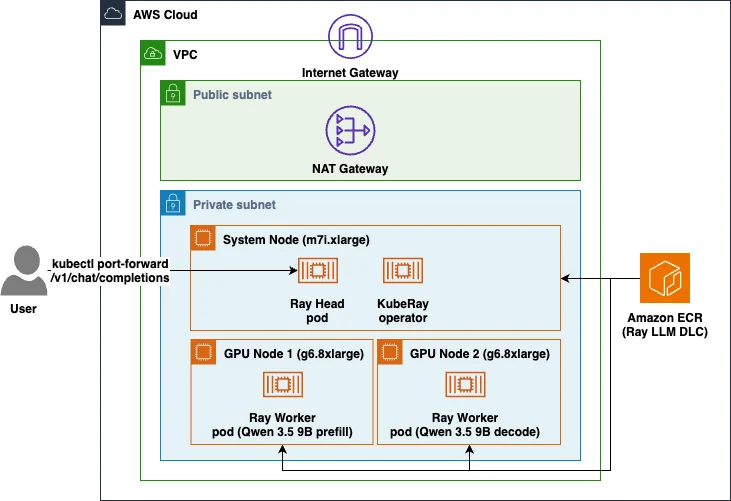
On Amazon EKS, a CPU system node manages system workloads and the KubeRay operator, while two GPU worker nodes handle the prefill and decode phases respectively. The KV cache flows between the workers over NIXL and EFA, keeping network latency low to preserve the performance advantages of disaggregation.
Sources
- AWS Machine Learning BlogRun multi-node inference workloads using Ray LLM Deep Learning Containers
Continue chronologically

Related entity coverage
Related stories
Scaling MoE Reinforcement Learning on Amazon EKS with EFA
Learn how AWS combines Amazon EKS, EFA, and DeepEP to increase aggregate reinforcement learning rollout throughput by 40% for large-scale MoE training.
Deploying NVIDIA Nemotron 3.5 Super VL on AWS EKS and SageMaker
Learn how to deploy the NVIDIA Nemotron 3.5 Super VL mixture-of-experts model on Amazon EKS, EKS Auto Mode, and SageMaker HyperPod EKS.
Share GPU Clusters Across Teams with Amazon SageMaker HyperPod
Discover a reference architecture to share a single Amazon SageMaker HyperPod EKS cluster across multiple teams with isolation and fairness.
Build Agent Memory With NVIDIA NeMo and Amazon S3 Vectors
Learn how to use Amazon S3 Vectors as a persistent memory layer within the NVIDIA NeMo Agent Toolkit deployed on Amazon EKS.