
Cloudflare Releases Open-Source Clef Decision Models
Cloudflare has introduced Clef and Clef-flash, a new family of open-source decision models designed for high-speed classification and agentic workflows, alongside a reinforcement learning fine-tuning platform.
 Radwan AbdulhadiEditor and technology writer

Introduction to Clef Decision Models
Over recent weeks, interest has grown significantly around decision models such as Typesafe AI’s Jev System One model. While traditional classifier models have existed for some time, this concept introduces a specialized approach to artificial intelligence by producing bounded structured outputs quickly, cheaply, and consistently. These models can handle any set of inputs without requiring constant retraining to incorporate new classification categories, distinguishing them from large language models that remain largely non-deterministic even though they excel at open-ended reasoning and generating text.
Responding to this shift in the AI landscape, Cloudflare has released two homegrown decision models known as Clef and Clef-flash. These models are fully compatible with the Jev API and are hosted directly on Workers AI, allowing developers to experiment with them easily. Furthermore, Cloudflare has fully open-sourced the models on Hugging Face under an Apache 2.0 license so that developers can run and experiment with them locally.

Understanding Decision Models and Agentic Workflows
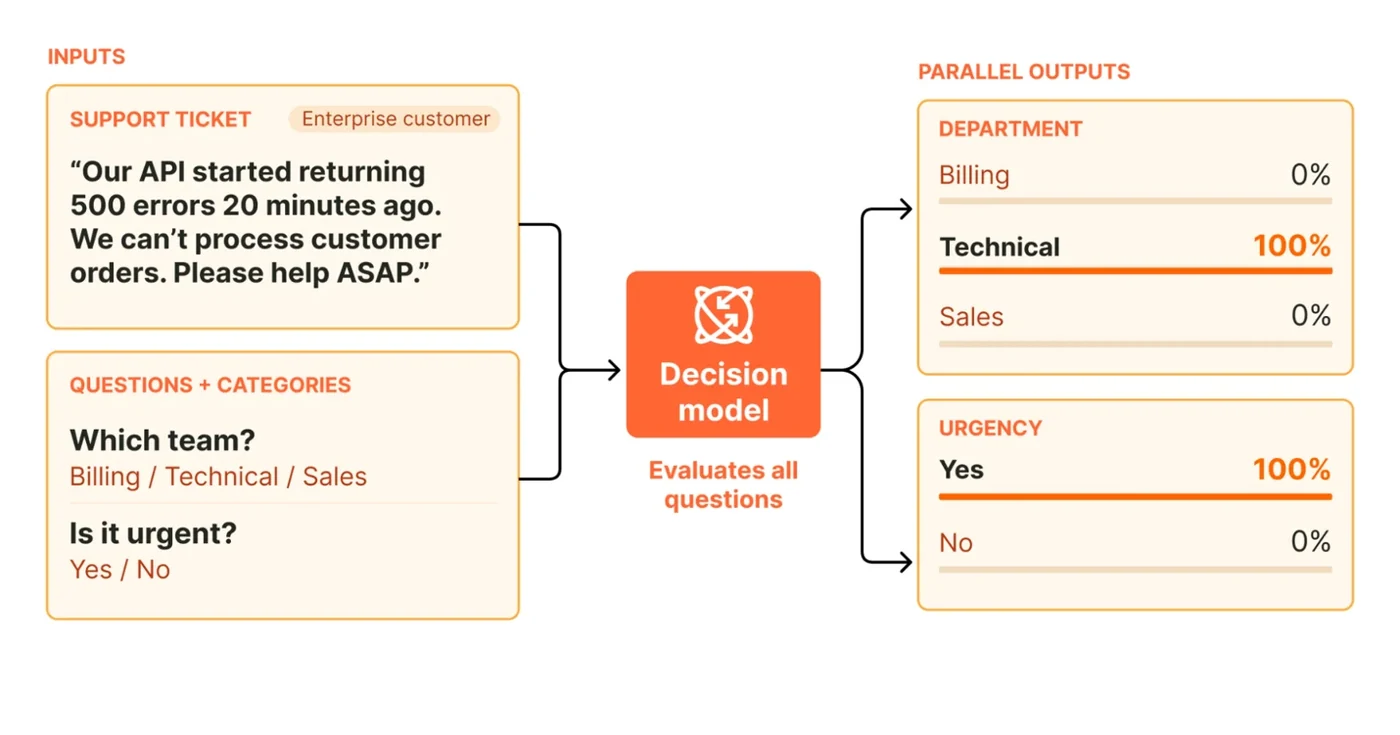
A decision model performs classifications to help autonomous agents decide how to act based on specific probabilities. For instance, a customer support message can be passed as input to determine whether the request is urgent and which internal team should handle it. The decision model returns typed answers with associated probabilities, enabling code to automatically route tickets, trigger escalations, or defer to human intervention only when necessary. This capability allows agents to programmatically gather context, make decisions, and execute tasks without human intervention in every step of the workflow.
Cloudflare has tested the new Clef model internally within its Threat Intelligence team to classify website domains. By submitting a domain alongside browser execution tooling, the model rapidly identifies underlying categories, such as a high probability of being a fashion website, an ecommerce platform, or a phishing threat. In internal testing, the Clef model completed the fetch, render, and classification process significantly faster than general large language models while returning a more comprehensive set of classification categories, demonstrating clear latency advantages for threat intelligence and security pipelines.
Key Architectural Advantages and Benchmarks
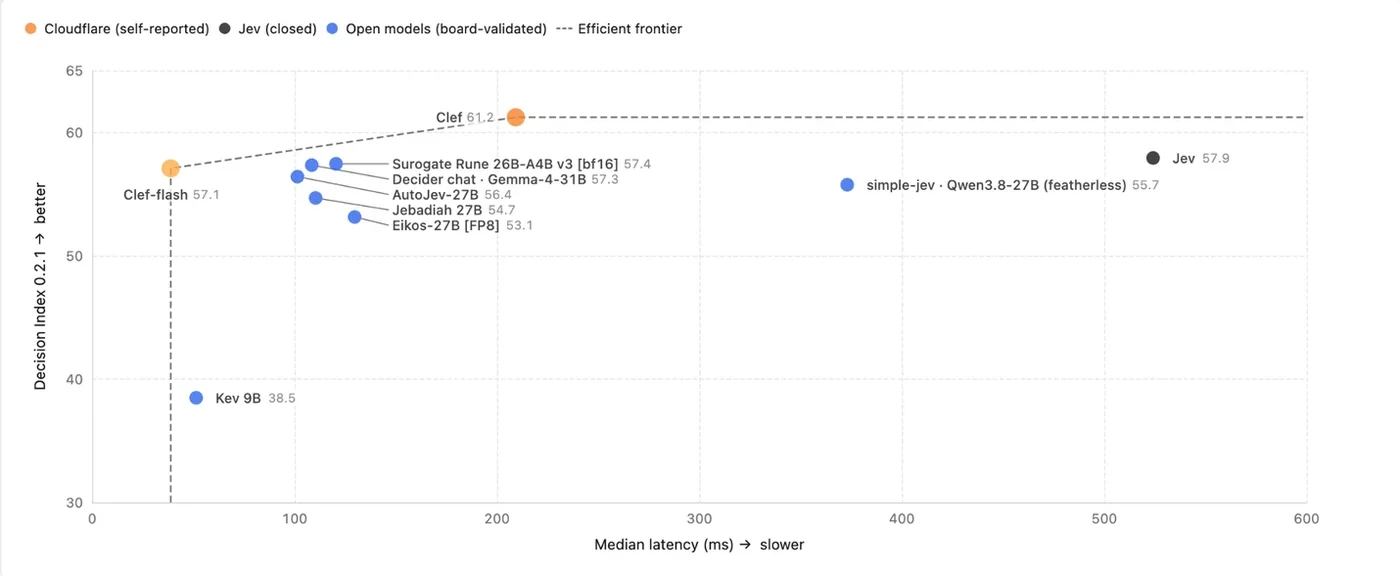
Although the market for decision models continues to expand, the Clef family incorporates several unique architectural properties. First, the model integrates a vision encoder, enabling it to ingest and classify visual content directly—a capability absent in text-only models like Jev. Second, the model provides an extended 64k context window compared to alternative 32k limits, allowing users to supply larger input states for the system to evaluate against.
Performance evaluations on the Jev Decision Index and other quality benchmarks indicate that Clef models score competitively against existing alternatives. Developers can inspect full evaluations and benchmark results on the live benchmark demo site to analyze how the models perform across various standardized test suites.
Infrastructure and Edge Hosting on Workers AI
Beyond the capabilities of the model architecture itself, Clef models benefit directly from being hosted on Workers AI. By utilizing Cloudflare’s distributed infrastructure and edge GPUs, the deployment reduces network latency and accelerates decision-making speeds. This low-latency profile allows developers to place decision models directly into the hot path for agentic workflows, pairing them with large language models on the same infrastructure to execute downstream actions seamlessly.
The release includes two distinct variants to cater to different operational requirements. The larger Clef model serves as a high-precision option for complex tasks, whereas the Clef-flash model is optimized for latency-critical applications. Both models operate under enterprise-ready guidelines ensuring that user requests and responses are not read, stored, or utilized for training unless developers explicitly opt into fine-tuning features.
Reinforcement Learning and Fine-Tuning Platform
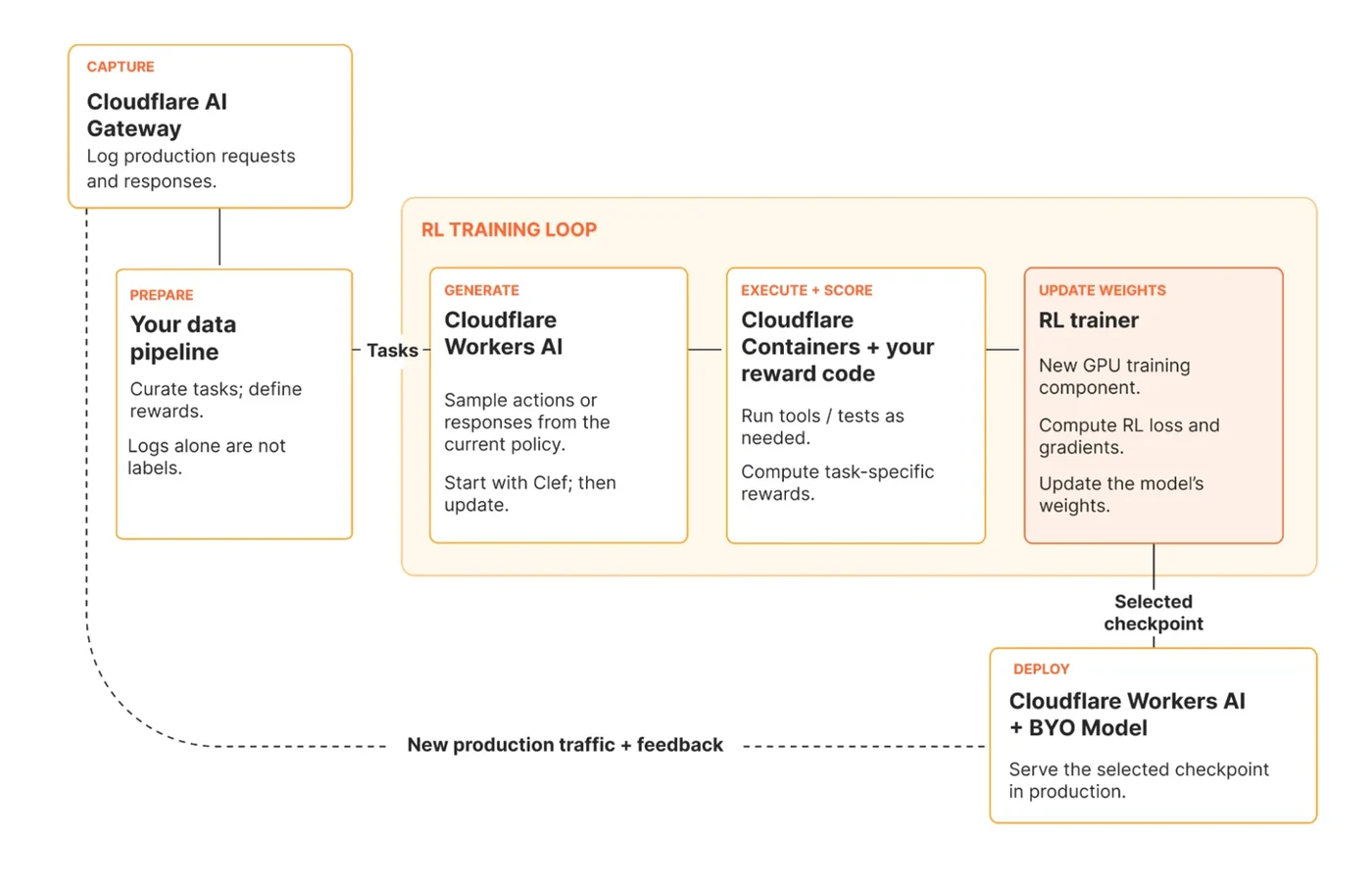
Alongside the model releases, Cloudflare has debuted a new reinforcement learning platform designed to help developers fine-tune decision models using their own proprietary data. Organizations looking for assistance with specific workloads can access fine-tuning support initially through a hands-on partnership with forward-deployed engineering teams, with self-serve deployment options slated for future rollout.
Under the hood, Clef utilizes Qwen as its base backbone model, which has been post-trained specifically for decision model use cases. During inference, the system executes a prefill-only pass and scores valid schema choices in parallel. Because the decision step is entirely non-autoregressive and avoids generating intermediate text token by token, the models achieve substantially higher execution speeds compared to standard autoregressive large language models.
Sources
- Cloudflare BlogIntroducing Clef: our open-source decision models, and new RL fine-tuning platform