NVIDIA Expands Cosmos Platform With New Training and Simulation Tools
NVIDIA has expanded the Cosmos platform to help developers rapidly build world models, featuring new training tools, simulation checkpoints, and Cosmos Data Factory blueprints designed for physical AI systems.
 Radwan AbdulhadiEditor and technology writer
Expanding the Cosmos Platform for Physical AI
To help developers rapidly build world models, which help physical AI systems understand and simulate the real world, NVIDIA has expanded the Cosmos platform with new training tools, simulation checkpoints, and Cosmos Data Factory blueprints. Ranking top five on six different open models leaderboards, the NVIDIA Cosmos platform gives world model builders the frontier open models—along with data, training and optimization tools and recipes—to scale training data, adapt models, test behavior, and optimize for performance before deployment.
Cosmos Data Factory and Cloud-Native Blueprints
Building world models begins with multimodal, multisensory data. NVIDIA Cosmos Data Factory brings together the tools and skills for labeling, curating, augmenting, and evaluating data at scale for training physical AI. Cosmos Curator, a GPU-accelerated solution for curating video training datasets, has added support for multimodal multisensory inputs and processing blocks.
Cosmos Data Factory now offers five cloud-native blueprints and is available through GitHub, Microsoft Azure, Nebius, and CoreWeave. These include Autonomous Vehicle Dataset Generation, Image Attribute Augmentation, Event Video Generation, Defect Image Generation, and Video Data Augmentation. Cosmos Data Factory accelerates data curation, processing, and synthetic data generation with agentic skills.
Early Industry Adoption and Workflows
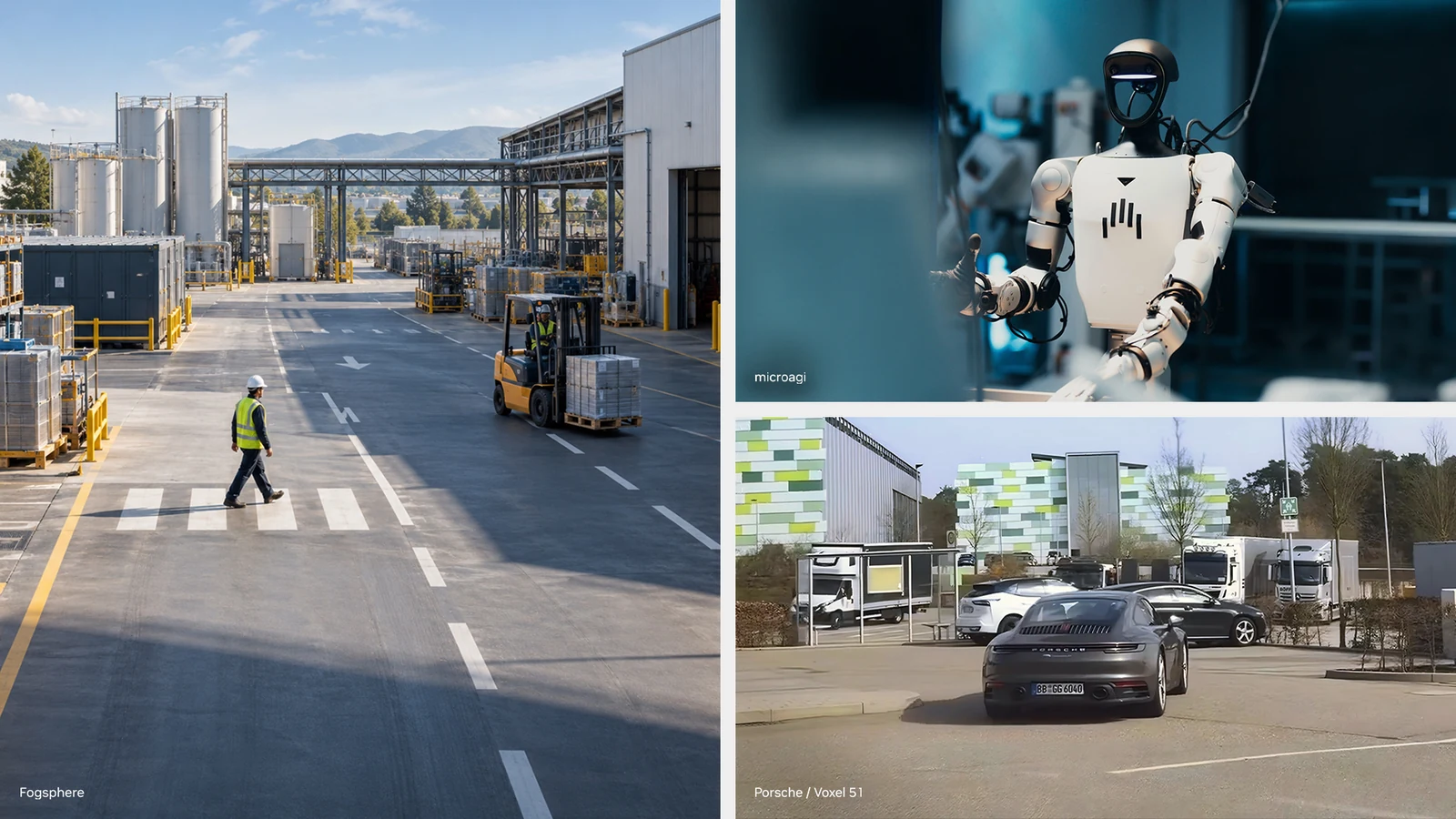
Companies are already putting Cosmos Data Factory blueprints to work to speed their physical AI development workflows. Porsche is leading the development of a shared autonomous vehicle data flywheel across Volkswagen Group brands, using Cosmos Data Factory through Voxel51 on Microsoft Azure, which is expected to reduce repeated physical test drives by up to 90% and shorten development cycle times by up to 85%.
Additionally, ANYbotics generated over 1,500 synthetic video clips with Cosmos Data Factory blueprints to train its industrial-inspection robots to recognize liquid spills and other facility changes. Ultralytics retrained its YOLO model with real images and targeted synthetic defects generated using Cosmos Data Factory, improving defect localization and recall.
Framework Enhancements and Cosmos 3 Adaptations
At GTC Berlin, NVIDIA extended Cosmos Framework training, optimization, and deployment tools and recipes as agent skills to more open models, along with Cosmos 3, giving world model builders a faster path from experimentation to deployment. Developers and agents can adapt open models like GR00T, Alpamayo, QWEN, Pi0.5, and other compatible Hugging Face models through fine-tuning and reinforcement learning.
To develop a world model specialized for egocentric manipulation, robotics research lab MicroAGI post-trained Cosmos 3 on videos of humans manipulating objects and distilled its 32-billion-parameter reasoner down to an 8-billion-parameter Nano model with no loss in accuracy. Developers can label data and post-train Cosmos 3 on Roboflow for their specific environments and tasks before deploying them.
Simulation, NIM Microservices, and Deployment
New Cosmos 3 Nano model variants for simulation enable developers to test autonomous policies in repeatable, hard-to-capture, multiview multisensor scenarios. Accompanying code allows developers to adapt the models to train and evaluate their own policies for autonomous vehicles and bimanual robots in interactive simulations prior to real-world testing.
Developers can deploy core Cosmos models using updated NVIDIA Cosmos 3 NIM microservices, which deliver up to 2x faster inference with no quality loss in validated configurations. Furthermore, the new NVIDIA Metropolis Blueprint for video search and summarization 3.3, built on Cosmos NIM microservices, helps teams monitor 40% more video streams with the same GPU.
Sources
- NVIDIA BlogNVIDIA Cosmos Opens New Tools to Train, Evaluate and Deploy World Models
Continue chronologically
Related entity coverage
Related stories
NVIDIA and CoreWeave Launch Vera Rubin for Agentic AI
NVIDIA and CoreWeave announce the production availability of NVIDIA Vera Rubin systems, accelerating agentic AI workflows and token throughput.

NVIDIA Expands Confidential Computing to Scale AI Infrastructure
NVIDIA expands its Confidential Computing platform with Confidential Bare Metal, securing frontier AI models and data across global infrastructure.
NVIDIA Transforms European Retail With Open Models and Robotics
Discover how European retailers leverage NVIDIA-accelerated open models, digital twins, and physical intelligence to optimize operations and cut costs.
European Leaders Adopt NVIDIA Vera CPUs for Local AI Infrastructure
European cloud providers and global technology partners are adopting NVIDIA Vera CPUs to build local infrastructure and scale agentic computing workloads.